The Power of Plastic Credits: How Verra’s Waste Reduction Program Can End Global Plastic Pollution

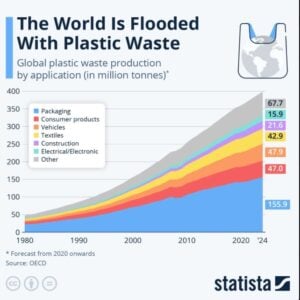
Plastic pollution is one of the greatest environmental challenges facing the world today. As per Verra, every year, more than 430 million tons of plastic are produced, and nearly two-thirds of this ends up as waste—dumped, burned, or abandoned in open spaces, rivers, and oceans.

Without significant intervention, global plastic waste is projected to triple by 2060, threatening ecosystems, economies, and communities alike. Thus, plastic credits are becoming essential tools in sustainable development strategies, particularly in emerging markets.

Let’s start with a quick look at what plastic credits are and how they help tackle the global plastic crisis.

What Are Plastic Credits and How Do They Work?

Plastic credits are a way to tackle plastic pollution through the market. Individuals and organisations can buy these credits to balance out the amount of plastic they use. The money from these purchases helps fund projects that collect, recycle, or reuse plastic waste—keeping it out of oceans, landfills, and the environment.

This system encourages people and businesses to cut back on plastic use while supporting waste recovery efforts both locally and globally.

This video further explains plastic credits:

How Are Plastic Credits Created?

Plastic credits are only given for plastic waste that would have harmed the environment if it hadn’t been collected. Projects working with credit organizations gather plastic waste and recycle or process it using methods like:

  • Mechanical recycling

  • Advanced recycling

  • Reprocessing

  • Co-processing

For every extra kilogram of plastic that is recycled or recovered, a certified plastic credit is issued. These credits are checked through records and audits to make sure the plastic waste would have otherwise ended up in the environment without the project’s help.

Moving on to Verra, its globally recognized standards-setting organization ensures credibility, transparency, and impact of plastic credit programs.

This article explores how Verra’s Plastic Waste Reduction Program is transforming waste management, strengthening Extended Producer Responsibility (EPR) systems, and helping countries and businesses alike combat plastic pollution through verified, high-integrity plastic credits.
plastic pollution

Why Verra’s Work Is Key to Ending the Global Plastic Problem

Plastic pollution has long been a global concern, but its impact is particularly acute in emerging markets and developing economies (EMDEs). These regions face critical gaps in waste management infrastructure, financing, and regulation, which hinder their ability to collect and effectively recycle plastic waste.

Some key challenges include:

  • Lack of collection and recycling infrastructure

  • Funding shortages and limited private investment

  • Weak legal and regulatory frameworks

  • Underrepresentation of informal waste workers

  • Reliance on open dumping and burning of waste

These challenges make it difficult to reduce plastic pollution without external support, technological innovation, and robust governance frameworks.

And in the plastic sector, Verra is leading by creating a global framework for plastic credits that drives waste reduction, community support, and sustainable growth. Its results-based financing channels investments into projects with proven impact, building a cycle of trust and long-term environmental solutions.

Unlocking Verra’s Plastic Waste Reduction Standard

Verra’s EPR Discussion Paper states that its Plastic Waste Reduction Standard is the key to its plastic credit program. It offers a transparent, science-based methodology for tracking and certifying plastic waste recovery, ensuring that projects create real, measurable impact.

The standard is built on four foundational pillars:

1. Measurability and Transparency

Verra’s methodology makes projects document every step of waste collection and recycling. Projects track waste sources, volumes, and weights. They record management practices and verify the chain of custody from collection to recycling.

All data is accessible and traceable. This helps governments, funders, and consumers confidently assess project performance.

2. Impact Verification

Verra requires third-party auditors to validate the waste collection and recycling claims made by projects. These audits confirm that plastic waste would otherwise have been lost to the environment and that the recovery efforts are additional, meaning they would not have occurred without the project’s intervention.

The verification process safeguards against inflated reporting and helps maintain trust in the plastic credit system.

3. Social and Environmental Safeguards

Plastic waste projects often involve communities that rely on informal waste collection for their livelihoods. Verra integrates safeguards to ensure that projects:

  • Uphold human rights and provide fair compensation

  • Offer safe working conditions

  • Respect local environmental and social concerns

By aligning sustainability goals with community development, Verra ensures that projects generate benefits beyond just waste reduction.

4. Market Access and Financing

Verra’s certification enables projects to access both voluntary and regulatory markets. This creates investment opportunities for businesses aiming to offset their plastic footprint while supporting high-impact waste management efforts globally.

How Verra Supports Extended Producer Responsibility (EPR) Systems

Extended Producer Responsibility (EPR) is a policy tool that shifts the financial and environmental responsibility for plastic waste from governments to producers. Effective EPR frameworks incentivize companies to design recyclable products, invest in waste management infrastructure, and reduce their overall plastic consumption.

However, developing EPR systems is challenging, especially in countries with limited resources. Verra helps strengthen EPR systems across three phases:

Phase I – Initiation

During this phase, governments explore EPR as a policy tool and begin building legal frameworks. Verra’s methodologies help producers understand the measurable impacts of waste management, providing data that informs policymaking.

Phase II – Transition

This phase focuses on implementing enforceable regulations and aligning stakeholders. Verra’s third-party audits and reporting tools ensure that data collection is transparent, helping build trust in the early stages of regulation.

Phase III – Maturity

In mature systems, EPR frameworks are fully operational, with clearly defined regulations and robust monitoring mechanisms. Verra’s certifications support scaling waste management solutions by providing financing options and ensuring compliance with international standards.

By integrating plastic credits into EPR systems, Verra helps governments and companies build resilient waste management infrastructures while promoting accountability and innovation.
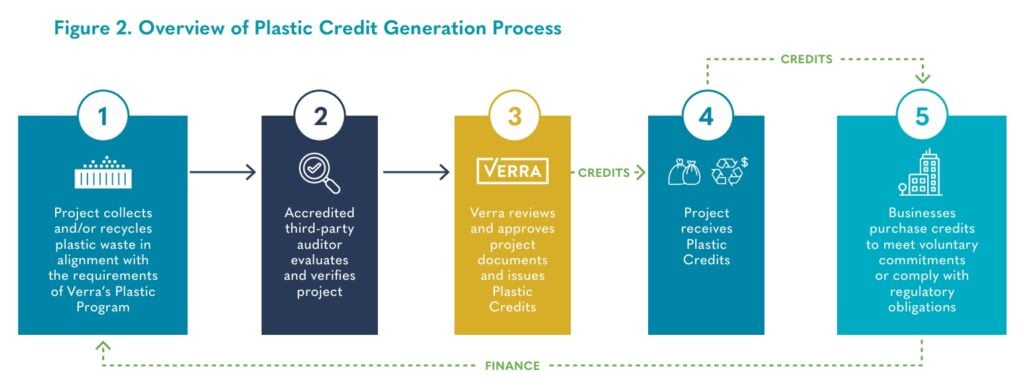
plastic credits Verra
Source: Verra

Making Every Ton Count: Financing Change with Plastic Credits

Plastic credits are only as effective as the financing structures behind them. Verra’s program helps mobilize investments from both public and private sectors, ensuring that projects receive the support they need to scale operations.

Key ways Verra enables financing include:

Bridging Funding Gaps

Plastic credit markets channel investments into waste collection and recycling projects that would otherwise lack access to funding. This is especially important in regions where waste management is underfunded and informal labor plays a significant role.

Results-Based Incentives

By issuing credits only after verified waste recovery, Verra ensures that funds are aligned with real-world impact. Investors and governments alike can be confident that their contributions lead to measurable improvements.

Promoting Innovation

Verra’s framework encourages the development of new recycling technologies, supply chain management tools, and data tracking solutions, helping to modernize waste management practices across sectors.

Encouraging Circular Economy Models

With verified credits, recycled plastic becomes a more valuable commodity, attracting demand and promoting the reuse of materials within production cycles. This supports long-term sustainability and reduces reliance on virgin plastics.

Verra’s Impact Across the Globe
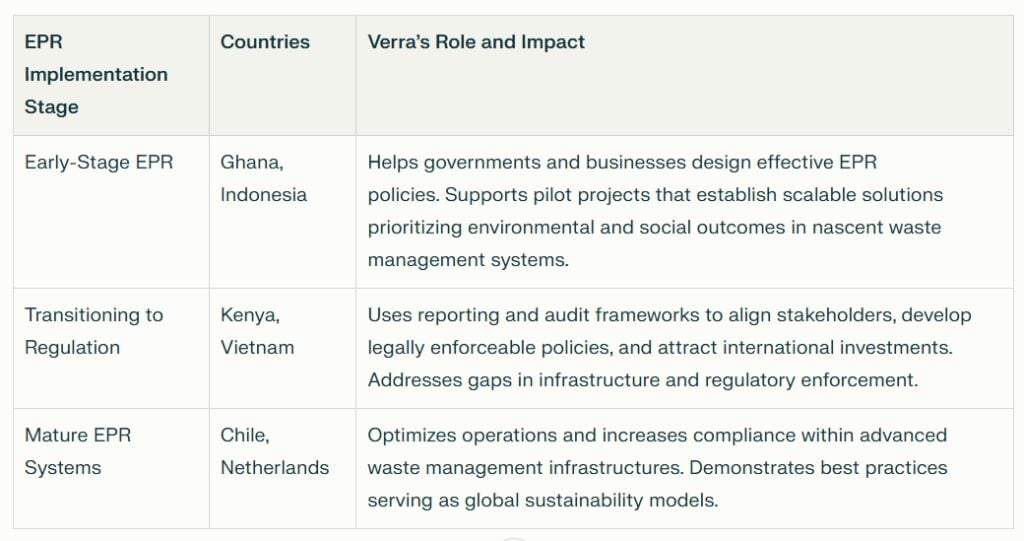
Verra
Source: Data from Verra

Challenges and the Way Forward

While Verra’s plastic credit program offers promising solutions, challenges remain:

  • Data Quality: Accurate measurement and reporting remain difficult, especially in regions lacking infrastructure.

  • Risk of Misuse: Without strict regulation, companies might offset plastic usage without reducing consumption.

  • Funding Constraints: Infrastructure development requires significant capital, particularly in developing regions.

  • Inclusion of Informal Workers: Waste collection often depends on informal labor sectors, which require support and integration into formal systems.
However, Verra is actively working to address these challenges by promoting rigorous third-party audits, encouraging governments to adopt transparent frameworks, supporting inclusive policies that empower communities, and collaborating with global financial institutions to expand investment flows.

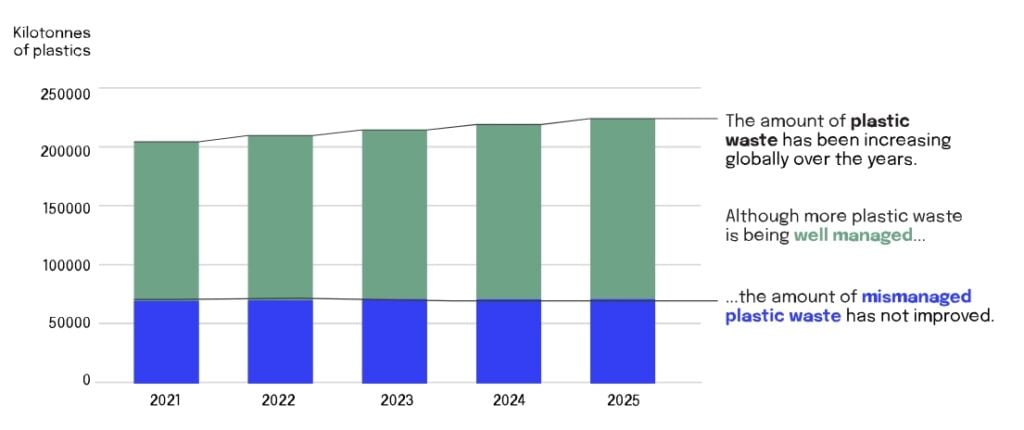
Global plastic waste generation: Management Vs Mismanagement

plastic waste generation report
Source: Plastic Overshoot 2025 Report

The Plastic Credit Market: Growing Demand and Opportunities

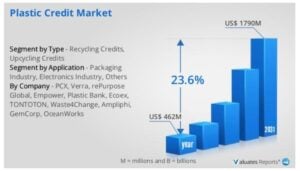
Industry report says, the global plastic credit market, valued at US$462 million in 2024, is projected to reach US$1790 million by 2031, growing at a CAGR of 23.6%. This surge is driven by increasing environmental awareness, regulatory frameworks, and consumer expectations.

Other key players include PCX, rePurpose Global, Empower, Plastic Bank, Ecoex, TONTOTON, Waste4Change, Ampliphi, GemCorp, and OceanWorks.

plastic credit market size
Source: Valuates

As read and studied, Verra’s Plastic Waste Reduction Program plays a pivotal role in ensuring that these efforts are credible, verifiable, and impactful. Last but not least, as plastic pollution worsens, Verra leads with accountability and innovation, turning waste into opportunity and responsibility into lasting action.
Top 3 Carbon Credit Companies Driving Climate Impact in 2025

The global carbon credit market is on a steep growth path as governments enforce stricter climate rules and businesses accelerate their net-zero commitments.

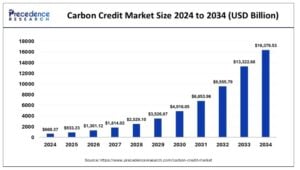
A research report showed that, in 2024, the market was valued at USD 669.37 billion, and it is projected to rise from USD 933.23 billion in 2025 to nearly USD 16,379.53 billion by 2034, expanding at a CAGR of 37.68% during the forecast period.

This momentum underscores a pivotal shift: carbon credits are now central to both government climate policies and corporate sustainability strategies. Europe dominated the market in 2024, while North America is set to post the fastest growth over the coming decade.

carbon credit maket

As demand rises, trust in providers becomes essential. In 2025, three companies—Regreener, South Pole, and ClimatePartner—stand out for their innovation, credibility, and measurable impact.

Why Top Carbon Credit Providers Stand Out

Not all carbon credits carry the same weight, and the leading providers set themselves apart through strict adherence to global standards such as Verra, Gold Standard, and ICROA. They emphasize transparency in project reporting, ensuring that buyers clearly see the impact of their investments. By adopting science-based methods, these companies guarantee permanence and additionality, making every credit credible and durable.

Beyond cutting emissions, they deliver wider benefits, from protecting biodiversity to improving community livelihoods. Together, the top three providers embody these qualities while scaling solutions that serve both people and the planet.

1. Regreener: Community-Backed, Science-Driven

Regreener, based in the Netherlands, has emerged as one of 2025’s most progressive carbon credit companies. Its model blends scientific rigor with local empowerment, ensuring every project delivers lasting benefits.

Why Regreener Leads

Regreener stands out by helping farmers adopt sustainable practices that create verified carbon credits. Each project is judged on strict criteria, including additionality, permanence, social impact, and environmental benefits. This ensures the credits are reliable while also supporting communities and protecting ecosystems.

Project Portfolio

  • Carbon Removal Projects: Reforestation, regenerative agriculture, mangrove and seaweed restoration, and soil carbon storage.
  • Carbon Reduction Projects: Clean cookstoves, renewable energy, methane reduction, and industrial energy efficiency.

Regreener prioritizes community development—creating jobs, improving livelihoods, and advancing the UN Sustainable Development Goals (SDGs). Its user-friendly platform also enables individuals and businesses to measure emissions, select verified projects, and transparently track contributions.

Regreener carbon credits
Source: Regreener

Why it matters: Regreener proves that climate science and social responsibility can work hand in hand, making it a trusted leader in 2025.

2. South Pole: A Global Climate Powerhouse

Founded in Zurich in 2006, South Pole has become one of the world’s most influential climate solutions providers. By 2025, its projects across more than 50 countries have cut or removed over 200 million tonnes of CO₂.

Core Strengths

South Pole delivers solutions ranging from rainforest protection and renewable energy to energy efficiency in emerging markets. Alongside verified carbon credits, it offers advisory services that help organizations measure emissions, set science-based targets, and design long-term climate strategies.

This mix of credits and consulting makes South Pole a trusted partner for global businesses. Its core strengths are:

  • Carbon Credits & Offsetting: Develops, finances, and trades verified projects.
  • Corporate Advisory: Helps businesses set science-based targets and map out net-zero strategies.
  • Beyond Carbon: Offers biodiversity and energy attribute certificates.
South Pole Carbon Credits
Source: South Pole

Market Reach and Investor Confidence

South Pole is well established in Europe and is growing quickly in Asia and Africa, giving it strong reach in both mature and new markets. Investors and financial institutions value the company because it offers clear carbon credit strategies. This trust reinforces South Pole’s position as a global leader in large-scale climate solutions.

3. ClimatePartner: Technology Meets Transparency

ClimatePartner, based in Germany, blends digital tools with verified climate projects to make carbon management simple for businesses. Its services cover accurate emissions measurement, credit procurement and retirement, and transparent reporting. This digital-first approach helps companies set credible climate strategies while showing clear results.

Project Reach and Scale

The company’s projects span renewable energy, forest conservation, sustainable farming, methane capture, and efficient cookstoves.

  • As per company data, ClimatePartner has built both scale and trust. It has worked with more than 6,000 clients worldwide, retiring over 57 million verified credits, and developing over 15 in-house projects.

Driving Accessible Climate Action

This matters because ClimatePartner combines digital-first tools with credible offsets, making climate action both accessible and accountable.

The global carbon credit market is on track to become a trillion-dollar industry, and trusted providers are key to this growth. We infer that companies like Regreener, South Pole, and ClimatePartner stand out by combining transparency, strong verification, and real-world impact.

Their work proves that carbon credits are more than financial tools. They are powerful drivers of climate solutions that protect ecosystems, support communities, and help businesses meet net-zero goals. As demand rises, these leaders will continue to shape a market that makes climate action both credible and scalable.

Frontier’s $31.3M Offtake with Planetary Signals a New Era for Ocean Carbon Removal

Frontier has taken another major stride in scaling up high-quality carbon removal. The coalition has signed a $31.3 million offtake agreement this August with Planetary Technologies, a company that uses ocean alkalinity enhancement (OAE) to remove carbon dioxide from the atmosphere and reduce ocean acidification.

Planetary and Frontier Push OAE Toward Large-Scale Deployment

Planetary’s journey has been defined by innovation and scientific rigor. Earlier this year, Isometric Registry issued the world’s first verified OAE credits, marking a historic milestone.

These credits were based on pilot projects such as the Tufts Cove facility in Halifax, where purified magnesium oxide was introduced into coastal waters and monitored with cutting-edge measurement protocols.

Significantly, the Frontier deal builds on Planetary’s earlier success with Isometric. And now, the company is moving into its next phase i.e., large-scale deployment.

  • Starting in 2026, Frontier buyers will receive 115,211 tons of verified CO₂ removals spread across a five-year delivery window through 2030.

It’s a turning point for marine-based carbon removal, showing the pathway’s credibility, scalability, and growing importance in global climate strategies.

The Science Behind Planetary’s Ocean Alkalinity Approach

OAE is an emerging method of carbon dioxide removal that strengthens the ocean’s natural ability to act as a carbon sink. Here’s how Planetary does it:

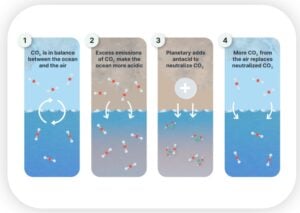
  • Mineral addition: Planetary adds carefully dissolved alkaline minerals such as calcium oxide (CaO) or magnesium oxide (MgO) into coastal waters.

  • Carbon capture chemistry: These minerals react with dissolved CO₂, transforming it into stable bicarbonate ions that are stored in the ocean for more than 10,000 years.

  • Seamless integration: Planetary’s system plugs into existing outfalls like wastewater plants or power stations, avoiding the cost of building new infrastructure.

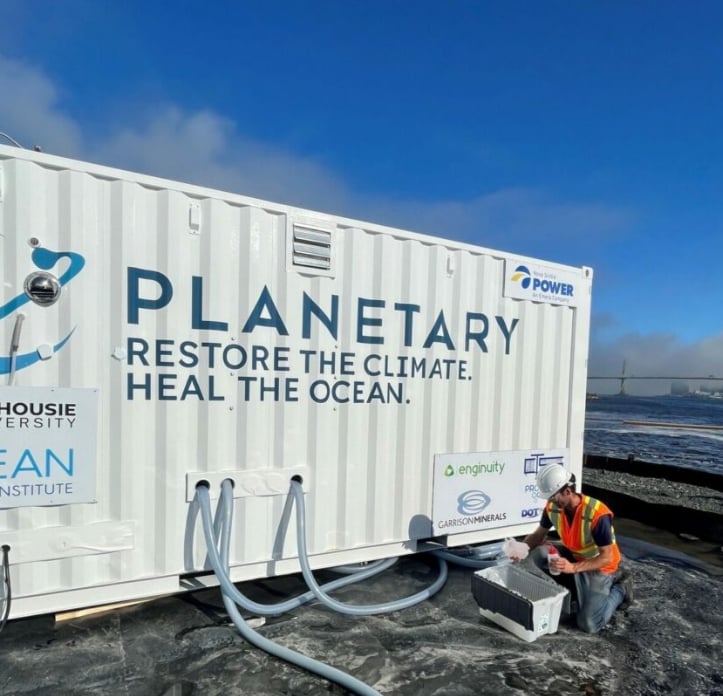
  • Scalability by design: The entire operational footprint fits into two shipping containers, allowing setups to be deployed in a matter of days.

Planetary OAE
Source: Planetary

This chemical pathway is powerful because it bypasses many uncertainties of biological methods. Instead of relying on ecosystems that may be vulnerable to climate change, OAE leverages the ocean’s natural buffering system to lock away CO₂ for millennia.

Why OAE Could Change the Game

OAE is gaining traction because it combines scale, affordability, and co-benefits—a rare combination in the carbon removal sector.

  • Gigaton potential: Scientists estimate OAE could remove billions of tons of CO₂ annually, making it one of the largest scalable solutions.

  • Cost advantage: Early estimates suggest costs between $50 and $160 per ton, with credible pathways to below $100/ton as operations scale.

  • Ecosystem impact: Unlike many removal methods, OAE tackles a second crisis—ocean acidification. Raising local pH creates better conditions for marine calcifiers such as oysters, shrimp, and crabs.

  • Proven monitoring: Planetary dissolves minerals before releasing them, eliminating uncertainties about when and where reactions take place. Real-time sensors and computational models track the carbon removal and ecological impact.

  • Strong safeguards: Each deployment includes feedstock screening, live monitoring of discharge waters, and a “stop trigger” system to halt operations if thresholds are exceeded.

These elements combined make OAE one of the most promising, durable, verifiable, and scalable methods of carbon removal.

Co-Benefits for Communities

Planetary’s work goes beyond carbon removal. The company partners with Indigenous leaders, scientists, regulators, and local communities to ensure projects support local priorities.

It also shares data openly under FAIR principles and the Carbon to Sea protocol, building trust and transparency. This community-first approach shows that carbon removal can deliver climate benefits while strengthening coastal ecosystems and communities.

The Frontier Deal: Who’s Backing OAE

Frontier’s offtake brings together some of the world’s leading climate-focused companies. The coalition comprises founding members Stripe, Google, Shopify, and McKinsey Sustainability, as well as Autodesk, H&M Group, and Workday.

Through a partnership with Watershed, additional companies, including Aledade, Canva, Match Group, Samsara, SKIMS, Skyscanner, Wise, and Zendesk, also participated in the purchase.

For buyers, the deal represents more than carbon credits. It’s a chance to support field-first innovation. Backing a method like OAE helps accelerate development, lower costs, and scale removals faster while also addressing the ocean health crisis.

Verified Ocean Carbon Credits: A New Chapter for Carbon Markets

The recognition of OAE by registries like Isometric signals a broader shift in the carbon markets. For years, marine-based solutions struggled to gain credibility due to measurement challenges. That barrier has now been broken.

  • Credits are issued only after rigorous MRV protocols confirm that CO₂ has been captured and stored as bicarbonate.

  • Standards such as the Ocean Alkalinity Enhancement from Coastal Outfalls Protocol guide verification and ensure environmental integrity.

  • Leading corporations like Stripe, Shopify, and British Airways have already purchased these credits, sending a clear market signal.

CDR
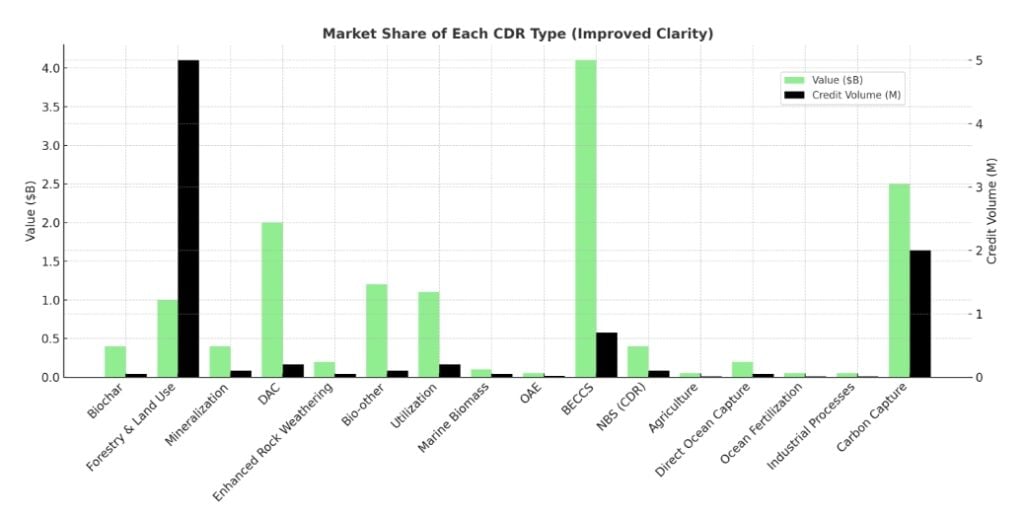
Data Source: Allied Offsets Q1 2025 Carbon Dioxide Removal (CDR) Market Update

Verified OAE credits are now entering the market, introducing a new wave of high-quality carbon removals. This method shows strong potential as an affordable, scalable solution that benefits both the climate and ocean health.

The $31.3 million Frontier-Planetary deal proves OAE can deliver durable, scientifically verified carbon storage at scale. And for carbon markets, the deal signals that ocean carbon removal solutions are ready.

Amazon’s $20B Carbon Credit Boom? Brazil’s REDD+ Faces Integrity and Demand Test

A new analysis of jurisdictional REDD+ (JREDD+) in Brazil’s Amazon reveals a big chance. The potential credit sales could reach $10–$20 billion this decade. However, the market faces delays, integrity issues, and a drop in voluntary demand.

The report from the Earth Innovation Institute (EII) outlines the numbers and assumptions. It also offers a roadmap connecting carbon credit sales to real forest results and social safeguards.

The $20B Amazon Question: EII’s JREDD+ Forecast

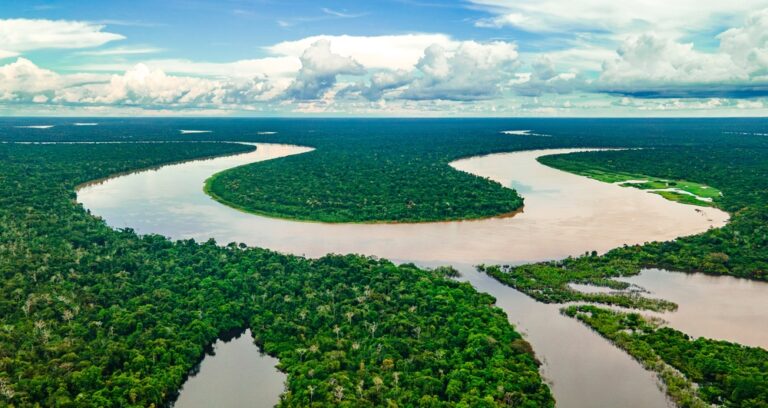
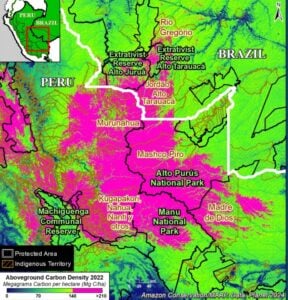
The Amazon remains a vital carbon reservoir, holding approximately 56.8 billion metric tons of carbon above ground. Brazil alone contains over 32 billion metric tons of this total. This carbon stock equates to more than one and a half times global annual CO₂ emissions in 2023.

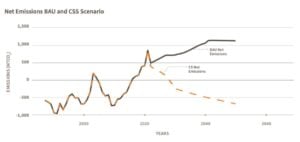
EII’s Amazon Forest Climate Solution (AFCS) expects Amazon emissions from deforestation, fire, and logging to drop by 90% by 2030 from a 2018–2022 baseline. Then, they aim for a 95% reduction by 2040 and a 98% cut by 2050.

Amazon net emissions
Source: EII Report

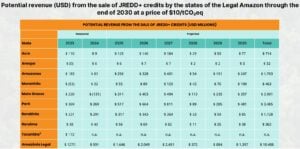
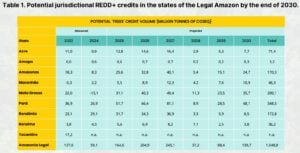
Brazil’s Amazon states could issue around 1.05 billion TREES standard credits. This would be for reductions achieved from 2023 to 2030. At $10–$20 per credit, that equals $10–$20 billion in potential revenue.

Potential revenue (USD) from the sale of JREDD+ credits
Source: EII Report

Timing matters. EII notes it typically takes two to three years to verify, issue, and sell credits. The four most advanced states—Acre, Mato Grosso, Pará, and Tocantins—might sell around 100 million credits in 2026. This could bring in about $1 billion at $10 per ton. That figure is roughly comparable to the $1.4 billion donated to the Amazon Fund since 2008.

A state-by-state table shows around 1,048.8 MtCO₂e in potential credits by 2030. This could bring in about $10.49 billion at $10 per ton. Pará leads with 348.5 Mt and $3.49 billion, followed by Mato Grosso with 200.1 Mt and $2.00 billion.

Potential jurisdictional REDD+ credits Amazon
Source: EII Report

Why Billions Haven’t Flowed Yet

Analysts underscore the gap between early promises and actual transactions, while the EII report highlights these bottlenecks:

  • No Brazilian state issued credits by June 2025.
  • Only Pará and Tocantins signed forward Emissions Reduction Purchase Agreements (ERPAs).
  • Acre and Mato Grosso are advancing through pay-for-performance (non-credit) mechanisms.

Meanwhile, the voluntary carbon market retrenched in 2023–2024. Global transactions fell to about 84 MtCO₂e from a 516 MtCO₂e peak in 2021, and forest/land-use project volumes slid from about 227 MtCO₂e to about 37 MtCO₂e. This slump undermines demand just as Brazilian states prepare to sell large volumes.

carbon credit trading volume 2024

Put simply, the supply pipeline is maturing faster than demand. Integrity controversies around some project-level REDD+ credits have cooled buyers’ risk appetite. 

EII argues that jurisdictional programs, using conservative baselines and including leakage deductions, can tackle many concerns. They also have social safeguards under the TREES standard. However, these programs still need clear policies and buyer confidence to turn modeled volumes into cash.

What Makes JREDD+ More Credible than Old REDD+?

EII emphasizes that JREDD+ credits reward performance at the state or national scale, not farm-by-farm activities. Also, participation is voluntary. The programs are created with Indigenous peoples, traditional communities, and farmers. They do not limit how landholders can use their land. Critically, project-level credits are subtracted from the jurisdictional pool to prevent double-counting.

Under TREES, crediting leaves out some removals, like those from fire-damaged forests. It also tightens baselines every five years. Moreover, there are significant deductions for leakage, uncertainty, and reversals. These choices underestimate climate benefits but aim to raise robustness.

These features are key to EII’s claim. They say JREDD+ can help finance quick emissions cuts now. Meanwhile, longer-term funds like the proposed “Tropical Forest Forever Fund” can grow.

Policy Shifts and Potential Buyers: From Petrobras to China

Converting potential into real revenue hinges on policy and demand signals:

  • Domestic regulation:
    Brazil’s federal government can explain how states can access Paris Agreement Article 6.2 transactions. This is for those who exceed the national NDC pathway. It could raise carbon prices and volumes for jurisdictional credits.
  • Corporate demand:
    EII floats a COP 30 initiative where Petrobras convenes oil-and-gas peers to buy JREDD+ credits equal to about 1% of the sector’s Scope 3 emissions. This alone would multiply current forest and land-use demand on the voluntary carbon market tenfold.
  • Trade linkages:
    A Brazil–China partnership on “forests, food, and climate” could link trade with local deforestation cuts. It might also direct credit purchases into state JREDD+ programs. Discussions are underway with Brazilian states.

EII believes these steps can shift the market from intent to action. They could also help bridge the multi-billion-dollar funding gaps in law enforcement, fire management, and regenerative land use.
What Success Would Mean for Climate — and the Amazon

The AFCS scenario suggests around 1.5 GtCO₂e in net reductions from 2025 to 2030. This is nearly double what the EU-27 is expected to achieve during that time. This relies on Brazil continuing to reduce deforestation and improving fire prevention and natural regeneration.

About 21% of the cleared land in the Amazon is marginal and turning back into forest. So, targeted incentives could boost natural regeneration at a lower cost than active restoration. This could also help stabilize regional rainfall.

Brazil Amazon carbon intensity
Source: MAAP Program

EII connects climate benefits to public health and economic gains. This means fewer smoke-related illnesses and deaths. It also lowers risks for farm and forest investments. Plus, it creates new income streams for Indigenous peoples and smallholders. These include non-timber products, perennials, and aquaculture.

Still, EII’s main claim can be tested soon. If states set benefit-sharing rules, secure Article 6.2 eligibility, and finalize multi-buyer offtakes, then the first $1 billion in 2026 would prove that jurisdictional crediting works at scale.

Signals to Watch Before COP30

The report highlights COP30 in Belém, Brazil, as a pivotal moment for Amazon JREDD+. The country will host global climate negotiators in November 2025. This event will allow states to showcase their programs. They can also finalize pathways for Article 6.2 crediting. 

EII believes COP30 can be used to reveal big corporate groups. This includes oil-and-gas or agribusiness buyers who commit to JREDD+ purchases. This event may determine whether modeled revenues of up to $20 billion move from projections to real contracts within the decade.

Some of the key market trends to watch are:

  • State milestones: publication of final benefit-sharing frameworks and issuance of first TREES credits.
  • Federal signals: Brazil’s alignment of Article 6.2 pathways for subnational programs.
  • Buyer coalitions: oil-and-gas Scope 3 purchase commitments and commodity-trade linkages with China.
  • Market breadth: whether jurisdictional credits revive voluntary carbon market volumes and pricing after the 2024 slump.

The EII report quantifies a plausible $10–$20 billion revenue pathway for Amazon JREDD+ this decade if governance, integrity, and buyer demand align. That level of financing could speed up Brazil’s forest-climate shift and provide social benefits. But this will only happen if policies and purchase commitments develop as quickly as expected.

FIFA World Cup 2026: Ticket Frenzy, $11B Payday, and Football’s Climate Test

The countdown to the FIFA World Cup 2026 has begun, and excitement is already building. FIFA has announced that ticket sales will officially start next week, with entry-level tickets priced at $60. This is the start of a wave of global interest in the first World Cup hosted by three countries: the United States, Canada, and Mexico.

Beyond football, the 2026 World Cup is being framed as the largest sporting event in history, set to break records in scale, audience, and financial impact. However, as the tournament grows, questions about sustainability and climate accountability are surfacing more strongly than ever.

This article explores the key elements shaping the 2026 World Cup—from the scale of ticketing and stadium preparations to the climate debate and FIFA’s promises on environmental management.

Ticket Sales and Record Demand

FIFA confirmed that ticket sales for the 2026 World Cup will start next week, with the lowest-priced tickets at $60. While this marks a lower entry point compared to past tournaments, demand is expected to outpace supply significantly.

The 2026 edition will host 48 teams for the first time, up from 32, and feature 104 matches across 16 cities in the U.S., Mexico, and Canada. This expansion increases the number of tickets available. FIFA projects that over 5.5 million tickets could be sold, surpassing the record 3.1 million sold in Brazil 2014 and the 3.4 million in Qatar 2022.

FIFA is also testing new ticketing models, including bundled packages for group-stage matches and hospitality programs. Organizers are betting on the North American market’s strong purchasing power to drive record-breaking revenue. It could potentially surpass $11 billion in total tournament income.

Stadiums and Infrastructure: North America’s Advantage

The United States, Canada, and Mexico have much of the needed infrastructure. This lowers construction costs and cuts environmental impact compared to previous hosts. FIFA’s Bid Book notes that 16 stadiums across the three countries are already built and will require minimal adaptation.

The U.S. alone will host 11 stadiums, including New Jersey’s MetLife Stadium (capacity ~82,500), Dallas’ AT&T Stadium (~80,000), and Los Angeles’ SoFi Stadium (~70,000). Canada contributes Toronto and Vancouver, while Mexico adds Mexico City, Guadalajara, and Monterrey.

The use of existing facilities shows a change from past tournaments. For example, in Qatar 2022, seven new stadiums were built. This will lower the carbon footprint of construction. However, emissions from operations and travel are still significant.

Football’s Carbon Footprint

Football—known as soccer in North America and other regions—is far from climate-friendly. The sport generates an estimated 64–66 million tonnes of CO₂ equivalent annually, making it as emissions-intensive as the entire country of Austria.

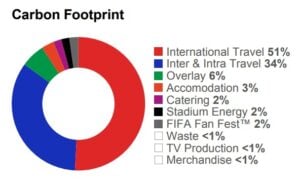
CC Football Carbon Footprint March2025_1 (1)

This figure shows energy use in stadiums, construction, and merchandise. It also highlights travel and high-carbon sponsorships. These two areas make up about 75% of total emissions.

At the elite club level, teams like Liverpool FC and FC Barcelona are leading the action. Liverpool cut operational emissions by 89% from 2019 to 2024, sources 96% of energy from renewables, and offsets all remaining club operations. FC Barcelona registered a footprint of 1,190 t CO₂e in 2021–22, has switched entirely to renewable electricity, and aims for net-zero by 2030.

Football has a big impact on global emissions. Yet, top clubs are finding ways to lessen this harm. They aim for a more sustainable future for the sport.

The Climate Debate: FIFA’s “Blind Spot”

FIFA is under increasing scrutiny about the tournament’s environmental impact, even with better stadium usage. A recent report, IFA’s Climate Blind Spot (July 2025), said that FIFA’s climate promises are unclear and not enough for the World Cup’s needs.

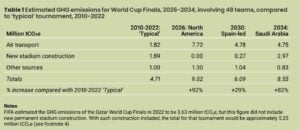
Air travel emerges as the largest concern. With 48 teams, expanded matches, and international fans, emissions from flights are expected to reach record highs. The report highlights that travel-related emissions could exceed those of Qatar 2022, where the event generated an estimated 3.6 million metric tons of CO₂e.

Estimated GHG emissions for World Cup Finals, 2026-203
Source: New Weather Institute

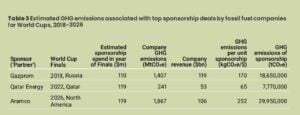
Moreover, emissions related to top sponsors are adding up to the event’s total carbon footprint.

GHG emissions associated with top sponsorship deals
Source: New Weather Institute

Critics say FIFA’s carbon-neutral pledges lack clarity. The organization often relies on offsets, especially forestry projects. However, these have faced questions about their permanence and integrity. FIFA is facing calls to invest in direct emissions cuts. This includes renewable energy and low-carbon transport.

FIFA’s Environmental Promises

FIFA’s Bid Book and environmental assessment documents outline strategies to mitigate the tournament’s impact. The focus is on three pillars: infrastructure efficiency, waste reduction, and renewable energy.

FIFA has committed to:

  • 100% renewable energy use at stadiums and fan zones.
  • Waste recycling systems aim for 80% diversion from landfills.
  • Water-saving technologies in stadiums, especially in drought-prone areas like California and Mexico.
  • Partnerships with public transit systems to encourage sustainable travel.

In theory, hosting across three countries spreads the load across existing infrastructure. However, the flip side is significantly higher travel demand. Fans, teams, and officials will need to fly long distances between cities such as Vancouver, Miami, and Mexico City. This challenge raises doubts about whether the tournament can realistically achieve a “sustainable” profile.

FIFA world cup 2026 carbon footprint
Source: FIFA World Cup 2026 Bid Book

Chasing $11B: Football’s Financial Juggernaut

The World Cup is not only a sporting spectacle but also a financial powerhouse. FIFA expects revenues to exceed $11 billion, up from $7.5 billion in Qatar 2022. The majority will come from broadcasting rights, sponsorships, and ticket sales.

North America’s large stadiums and established sports economy are central to this projection. For instance:
  • The average stadium capacity is over 60,000, compared to Qatar’s average of 47,000.
  • Sponsorship opportunities are expected to grow by 20–25%, as global brands align with the expanded 48-team format.

The global audience could exceed 5 billion viewers, making it the most-watched sporting event in history. This scale raises the stakes for FIFA not just financially, but in terms of its responsibility toward sustainability and social impact.

Expansion vs. Emissions: Can Growth Be Green?

FIFA’s expansion to 48 teams reflects the tension between inclusivity and sustainability. More nations participating increases global engagement, but also magnifies emissions and logistical challenges.

Environmental experts argue that FIFA should use the World Cup to set new standards for sustainable mega-events.

Options include:

  • Mandating airlines to provide emissions disclosures.

  • Investing in renewable energy projects in host cities.

  • Funding carbon removal technologies instead of relying heavily on offsets.

The July 2025 report emphasizes that FIFA cannot afford to ignore climate accountability, especially as global climate negotiations intensify. With COP30 set to take place in Brazil in late 2025, pressure will grow on FIFA to align with global climate goals.

Lessons from Past Tournaments

Comparisons with earlier tournaments illustrate both progress and gaps:

  • Germany 2006 was the first World Cup to adopt a formal sustainability program, focusing on energy efficiency.
  • Brazil 2014 faced criticism for stadiums that became “white elephants.”
  • Russia 2018 introduced carbon offset programs, but they were limited in transparency.
  • Qatar 2022 claimed “carbon neutrality,” but independent reviews challenged these claims due to reliance on offset credits.

The 2026 edition, taking place in countries with great infrastructure and solid climate policies, can set a strong example. It all depends on whether FIFA keeps its promises seriously instead of just using marketing talk.

What to Watch in the Lead-Up

As the tournament approaches, several milestones will shape both excitement and scrutiny:

  • Ticket sales volume and pricing trends once sales open next week.
  • Details on FIFA’s climate and sustainability programs, expected in late 2025.
  • Infrastructure upgrades, particularly in transport and stadium retrofits.
  • Policy linkages between host governments and FIFA, especially around emissions and energy use.

The spotlight will intensify not only on the quality of football but also on FIFA’s ability to balance entertainment with responsibility.

The 2026 World Cup will be the biggest ever. It boasts record ticket sales, more teams, and amazing financial returns. Yet, its growth comes with heightened responsibility. FIFA’s climate strategy faces criticism. How the organization manages emissions, offsets, and renewable energy will affect views on the event, extending beyond football.

As ticket sales begin and excitement builds, fans and stakeholders alike will be watching not only for goals on the pitch but also for progress on sustainability. The World Cup offers an unparalleled opportunity to demonstrate that mega-events can align with global climate goals—if the commitments are real and the implementation matches the ambition.

Netflix (NFLX Stock) Partners with American Forest Foundation on Carbon Credits: A Step Toward Its Net-Zero Goal

Netflix (NASDAQ: NFLX) has taken another step in its climate strategy by signing a long-term carbon credit deal with the American Forest Foundation (AFF). The agreement backs tree planting and forest restoration in the U.S. South. It also boosts Netflix’s efforts to reduce emissions throughout its operations.

The deal shows a shift in the voluntary carbon market(VCM). Companies now want high-quality, verifiable credits that offer social and environmental benefits.

Building Forests, Supporting Landowners

Through AFF’s Family Forests program, Netflix will help convert farmland into new forests. The partnership follows a milestone-based financing model. Netflix gives partial funding as acres are planted and trees grow. The rest is paid once the carbon credits are verified.

The project already covers about 2,500 acres with 1.4 million trees planted and has directed $2 million in payments to landowners. By 2032, AFF aims to expand the program to 75,000 acres, generating an estimated 4.8 million carbon credits. These credits represent millions of tonnes of carbon dioxide captured and stored in forests over decades.

This program helps rural economies by creating new income for family landowners. It also supports biodiversity, water quality, and soil restoration. In a carbon market under increasing scrutiny, such local, transparent projects align with the Core Carbon Principles set by the Integrity Council for Voluntary Carbon Markets.
More Than Tree Planting: The Power of ARR

ARR projects help restore degraded land and increase forest cover. They lock away carbon and support biodiversity.

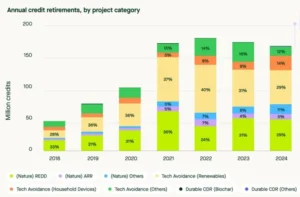
These projects represent one of the fastest-growing forest carbon project types in the VCM, with 346 registered ARR projects having issued over 150 million tons of CO2 credits. By 2030, ARR issuances could reach 100 million tons annually. This makes them the second largest project subtype within the VCM.

ARR carbon credit retirement
Source: Sylvera

Studies suggest reforesting suitable areas worldwide could remove up to 3–10 gigatons of CO₂ annually by 2050. In the U.S., ARR projects have captured tens of millions of tonnes of CO₂e. Companies like Microsoft, Apple, and Netflix are increasingly investing in forest-based credits, which boosts momentum.

ARR also provides co-benefits such as cleaner water, soil restoration, and community engagement. For Netflix, this deal is key to its net-zero and ESG strategy.

Net-Zero on Screen: Inside Netflix’s ESG Strategy

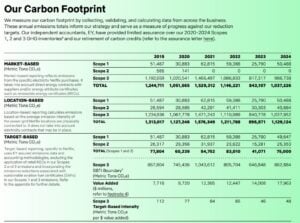
Netflix has sharpened its climate strategy, with updated emissions data from its 2024 ESG report providing a clearer picture of its environmental footprint. The company reported total greenhouse gas (GHG) emissions of 1,037,226 metric tons of CO₂e in 2024, measured under the market-based method. This figure includes:

  • Scope 1: 50,488 tCO₂e (direct emissions from facilities, vehicles, and equipment).

  • Scope 2: 0 tCO₂e (purchased electricity, reported as zero under market-based accounting due to renewable energy sourcing).

  • Scope 3: 986,738 tCO₂e (upstream and downstream emissions, largely from cloud services, content production, and supply chains).

Netflix carbon footprint ghg emissions 2024
Source: Netflix ESG Report

This marked a 23% increase from 2023, when emissions totaled 843,107 tCO₂e. Much of the rise was attributed to higher production activity and expanded content delivery across global markets.

Netflix shares a second set of emissions figures. These come from its Science-Based Targets initiative (SBTi). This framework has stricter rules for counting emissions. Under this method, Scope 1 and 2 totaled 75,000 tCO₂e in 2024, while Scope 3 reached 862,884 tCO₂e. These metrics form the baseline for Netflix’s near-term reduction goals.

  • Netflix confirmed its Science-Based Target. It aims for a 46% cut in Scope 1 and 2 emissions by 2030, using 2019 as a baseline. Also, it plans a 27.5% reduction in Scope 3 emissions by 2030.

Netflix Climate Transition Plan
Source: Netflix

To get there, Netflix is pursuing a “reduce, retain, and remove” strategy. The focus includes:

  • Reduce: Cutting energy use in production, optimizing streaming efficiency, and working with cloud providers to source renewables.

  • Retain: Using renewable energy credits to ensure 100% renewable electricity, which it already reports under Scope 2.

  • Remove: Investing in natural climate solutions and verified carbon removal projects to offset residual emissions.

Netflix has funded reforestation and forest management projects. These efforts align with its new deal with the American Forest Foundation. It is also piloting partnerships to support carbon removal technologies.
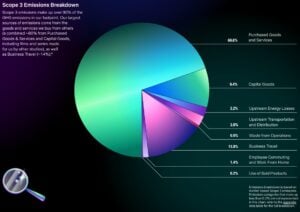
The streaming giant tracks emissions intensity, measured as tCO₂e per revenue unit. This helps ensure that climate progress matches business growth. The company notes that reducing Scope 3 remains its biggest challenge, as these emissions account for more than 95% of its total footprint.

Netflix scope 3 emissions
Source: Netflix

Carbon Credits in Action: Positioning Ahead of Demand

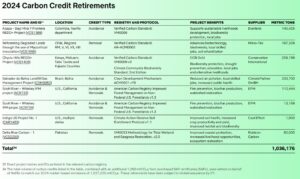
Netflix also relies on carbon credits as part of its “retain and remove” strategy to reach its net-zero target. In 2024, the company purchased and retired 1,036,176 metric tons of CO₂ equivalent in high-quality carbon credits.

These credits came from various nature projects like reforestation, better forest management, and mangrove restoration. They also include tech-based methods that capture and store carbon. Netflix uses these credits after cutting operational emissions. They focus on projects that offer clear carbon removal and help the community.

netflix carbon credit retirements 2024
Source: Netflix

The VCM has grown into a multibillion-dollar sector. In 2024, its value was about $2.5 billion. By 2030, it could jump to $20–45 billion. This will depend on corporate demand and regulatory support.

Nature-based solutions, such as forestry, make up 40–60% of traded credits. Carbon prices usually fall between $15 and $25 per tonne of CO₂.

High-quality credits linked to recent vintages usually have strong verification. They often include co-benefits like biodiversity or community development, which can raise their prices. In contrast, older credits or less verifiable renewable energy offsets are valued much lower, sometimes under $10 per tonne.

Netflix’s decision to invest in AFF’s afforestation projects reflects this market reality. By securing 4.8 million future credits, the company positions itself ahead of growing demand and potential supply shortages. It also signals confidence in domestic forestry as a reliable and socially beneficial source of removals.

American Forest Foundation’s Nature-Based Solutions

The American Forest Foundation is dedicated to supporting family forest owners across the United States. Small private forests make up nearly 39% of U.S. forestland, yet many landowners face barriers to managing them for climate benefits.

AFF’s programs, including the Family Forest Carbon Program (FFCP) and the Fields & Forests initiative, help landowners adopt sustainable practices like reforestation, forest management, and climate-smart planting. These efforts improve carbon sequestration, wildlife habitat, and rural economies.

With this expanded support, AFF is positioned to accelerate enrollment and ensure forestry-based carbon credits deliver real, lasting climate impact. This raises important questions about how the partnership shapes both landowner participation and the integrity of carbon credits.

AFF provided insights in an exclusive interview with the CarbonCredits team.

Q: “How does the partnership with Netflix change the scale and speed at which AFF can expand its Family Forests program, and what impact do you expect this will have on U.S. landowners over the next decade?”

A: Netflix’s investment will catalyze and launch the first 6,000 acres of Fields & Forests, and their funding will support essential research & development, outreach, and practice improvements, helping us scale to 75,000 acres enrolled over the next decade.

Additionally, Netflix’s long-term investment helps Fields & Forests build trust with landowners, a critical component in meeting our long-term enrollment goals. Engaging and building relationships with small-acreage landowners takes time, and one question landowners often have is whether the program will be there for the long haul. 

Landowners enrolled in Field & Forests are making a major decision that will impact them and their heirs for decades, and they want to know that we are dependable partners in the long-term. This deal provides landowners with that assurance. 

Q. “Given growing scrutiny of forestry-based offsets, what measures is AFF taking with Netflix to ensure these carbon credits remain high-integrity, permanent, and resilient against risks like wildfires or pests?”

A: AFF has been working for years, alongside a number of partners, to improve the way that the impacts of forest carbon projects are measured, and to ensure that the atmosphere feels a difference from this work.

We helped develop the use of dynamic baselines in forest carbon accounting, leading to the creation of VM 0047, used in Fields & Forests and now the established gold standard for ARR projects. The dynamic baseline compares the carbon sequestered on land enrolled in a program to highly comparable unenrolled forests, isolating the program as the key intervention that can be credited with creating the carbon benefit.

A Blueprint for Corporate Action

Netflix’s partnership with AFF shows how corporations can combine climate commitments with community benefits. By investing in U.S. forests, the company addresses both carbon reduction and rural economic development. This dual focus could serve as a model for future offset deals, more so as stakeholders want more impact from corporate ESG strategies.

If AFF meets its targets, the program will capture millions of tonnes of CO₂ and set a standard for high-quality nature-based credits. For Netflix, the credits will support its net-zero goal while strengthening its ESG narrative for investors and subscribers. Its recent step in the evolving carbon market highlights the value of long-term partnerships. These collaborations can provide climate credibility and help withstand supply challenges and growing expectations.

The AI Energy War: How China’s Solar and Nuclear Outshine the U.S.

China is rapidly changing the global energy landscape. In just a few years, the country has boosted its renewable and nuclear energy capacity. This growth not only surpasses much of the world but also sets the stage for future industrial growth.

China’s focus on clean energy is making it the top choice for the digital age. This comes as AI, robotics, and large data centers use huge amounts of power.

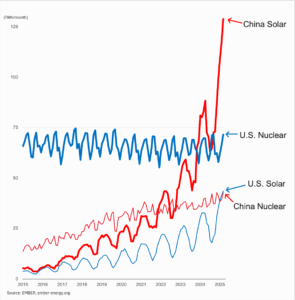
Recent charts show clear momentum: China’s solar output now exceeds U.S. nuclear generation. Also, its nuclear expansion is the largest globally. These developments are not accidental. They come from careful planning, state funding, and a choice to lead in clean energy and related industries.

China’s Solar Boom Surpasses U.S. Nuclear

China’s solar industry has experienced an explosive rise. In early 2025, monthly solar generation surged past 125 terawatt-hours (TWh)—a more than fivefold increase since 2018. For perspective, this figure is now higher than the steady 65–75 TWh per month produced by the entire U.S. nuclear fleet.

China solar and nuclear
Source: https://x.com/Laurie_Garrett

This is a symbolic turning point. For decades, nuclear power was the gold standard for large-scale, carbon-free electricity. Today, China’s solar farms produce more clean power on a monthly basis than America’s entire nuclear sector. The gap is expected to widen, as China continues adding record-breaking solar capacity each year.

Solar growth has been so steep that it is no longer just about meeting household or industrial demand. China is producing extra electricity. This allows it to power energy-demanding technologies like AI, cloud services, and electric vehicles. This “overbuilding” strategy ensures that when demand spikes, the grid has capacity ready.

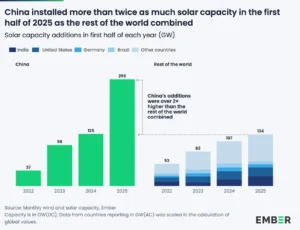
In the first half of 2025, China’s solar installations more than doubled from a year earlier. This surge meant China added over twice the solar capacity of all other countries combined. The country now accounts for 67% of global installations, up from 54% in the same period of 2024.

China solar capacity H1 2025 Ember
Source: Ember

Two Strategies, Two Futures: Beijing vs. Washington

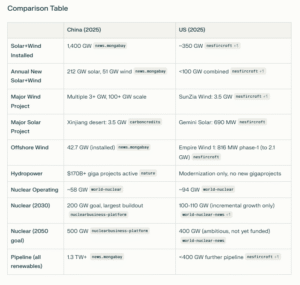
A side-by-side comparison of energy goals shows just how far apart the two countries are in their approaches.

  • Solar and Wind Capacity (2025): China is on track for 1,400 GW, while the U.S. will reach only about 350 GW.
  • New Additions in 2025: China plans to add 212 GW of solar and 51 GW of wind, compared to less than 100 GW combined in the U.S.
  • Mega Projects: China is developing multi-gigawatt solar bases in deserts and multiple 100+ GW wind farms. The U.S.’s largest solar project—Gemini in Nevada—is just 690 MW, or less than 0.7 GW.
  • Offshore Wind: China already has 42.7 GW installed, compared with the U.S.’s Empire Wind project (816 MW phase 1, with a potential expansion to 2.1 GW).

China vs US clean energy capacity

The comparison reveals a structural difference. China views clean energy as national infrastructure, central to its industrial policy. The U.S., meanwhile, relies more heavily on market incentives and tax credits, which can shift with each administration.

Nuclear Power: The Long Game 

China’s clean energy dominance is not limited to solar and wind. Nuclear power is becoming a core pillar of its long-term strategy.

As of 2025, China operates about 58 GW of nuclear power capacity, compared to 94 GW in the United States. At first glance, this seems like a smaller footprint, but the forward-looking numbers tell a different story.

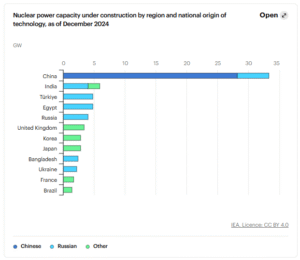
China has more than 30 GW of nuclear capacity under construction, representing over half of the world’s current nuclear buildout. By comparison, U.S. nuclear growth is limited to incremental projects, with little in the way of large-scale expansion.

China nuclear capacity
Source: IEA

Looking ahead:

  • 2030 Goal: China is targeting 200 GW of nuclear, while U.S. projections range from 100–110 GW.
  • 2050 Vision: China aims for 500 GW of nuclear capacity, compared to the U.S.’s ambitious but unfunded target of 400 GW.

Nuclear offers China two critical advantages. First, it provides reliable baseload electricity, balancing out the intermittency of solar and wind. It also provides a secure, carbon-free power supply. This is crucial for industries that need constant electricity, like AI supercomputing, semiconductor fabs, and robotics manufacturing.

Mega Projects That Redraw the Energy Map

China’s energy expansion is not just about adding capacity; it’s about reshaping the global map of mega energy projects. Some of the most ambitious include:

  • Xinjiang Desert Solar Farm:
    A 3.5 GW solar base, one of the largest in the world, leveraging the region’s vast open land and high sunlight exposure.
  • Hundred-Gigawatt Wind Clusters:
    Multiple projects, each scaling over 100 GW, dwarf anything currently planned in other countries.
  • Hydropower Expansion:
    With over $170 billion invested, China is pursuing new gigaprojects, unlike the U.S., which is focused only on modernizing existing dams.

These projects are not built in isolation. They connect to ultra-high-voltage transmission lines, ensuring that clean electricity from remote areas flows to coastal cities, industrial parks, and increasingly, to massive data centers.

Energy and AI: The Hidden Race Behind Algorithms

The global AI race is about algorithms and chips as well as energy. Training large-scale AI models requires massive amounts of electricity. Data centers using these systems now consume power like small countries. By the end of this decade, their demand is set to triple.

China’s decision to overbuild renewables and expand nuclear capacity is directly linked to this future. By ensuring a surplus of clean, low-cost energy, China is preparing to host the next generation of AI clusters, robotics hubs, and cloud infrastructure.

U.S. Policy Uncertainty: A Strategic Weakness

While China pushes ahead, U.S. clean energy growth faces obstacles. Policy shifts and partisan battles have slowed momentum. Proposals to roll back tax credits or defund renewable energy research could reduce investor confidence and stall growth.

As one observer, Laurie Garrett, noted:

“By blocking and de-funding alternative energy R&D and tax incentives for use of solar, wind, nuclear and other renewables, Trump is handing the future on a gold platter to China.”

This concern is not just about climate. It’s about competitiveness. If the U.S. can’t boost energy capacity to meet growing AI and industrial needs, it may lose its leadership in key sectors. These sectors will shape global influence in the coming decades.

US energy capacity additions, retirements by fuel type

Clean Energy as the New Industrial Edge

China’s renewable and nuclear surge is reshaping the balance of global power. With solar generation now surpassing U.S. nuclear, nuclear projects expanding faster than anywhere else, and gigaprojects rising across deserts, mountains, and coastlines, China is ensuring it has the energy backbone for the AI-driven future.

The U.S. still retains advantages in innovation, advanced nuclear designs, and private-sector dynamism. But without consistent policy support and accelerated project deployment, it risks falling behind.

Countries that control abundant, affordable, and carbon-free electricity will lead in AI, robotics, electric vehicles, and the digital economy. China seems determined to be that country.

How Princeton’s Break with BP Exposed the Hidden Influence of Fossil Fuel Money on Universities

For a quarter of a century, Princeton University partnered with one of the world’s biggest oil and gas giants, BP. The alliance poured money into the University’s Carbon Mitigation Initiative (CMI), one of its most prominent climate research programs. On the surface, the deal brought prestige and resources. In reality, critics argue that it delayed the urgent work of phasing out fossil fuels.

Now, the partnership is ending, as reported by The Daily Princetonian. When the current contract expires in 2025, BP will no longer fund CMI. Both sides insist it’s a mutual decision, but the move comes after years of growing criticism, student protests, and investigations that raised serious questions about how fossil fuel companies use academia to protect their business model.

A Deal That Shaped Climate Research

The report further explained: when Princeton struck its deal with BP back in 2000, it was framed as a groundbreaking collaboration. BP’s funding supported research into carbon capture, storage, alternative fuels, and other mitigation strategies.

CMI quickly became one of the University’s flagship institutes, producing influential studies like the Net Zero America report, which mapped possible pathways for the U.S. to achieve net zero by 2050.

Of the five modeled scenarios, four kept fossil fuels in play through mid-century, relying heavily on carbon capture to offset emissions. Critics later pointed out that this conclusion closely mirrored BP’s corporate strategy: continue pumping oil and gas while showcasing carbon capture as a lifeline.

At the time, renewable energy was less developed and more expensive than today. But as wind, solar, geothermal, and battery technologies advanced rapidly, the wisdom of pouring billions into carbon capture began to look like a stalling tactic.

Prestige for BP, Problems for Princeton

For BP, the partnership was a communications jackpot. Having Princeton’s name attached to its climate efforts gave the company a veneer of credibility, even as it expanded drilling and exploration. Internal communications later revealed how BP staff highlighted Princeton’s research to bolster its case for carbon capture and hydrogen in U.S. policy circles.

For Princeton, the financial support was significant, but the cost was reputational. As the climate crisis worsened, the University found itself increasingly criticized for giving BP legitimacy. By 2022, Princeton announced it would divest from fossil fuels, yet the BP relationship remained—an uncomfortable contradiction for a campus under growing activist pressure.

Net Zero: Whose Roadmap?

The partnership’s most contested legacy is the Net Zero America report. Funded by BP and Exxon, the study leaned heavily on carbon capture and fossil fuels. Just five months later, the International Energy Agency (IEA) issued its own net-zero roadmap, independent of fossil fuel influence.

The IEA’s message was blunt: no new investments in fossil fuel projects could be made if the world hoped to stay within 1.5°C of warming. The sharp contrast between Princeton’s BP-backed report and the IEA’s independent findings laid bare the risks of corporate-funded science.

Investigations Pull Back the Curtain

The true extent of BP’s influence came into sharper focus in 2024. A congressional investigation concluded that BP leveraged its Princeton ties to promote policies that aligned with its long-term strategy rather than committing to large-scale renewable investments.

The investigation found that BP not only shaped the narrative around carbon capture but also used the partnership to influence how energy and emissions policies were discussed in Washington. For student groups like Sunrise Princeton and Divest Princeton, this confirmed what they had warned for years: the partnership was less about science and more about extending the fossil fuel era.

Is Fossil Fuel Money Too Toxic for Academia?

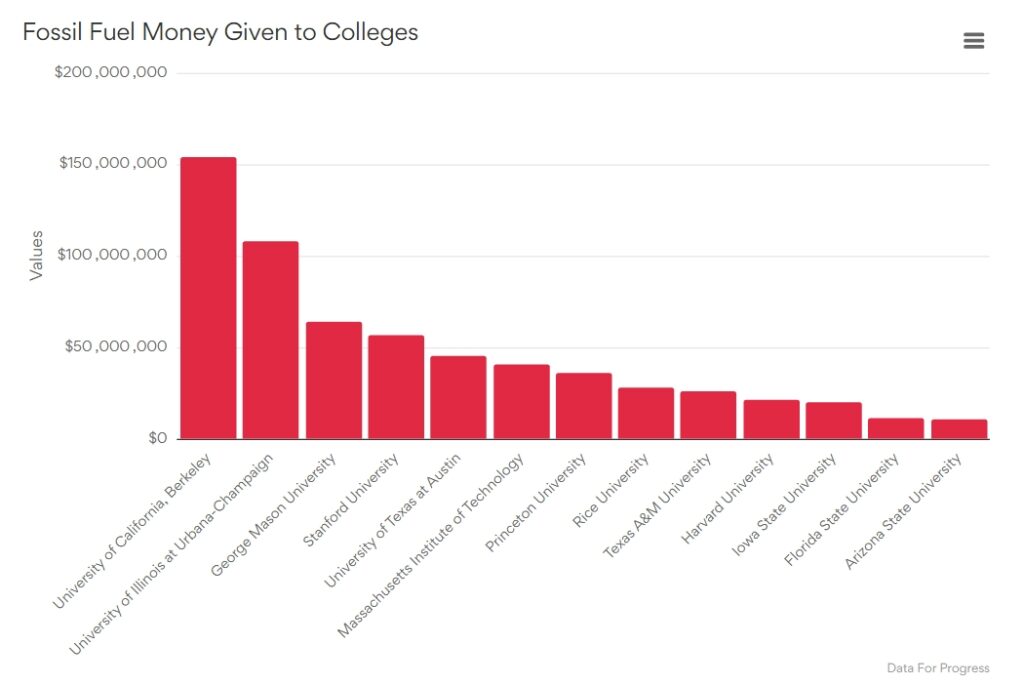
Princeton is hardly alone. We discovered that a 2023 report by Data for Progress and Fossil Free Research revealed that fossil fuel companies funneled more than $675 million into 27 U.S. universities between 2010 and 2020. The University of California, Berkeley topped the list with $154 million, followed by the University of Illinois at Urbana-Champaign ($108 million) and George Mason University ($64 million).

The debate over whether universities should accept fossil fuel funding is complex. Supporters argue that oil and gas companies bring valuable expertise, particularly in areas like carbon storage, green hydrogen, or sustainable aviation fuel. They say tapping into that knowledge can accelerate decarbonization.

Critics counter that these partnerships are inherently compromised. Any research tied to fossil fuel dollars risks being skewed toward preserving oil and gas interests. The history of tobacco industry funding of medical research is often cited as a warning: money from industries whose business models depend on harmful practices should not dictate academic inquiry.

What’s clear is that fossil fuel money buys more than just lab equipment—it buys influence, legitimacy, and access to future policymakers. That’s a trade-off many now say is too high a price to pay.

FOSSIL fuel
Source: Data for Progress

From Princeton to Harvard: BP’s Quiet Academic Powerplay

BP’s influence extended beyond Princeton. Documents show the company paid between $2.1 million and $2.6 million to CMI between 2012 and 2017. It also funded programs at Harvard and Tufts, contributing hundreds of thousands annually to policy-focused research. Harvard’s Kennedy School and Tufts’s Fletcher School, both heavily tied to government policymaking, received funds earmarked for climate policy labs.

The report noted that these partnerships gave BP access not just to research, but also to future policymakers—a revolving door that helped the company shape long-term political outcomes.

Princeton’s Climate Work Seeks New Lifelines

The end of BP’s sponsorship comes as Princeton faces broader challenges in securing climate research funding. In mid-2024, the U.S. Department of Commerce cut $4 million earmarked for University climate programs, claiming they no longer aligned with federal priorities.

Professor Stephen Pacala, CMI’s director, acknowledged that the termination of BP’s support will reduce funding for some projects and end the annual BP-Princeton conference, but he emphasized that the work will continue with other backers. Professor Jonathan Levine, a lead investigator, echoed that sentiment, noting that the research pillars will remain intact but under new funding models.

Student Demands for Real Leadership

With BP now stepping back, Princeton students and climate activists see an opening for change. Divest Princeton has called on the University to:

  • Cut all ties with fossil fuel companies.

  • Offer pension plans free of fossil fuel exposure.

  • Introduce an undergraduate climate crisis course requirement.

  • Make campus operations a model of sustainability, from dining halls to reunions.

  • Acknowledge and address harms inflicted on frontline communities impacted by fossil fuels.

To them, Princeton has lagged on sustainability, and its long partnership with BP represents decades of lost opportunity. Instead of backing bold renewable solutions already proven at scale—solar, wind, geothermal, and battery storage—Princeton, they argue, gave BP the cover it needed to keep selling fossil fuels.

A Chance for Princeton to Reset

The end of Princeton’s BP partnership represents more than just the expiration of a contract. It’s a moment of reckoning for the University, and a chance to redefine its role in the global energy transition.

Princeton could choose to double down on independent, transparent climate research that focuses on accelerating renewable deployment, scaling storage, and building resilient, low-carbon systems. It could use its prestige not to give cover to fossil fuel interests, but to lead the charge toward a sustainable future.

Whether Princeton seizes this opportunity or clings to the legacy of a 25-year deal that many see as a costly mistake. Nonetheless, it will send a powerful signal about the role of higher education in solving the climate crisis.

American Airlines (AAL Stock) Posts Strong Passenger Growth Ahead of Holiday Travel, Bets Big on SAF Future

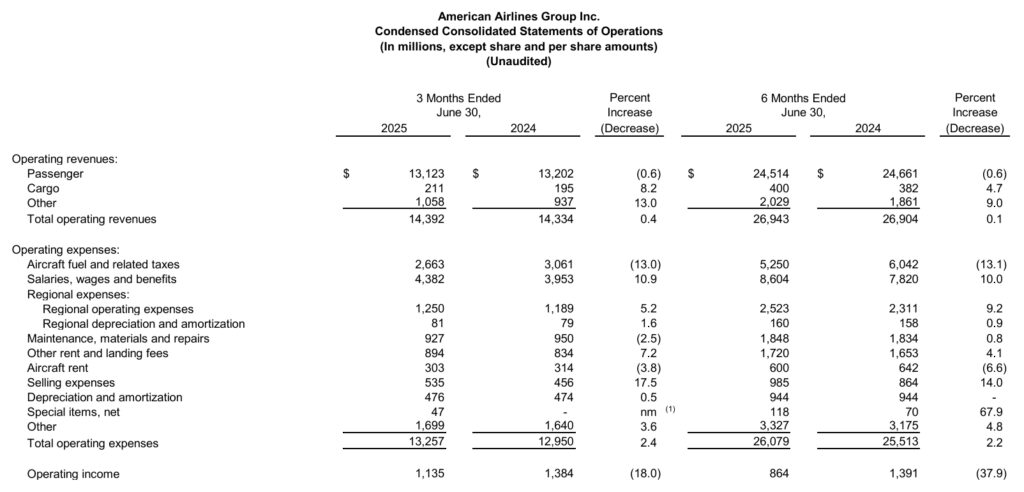
American Airlines (AAL Stock) entered the busy summer travel season with clear momentum. The carrier posted record Q2 2025 revenues of $14.4 billion, a 5% jump in international passenger unit revenue, with especially strong demand across the Atlantic. Its operating margin climbed to 8%, while earnings per share of $0.95 beat Wall Street expectations. AAL is also giving a strong net-zero push with significant investment in SAF.

Let’s deep dive into its revenue and its sustainability goals below.

American Airlines’ Passenger Growth Gives Earnings a Lift

The earnings release showed that premium cabins led the charge, with families, leisure travelers, and business flyers paying up for long-haul comfort. The airline also leaned into its AAdvantage loyalty program, which grew 7% in 2025. Upticks in co-branded credit card use and new perks like instant upgrades helped drive repeat bookings.

Together, these gains signaled more than just post-pandemic recovery—they showed targeted growth in high-margin categories.

American Airlines earnings
Source: American Airlines

Holiday Travel Tailwinds

Heading into the year-end holidays, American is adding capacity both at home and abroad. Routes to resilient leisure destinations are expanding, while premium travel remains a strong revenue engine. The airline is betting that higher engagement and a growing loyalty base will keep its planes full during the holiday surge.

Yet, investors are cautious. AAL shares trade at $13.39, nearly 28% below their 2025 peak of $18.66. AAL stock has been volatile, with 22 swings of more than 5% this year alone. Analysts maintain a neutral outlook, with a median 12-month price target of $13.55, suggesting limited upside unless cost pressures ease.

AAL stock
Source: Yahoo Finance

Q3 Forecast: Clear Skies or Turbulence Ahead?

Despite Q2 strength, management offered a more sober Q3 forecast. The company expects a loss per share between $0.10 and $0.60, missing analyst profit estimates. That guidance reflects the industry’s most stubborn challenges:

  • Fuel volatility – oil prices are holding around $86 per barrel.
  • Labor pressures – wage hikes, including a 10% pilot raise, are cutting into margins.
  • Tariff and macro risks – global trade uncertainties remain a drag.

Margins for Q3 are projected between -1% and +2%. At the same time, costs per available seat mile may climb another 2.5–4.5% year-on-year. Pilot shortages and weather disruptions have also played their part, denting operational efficiency.

Still, the company is leaning on its $12 billion liquidity buffer to manage volatility. With the industry facing similar headwinds, investors will watch closely to see how well the airline balances growth with cost control.

A Different Flight Path: American Airlines 2050 Net Zero Goals

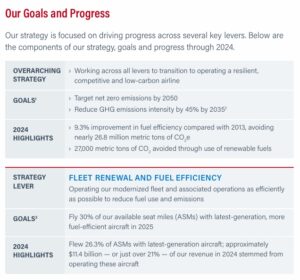
While financials dominate headlines, American Airlines is also pushing ahead on climate commitments. Aviation remains one of the hardest sectors to decarbonize, but the carrier has tied its long-term competitiveness to a net-zero emissions goal by 2050. Intermediate targets for 2030 and 2035 add pressure to deliver progress sooner.

Decarbonizing air travel requires public-private collaboration, innovation, and policy support. However, the company is investing heavily in efficiency, sustainable aviation fuel (SAF), and next-generation aircraft within its operations.

Capital Investments with Climate Benefits

In 2024, roughly 55% of American’s capital spending supported both profitability and decarbonization. That included billions invested in new aircraft, fuel-saving initiatives, and fleet modernization. Although deliveries slowed in 2024 due to supply chain delays, the company expects to take delivery of more efficient aircraft in 2025.

Next-generation aircraft is the key to the airline’s climate playbook.

  • It became the largest airline to sign a conditional purchase agreement for 100 ZeroAvia hydrogen-electric engines. They can power regional jets with zero emissions beyond water vapor.
  • The company aims to induct hydrogen-powered aircraft by 2032 or earlier.
American airlines AAL
Source: AAL

Betting Big on Sustainable Aviation Fuel

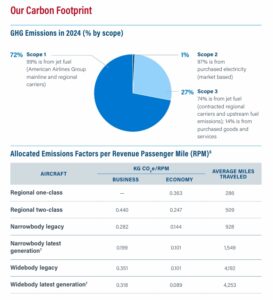
SAF is widely regarded as the most critical near-term lever for reducing aviation’s carbon footprint. Compared to conventional jet fuel, SAF can cut life-cycle emissions by up to 85%. But supply remains limited, and high costs are slowing adoption.

It aims to replace 10% of its jet fuel use with SAF by 2030, which would avoid about 3.5 million metric tons of CO2. In 2024, the airline used 2.9 million gallons of SAF, a modest 9.7% increase from 2023 but still under 0.1% of total fuel use.

It has signed offtake deals to scale SAF. They include

  • Up to 10 million gallons from Valero by mid-2026.
  • Agreement with Infinium, an e-fuels producer, with deliveries expected as early as 2027.

The company also became a founding member of the SAF Coalition, which lobbies for federal incentives to make SAF cost-competitive.

American applies strict sourcing principles to its SAF purchases, requiring at least a 50% life-cycle emissions reduction, full feedstock impact assessments, and sustainability certifications.

AMERICAL AIRLINES
Source: AAL

Airspace Efficiency

Beyond fuel, American is working with policymakers to modernize airspace management. Better flight planning and optimized routing reduce emissions while boosting safety and on-time performance.

In 2024, the airline rolled out a flight planning optimization tool and equipped its A321 fleet with ADS-B In technology, allowing pilots to adjust routes in real-time for efficiency. These upgrades enhance both operational reliability and sustainability.

Carbon Markets as a Backstop

American Airlines also participates in voluntary carbon markets to neutralize residual emissions. The company is exploring offsets and removals as complementary tools to in-sector solutions.

Last year, it onboarded new digital tools to help corporate customers meet their own decarbonization goals, signaling growing demand for carbon-aligned travel options.

Momentum vs. Risk: Can AAL Keep Flying High?

For shareholders, AAL stock presents a mix of opportunity and risk. The airline is benefiting from record revenues, stronger loyalty engagement, and solid demand for premium travel. Yet, rising costs, $38 billion in debt, and the heavy price of climate transition investments are weighing on its outlook.

With a price-to-sales ratio of 0.16 compared to the industry average of 0.69, AAL appears undervalued. Still, challenges like wage pressures and fuel volatility temper bullish sentiment. Most analysts recommend patience, noting that future gains will hinge on execution and broader market conditions.

Looking ahead, American Airlines has shown it can soar when demand is strong, but turbulence is likely in 2025. The airline is balancing earnings volatility with billions committed to its net-zero pathway. Its ability to manage profitability while pushing forward on decarbonization will shape its role as both a leading U.S. carrier and a case study in how aviation adapts to market and climate pressures.

ASEAN at COP30: How Malaysia Pushes Carbon Finance and Heritage Parks to the Forefront of Climate Action

ASEAN environment ministers met in Langkawi, Malaysia, for a three-day summit on climate and sustainability. The 18th ASEAN Ministerial Meeting on Environment (AMME-18) gathered more than 200 delegates from member states, Timor-Leste, and partners like the EU, China, South Korea, and Japan.

The timing is key. With COP30 in Brazil just weeks away, ASEAN leaders are aligning their climate goals. As per reports, Malaysia used the platform to push regional cooperation, highlight haze reduction, and strengthen climate finance strategies.

Carbon Credit Potential in ASEAN Heritage Parks

During the summit, Malaysia nominated three sites as ASEAN Heritage Parks: the Tengku Hassanal Wildlife Reserve, Bako National Park, and Lambir Hills National Park. These designations highlight biodiversity protection while boosting climate goals.

Heritage Parks act as natural carbon sinks. Protecting them enhances carbon capture, builds ecosystem resilience, and supports communities. They also set the stage for large-scale carbon credit projects that meet strict international standards.

ASEAN Heritage Parks are the protected areas of high conservation importance, preserving in total a complete spectrum of representative ecosystems of the ASEAN region.”

They now represent new frontiers for carbon markets. By safeguarding forests and restoring degraded land, these areas can generate verified carbon credits. With strong monitoring, reporting, and verification (MRV), the credits become highly attractive for global buyers.

Malaysia has already shown proof of concept. The Kuamut Rainforest Conservation Project sold its first carbon credits through auction earlier this year. Expanding this model to new Heritage Parks could unlock billions in climate finance while conserving vital ecosystems.

Building Trust Through Policy and Standards

Carbon markets rely on credibility. To address this, ASEAN is creating strong governance tools. The upcoming ASEAN Centre for Climate Change will guide compliance, carbon reporting, and green investment. This move gives investors confidence in the quality of regional credits.

At the same time, the ASEAN Climate Change Strategic Action Plan provides a roadmap for carbon pricing, emissions trading, and sustainable finance. These efforts prove that ASEAN is not only setting targets but also building systems that work.

Nature-Based Solutions Drive Climate Advantage

ASEAN holds one-quarter of the world’s natural climate solutions potential. Its tropical forests, wetlands, and mangroves can absorb vast amounts of carbon. By centering Heritage Parks in climate policy, ASEAN is positioning itself as a global leader in nature-based projects.

These projects also bring co-benefits. They protect biodiversity, improve water and air quality, and support rural livelihoods. Recognizing cities and parks for sustainability achievements adds momentum and strengthens public trust in climate action.

ASEAN and the COP30 Action Agenda

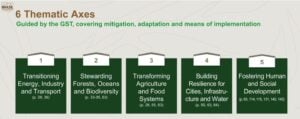
The outcomes from Langkawi directly tie into the COP30 Action Agenda, which calls for faster global action on mitigation, adaptation, finance, technology, and capacity-building. ASEAN’s focus on Heritage Parks, carbon markets, and haze reduction fits squarely into this framework.

The Action Agenda also builds on the results of the first Global Stocktake (GST-1), urging countries and non-state actors to close implementation gaps. ASEAN’s joint statement for COP30 signals that the region is ready to mobilize all actors—governments, businesses, and communities—to accelerate emission cuts and protect ecosystems.

By aligning regional goals with the six thematic pillars of COP30, ASEAN is demonstrating how nature-based solutions and carbon markets can translate negotiated commitments into practical outcomes. Heritage Parks, in particular, serve as proof that the region is putting Paris Agreement ambitions into action on the ground.

COP30 Brazil
Source: COP30 BR

Malaysia Pushes Carbon Pricing and Green Finance

Malaysia used AMME-18 to emphasize the financial opportunities of carbon markets. Officials called for emissions trading and carbon taxes as core tools for a low-carbon economy.

The stakes are high. Analysts estimate that ASEAN could generate up to $3 trillion in revenue by 2050 through carbon credit projects. Forest restoration, reforestation, and sustainable agriculture will drive this growth, yielding both economic and environmental benefits.

ASEAN carbon markets

Source: Abatable

What Carbon Market Stakeholders Should Watch

The Langkawi summit delivered key signals for businesses, investors, and project developers:

  • Aligned Standards: Expect smoother trading across Southeast Asia as regulations harmonize.

  • New Nature Projects: Forest-rich states will expand high-quality carbon credit projects.

  • Guidance Hub: The ASEAN Centre for Climate Change will release updates on MRV and finance.

  • Investor Confidence: Regional oversight will improve trust in ASEAN carbon credits.

These outcomes make ASEAN one of the most attractive regions for carbon finance in the coming decade.

Malaysia’s leadership at AMME-18 marked a turning point. Heritage Parks now stand as proof that protecting nature can fuel credible carbon credits and attract global investment.

By linking conservation to finance, ASEAN is creating a model where climate action also drives economic growth. With stronger policies, high-quality credits, and nature-based leadership, ASEAN is stepping onto the global stage as a key player in carbon markets and the COP30 Action Agenda.