Fordโ€™s New Energy Business Targets Teslaโ€™s Storage Empire, Sending Stock (F) Upward

Ford Motor Company ( has officially launched Ford Energy, a new business focused on manufacturing battery energy storage systems (BESS) for utilities, data centers, and industrial customers. The move is a big step for Ford. It goes beyond electric vehicles and puts the company in one of the fastest-growing energy markets in the world.

The company plans to produce 20 gigawatt-hours (GWh) of battery storage annually from its Kentucky battery facility by the end of 2027. That level of output would position Ford among the largest U.S.-based energy storage suppliers.

The launch also reflects a broader industry shift. Automakers are stepping into stationary energy storage. This shift comes as electricity demand grows due to AI, cloud computing, and renewable energy.

The U.S. government is also promoting domestic battery manufacturing. It offers clean energy tax credits and supply-chain incentives to encourage this effort.

Ford Energy stated:

“Utilities and developers need storage systems they can finance, insure and depend on for decades. They need suppliers who will be there in year 10 to honor a warranty claim. That is the gap Ford Energy is built to fill. Ford Motor Company has manufactured at industrial scale for more than a century, and weโ€™re excited to bring this immense capability to energy storage.”

Fordโ€™s Next Big Bet: Turning EV Batteries Into Grid Power

Fordโ€™s new business will manufacture large lithium iron phosphate (LFP) battery systems designed for utilities and large commercial users. These storage systems stabilize electricity grids. They also store renewable energy from solar and wind farms.

  • The company expects to invest about $2 billion over the next two years to scale production.

Ford built much of its manufacturing setup with South Korean battery partner SK On for electric vehicles. However, slowing EV demand and extra battery capacity led the company to focus more on stationary energy storage.

Ford Energyโ€™s flagship product is a 20-foot containerized battery unit similar to Teslaโ€™s Megapack system. Each container stores about 5.45 megawatt-hours (MWh) of electricity using high-capacity LFP battery cells. The company plans to offer two versions:

  • FE-250 with a two-hour discharge duration
  • FE-450 with a four-hour discharge duration

These systems are designed for:

  • utility-scale renewable projects,
  • AI data centers,
  • manufacturing facilities, and
  • grid balancing applications.

First deliveries are expected in late 2027. Ford stock surged about 13% after investors responded positively to the companyโ€™s new energy storage business. This is its biggest one-day gain in nearly six years.
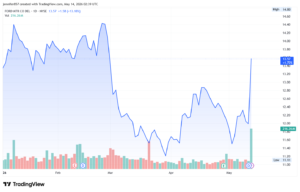
Ford F stock price

Analysts at Morgan Stanley said Fordโ€™s partnership with Contemporary Amperex Technology Co. Limited gives the automaker a strong strategic advantage in the fast-growing battery storage market. Investors liked Fordโ€™s plan to invest about $2 billion in U.S.-made battery storage systems.ย 

Battery Energy Storage Demand Is Growing Rapidly Worldwide

Ford is entering a market that is expanding at an extraordinary pace. According to BloombergNEF, global energy storage deployments reached about 307 GWh in 2025. The research firm forecasts worldwide deployments could rise to around 459 GWh in 2026 alone.
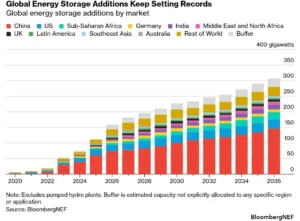
global energy storage BNEF

Meanwhile, the U.S. Energy Information Administration (EIA) expects the United States to add roughly 24 gigawatts (GW) of battery storage capacity in 2026. That would nearly double the record 15 GW added in 2025.

Industry forecasts also show total U.S. battery storage capacity could exceed 600 GWh by 2030. The growth is being driven by several major trends:

  • rising renewable energy installations,
  • surging electricity demand from AI,
  • grid modernization efforts, and
  • increasing electrification across industries.
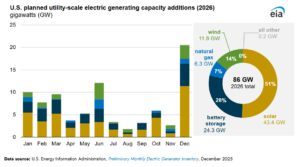
US planned electricity generation capacity 2026 by source
Source: EIA

Battery storage is becoming essential because solar and wind power are intermittent. Electricity production changes depending on weather conditions and time of day.

Storage systems help solve this issue by saving electricity when supply is high and releasing it later during periods of peak demand. This flexibility is becoming increasingly valuable for utilities and large electricity users.

AI Data Centers Are Creating a Massive Storage Opportunity

One of the biggest growth drivers for battery storage is the rapid expansion of AI infrastructure. Large AI data centers consume enormous amounts of electricity and require an uninterrupted power supply. This is creating growing pressure on electricity grids globally.

According to the International Energy Agency, global data center electricity use could more than double, from 415 terawatt-hours (TWh) in 2024 to around 945 TWh by 2030.

AI workloads could become a major source of this growth. The IEA estimates electricity demand from AI-focused servers could rise by around 30% annually through the end of the decade.

Many data centers need faster power solutions and so, companies are now using battery storage systems. This helps them unlock power capacity without waiting years for new grid infrastructure. This trend is creating major opportunities for battery suppliers such as Ford Energy.

Tesla Still Leads the Market, But Rivals Are Closing In

Tesla currently dominates the global BESS market through its Megapack business. Research firm Wood Mackenzie estimates Tesla held about 15% of the global battery storage integrator market in 2024. In North America, Tesla controlled roughly 39% of the market.
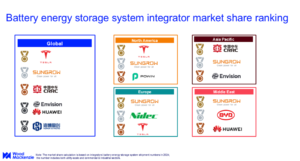
battery energy storage leaders tesla

Teslaโ€™s energy business has also become increasingly important financially. The company reported energy generation and storage revenue of approximately $12.8 billion in 2025, up 27% year over year. Fourth-quarter storage deployments reached a record 14.2 GWh.

However, competition is increasing quickly.

Chinese energy storage supplier Sungrow Power Supply Co., Ltd. held roughly 14% of the global market in 2024, narrowing Teslaโ€™s lead significantly. Other companies are also expanding aggressively into storage markets, including:

Several automakers are now exploring stationary battery systems using both new and repurposed EV batteries. This reflects growing recognition that energy storage could become a major long-term business opportunity beyond vehicle manufacturing.

U.S. Manufacturing Incentives Create New Opportunities

Ford may benefit from a growing policy push for domestic battery production. Recent U.S. clean energy policies push companies to get battery materials and make products at home. This shift reduces reliance on imports from countries seen as โ€œforeign entities of concern.โ€

Fordโ€™s battery plants in Kentucky and Michigan support this strategy while helping customers qualify for tax incentives. The company is also focusing on lithium iron phosphate batteries, which are cheaper, safer, and widely used in stationary storage systems.

Fordโ€™s Energy Push Is Part of Its Climate Goals

Ford says the expansion into energy storage supports its broader sustainability strategy. The company aims to achieve carbon neutrality across its global operations no later than 2050. The carmaker has also committed to using 100% carbon-free electricity for manufacturing globally by 2035.
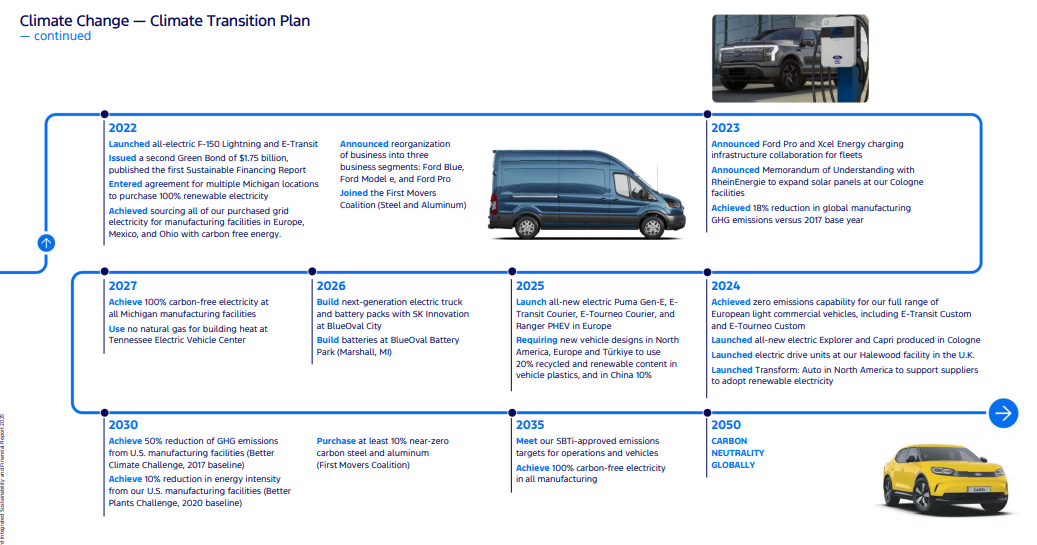
Ford road to carbon neutrality
Source: Ford; Road to Carbon Neutrality

Ford’s latest sustainability report shows it cut operational greenhouse gas emissions by about 40% from its 2017 baseline. The company is boosting its use of renewable electricity in manufacturing. It is also investing heavily in battery recycling and cleaner supply chains.
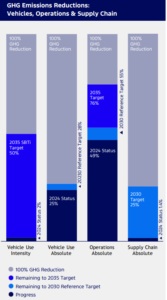
Ford ghg emissions reductions progress
Source: Ford

Battery energy storage is becoming more important. It helps expand renewable energy use and keeps the grid stable. As renewable energy grows worldwide, big storage systems will be key. They help balance electricity supply and demand.

Entering a High-Stakes Battle for the Future of Energy Storage

Ford Energy represents one of the companyโ€™s biggest strategic expansions beyond traditional automotive manufacturing.

The energy storage market is expanding quickly. This growth comes from AI infrastructure, more investments in renewable energy, and increasing electricity demand.

As grids update and electricity needs grow, battery storage is key for the global energy shift. Fordโ€™s entry into the sector shows how traditional carmakers are evolving into broader energy and technology companies.

WULF Stock Climbs on $31 Target as TeraWulf Bets Big on Low-Carbon, Nuclear-Powered Bitcoin Mining

TeraWulf Inc. (NASDAQ: WULF) has received a new $31 price target from Cantor Fitzgerald, reflecting rising investor interest in its low-carbon bitcoin mining strategy. The analyst note points out that TeraWulf uses low-emission energy, which includes nuclear and hydro power at its main facilities in the United States. These include the Lake Mariner site in New York and the Nautilus Cryptomine facility in Pennsylvania.

The update comes as investors pay closer attention to the environmental footprint of bitcoin mining. The sector remains highly energy-intensive.

The Cambridge Centre for Alternative Finance reports that global bitcoin mining uses over 100โ€“150 terawatt-hours (TWh) of electricity each year. This is comparable to the energy consumption of medium-sized countries.

TeraWulf stands out as one of the few public miners using low-carbon or carbon-free energy on a large scale. Cantor Fitzgerald said the companyโ€™s energy strategy and infrastructure model help it grow long-term. This is important in a sector under more ESG scrutiny.

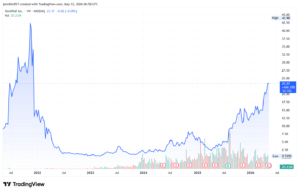
WULF stock has gained momentum after the raise in price target to $31. Investor interest has also been supported by rising demand for nuclear-powered and energy-efficient digital infrastructure tied to AI and crypto growth.

Terawulf WULF stock price

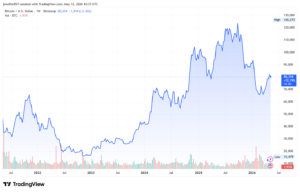
The recent bitcoin price rally has also improved sentiment across the mining sector. Bitcoin has continued trading around $80,000 level after reaching an all-time high above $126,000 in late 2025.

Higher BTC prices generally improve mining profitability. This is because miners earn more value from each bitcoin produced while operating costs remain relatively stable.

Bitcoin BTC stock price

This stronger market environment has supported renewed interest in crypto infrastructure stocks such as WULF stock. Investors are increasingly focusing on miners with lower energy costs and more stable power access.

A Low-Carbon Mining Model Built on Nuclear and Hydro Power

TeraWulf operates two main facilities that anchor its mining strategy. The first is Lake Mariner in New York, which draws power from a grid that is largely supported by nuclear and hydroelectric generation. The second is Nautilus Cryptomine in Pennsylvania. It gets its power directly from the Susquehanna nuclear plant through a behind-the-meter agreement.

Nautilus is the companyโ€™s most significant ESG asset. It runs entirely on nuclear power. This makes it one of the first large-scale bitcoin mining sites in the world to use nuclear energy directly.

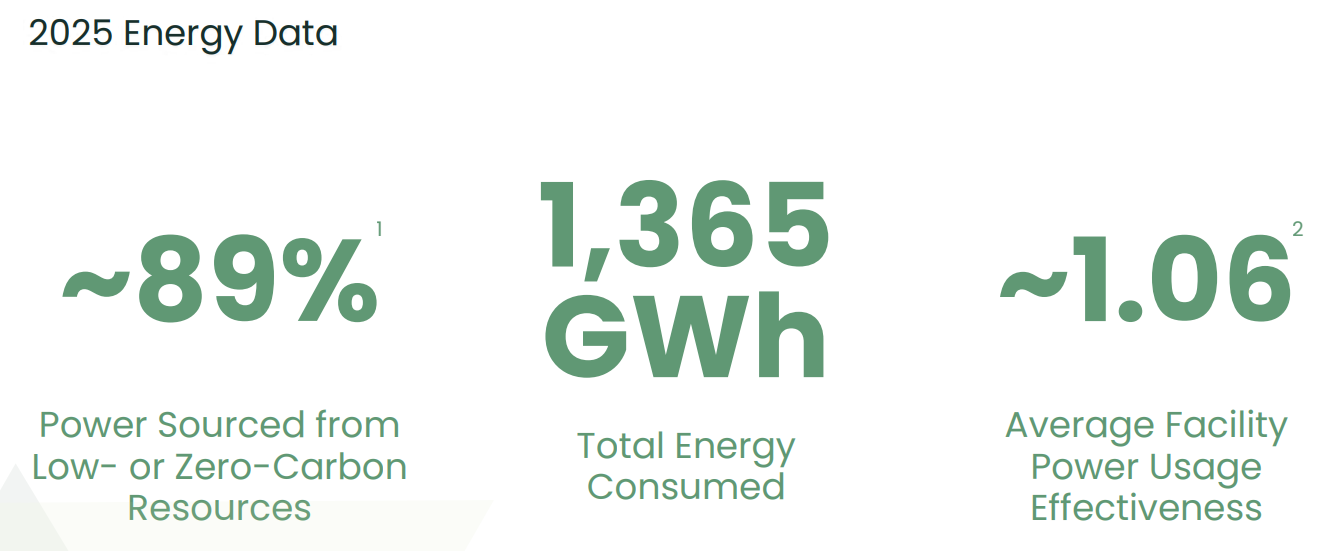
However, the companyโ€™s portfolio isnโ€™t always 100% carbon-free. Lake Mariner still uses a mix of grid electricity. TeraWulf says that a big part of its energy comes from carbon-free sources. This includes nuclear, hydro, and other low-emission options.

terawulf energy data
Source: TeraWulf

This distinction matters in ESG reporting. Many bitcoin mining firms still rely heavily on fossil fuels such as coal and natural gas. The International Energy Agency (IEA) says coal provides about one-third of global electricity. This still contributes significantly to emissions.

TeraWulfโ€™s strategy, therefore, focuses on reducing exposure to fossil-heavy grids by anchoring operations in cleaner energy regions.

Bitcoin Mining Faces Rising Pressure Over Energy Use and Emissions

Bitcoin mining continues to face strong debate over its environmental impact. Mining requires large amounts of electricity to run high-performance computing systems. These systems validate transactions and secure the blockchain network. The result is a high and continuous energy demand.

Studies from Cambridge and other research groups say Bitcoin’s energy use can sometimes surpass that of entire countries, like Argentina or the Netherlands.

Bitcoin Mining Annual Energy Use (TWh)

This has placed increasing pressure on miners to adopt cleaner energy sources. Institutional investors are also beginning to factor emissions intensity into their investment decisions.

At the same time, global electricity systems are gradually becoming cleaner. The International Renewable Energy Agency (IRENA) says that renewables made up about 30% of global electricity generation recently. They expect this to keep growing until 2030.

This shift is important for crypto mining. It creates a pathway for lower-carbon operations, especially for companies that can secure long-term access to nuclear, hydro, or renewable power. TeraWulfโ€™s model fits into this transition by prioritizing energy contracts tied to low-emission generation.

AI and Data Center Boom Push Electricity Demand Into Overdrive

The demand for digital infrastructure is growing quickly. This includes AI computing, cloud services, and blockchain systems.

The International Energy Agency estimates that global data centers consumed about 415 TWh of electricity in 2024. Under high-growth scenarios, this could rise to nearly 950 TWh by 2030.

This growth is driven by AI workloads and large-scale computing systems. These systems require constant power and high-density computing environments. As demand rises, electricity access is becoming a key constraint. Companies are no longer competing only on hardware or software. They are also competing for energy availability.

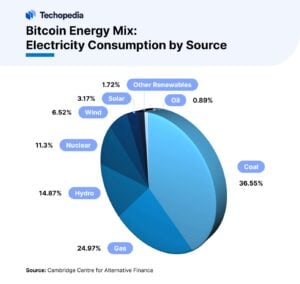
TeraWulf benefits from this shift. Its facilities are in areas with stable grid access and large baseload energy sources like nuclear and hydro. Industry reports show the following energy mix used by bitcoin miners, with hydro and nuclear being the top two renewable sources.ย 

bitcoin mining energy mix

This provides a competitive advantage. Unlike fossil fuel-heavy regions, nuclear and hydro systems offer more stable long-term pricing and lower carbon intensity. As a result, low-carbon mining infrastructure is increasingly seen as part of the broader โ€œclean computeโ€ economy.

Wall Street Turns to ESG-Backed Crypto Infrastructure Plays

The Cantor Fitzgerald price target reflects a broader trend in financial markets. Institutional investors are paying closer attention to ESG-linked digital infrastructure.

Bitcoin mining companies are now judged on more than just profits. They are also assessed based on their energy sources and emissions.

TeraWulf has an advantage on this shift because it can demonstrate measurable access to low-carbon energy. Its nuclear-powered Nautilus facility is especially important in this regard.

The company set up long-term agreements. These help ensure stable energy access and keep operating costs predictable. This is a key factor for institutional investors who prefer lower volatility infrastructure plays.

Other mining companies are also shifting toward cleaner energy strategies. CleanSpark says a large portion of its bitcoin mining operations uses low-carbon and renewable-heavy energy sources across the United States.

IREN Limited (formerly Iris Energy) operates data centers powered mainly by renewable electricity, particularly hydro energy in Canada. Meanwhile, MARA Holdings (formerly Marathon Digital Holdings) has expanded partnerships tied to renewable and flare-gas energy projects to reduce emissions intensity.

Clean Energy Mining as a Competitive Advantage

Energy sourcing is becoming one of the most important competitive factors in bitcoin mining. Companies that secure access to nuclear, hydro, or renewable power can operate with lower emissions and more stable energy pricing.

TeraWulfโ€™s strategy focuses on this advantage. Its nuclear-backed Nautilus facility provides consistent baseload power. Its Lake Mariner site benefits from a relatively clean regional grid mix.

This structure helps the company reduce exposure to fossil fuel volatility. It also improves long-term operational predictability.

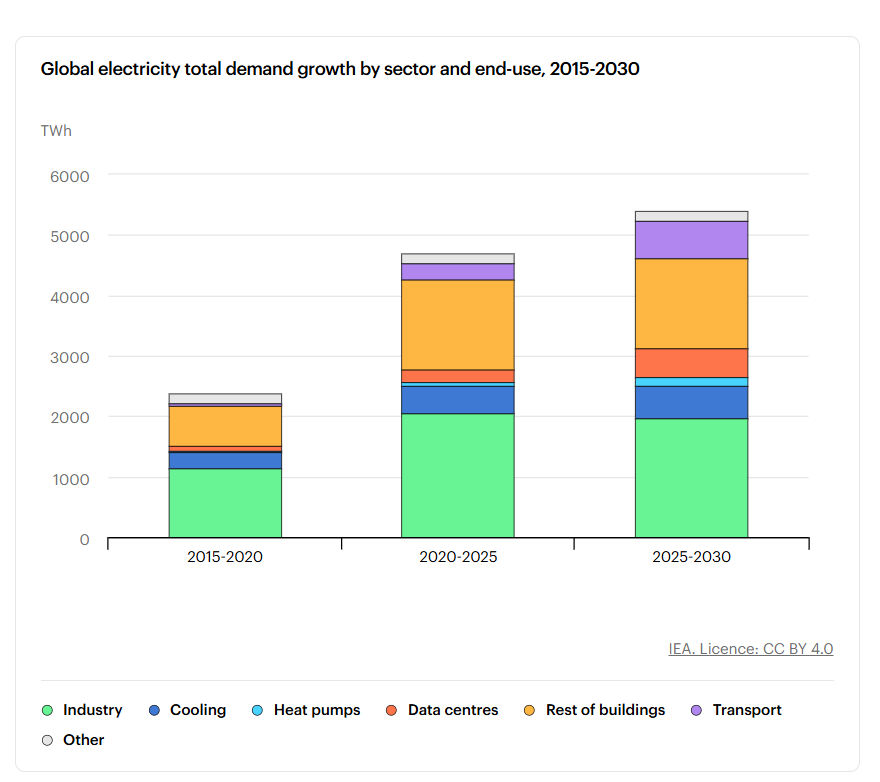
The International Energy Agency expects electricity demand from data centers, AI, and digital infrastructure to grow significantly through 2030. This will increase competition for clean power sources. In this setting, companies with low-carbon energy contracts might have a key advantage.

global electricity demand by sector 2030 IEA
Source: IEA

Analysts also note that institutional demand for Bitcoin continues to rise through spot Bitcoin ETFs, corporate treasury adoption, and growing digital asset investment flows. This broader market momentum is helping support long-term demand for scalable and energy-efficient mining infrastructure.

WULF Stock and the Shift Toward Low-Carbon Mining

TeraWulfโ€™s $31 price target highlights growing investor interest in low-carbon bitcoin mining infrastructure. The company has built a model based on nuclear and hydro energy access, with one of its key facilities operating on direct nuclear power. Its overall portfolio isn’t completely carbon-free, but it has much lower emissions than many industry peers.

Bitcoin mining remains one of the most energy-intensive computing industries in the world. Companies that secure clean, stable electricity can better adapt to market and regulatory changes.

For investors watching WULF stock, TeraWulf shows a shift. It blends digital computing with lower-carbon energy systems. This positioning places the company at the intersection of three major trends:

  • rising demand for digital infrastructure,ย 
  • increasing pressure to reduce emissions, andย 
  • growing importance of clean baseload energy.

As these trends converge, low-carbon mining may become a standard rather than an exception in the global bitcoin industry.

Oklo (OKLO) Reports Q1 Financial Results: Stock Climbs as It Expands AI-Nuclear Push With NVIDIA and Advances Reactor Licensing

Oklo reported its first-quarter 2026 financial results along with several major business and regulatory updates. The company is still pre-revenue and posted wider losses during the quarter. However, investors focused more on Okloโ€™s growing reactor pipeline, faster regulatory progress, and new partnerships linked to artificial intelligence (AI) infrastructure.

Oklo is becoming part of two major global trends. One is the rapid growth of AI data centers. The other is the rising demand for reliable carbon-free electricity.

Oklo Strengthens Cash Position as AI-Nuclear Interest Grows

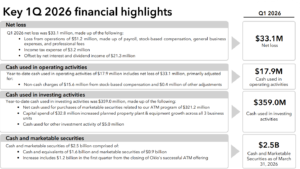
Oklo reported an adjusted earnings per share (EPS) loss of $0.18 for Q1 2026. This matched analyst expectations. The loss was bigger than last year during the same time. The company kept spending on reactor licensing, engineering, fuel research, and commercial projects.

Oklo Q1 2026 financial results
Source: Oklo

Still, the company improved its financial position during the quarter. Total liquidity reached about $2.6 billion after Oklo completed a large at-the-market stock offering. The stronger balance sheet gives the company more flexibility to fund future reactor projects without immediate financing pressure.

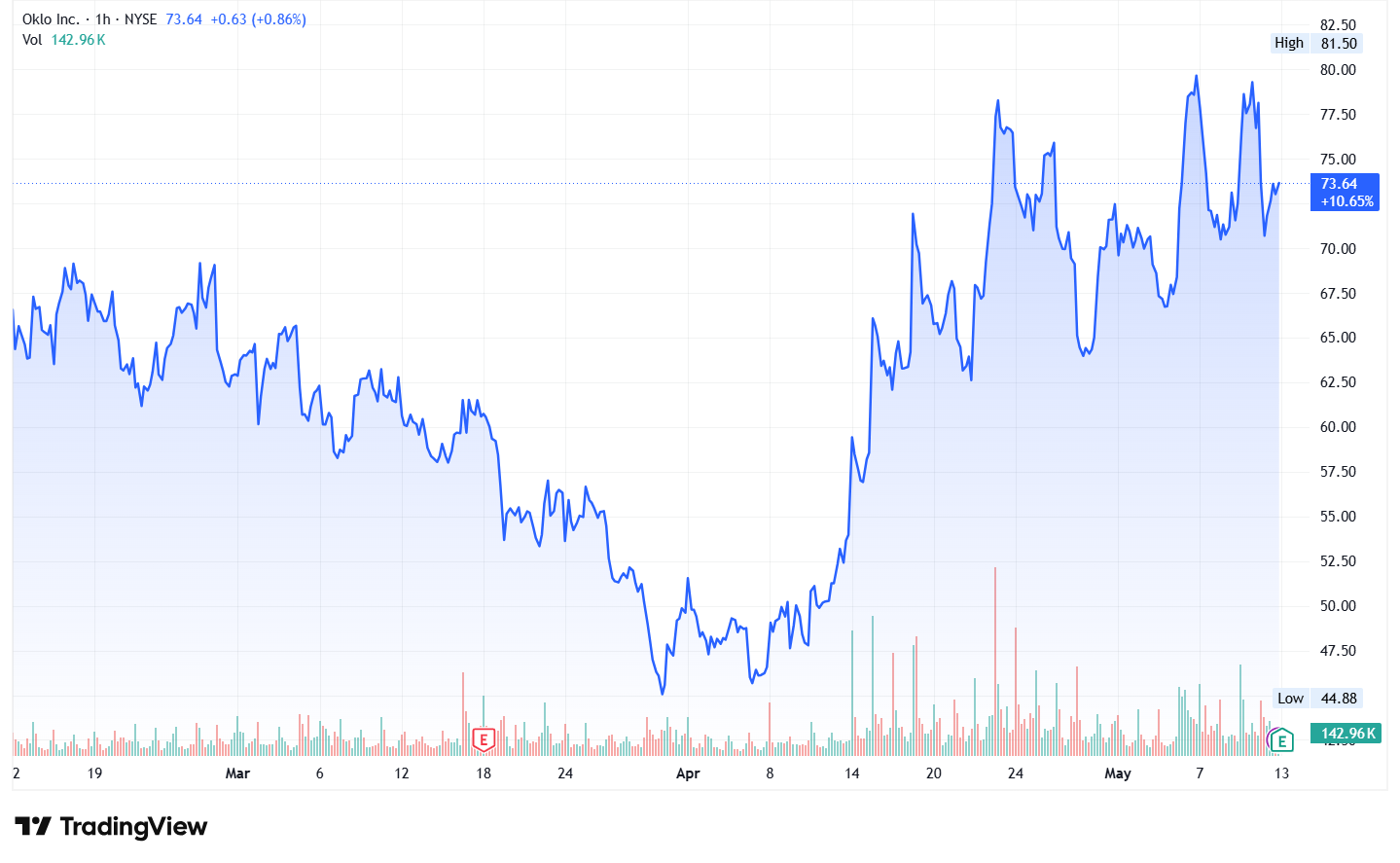
Despite the quarterly loss, OKLO stock has gained momentum in recent months. Shares have climbed sharply in 2026 as investor interest grows around nuclear energy and AI infrastructure.

OKLO stock price

The rally also reflects stronger momentum across the advanced nuclear sector. Small modular reactor (SMR) and microreactor companies are attracting interest as governments and tech firms want stable, low-carbon power sources.

According to the International Energy Agency (IEA), electricity demand from global data centers could more than double by 2030, reaching nearly 945 terawatt-hours (TWh).

AI systems could become one of the biggest drivers of this increase. This trend is creating new interest in nuclear energy because reactors can provide constant electricity around the clock without direct carbon emissions.

Fast-Tracked NRC Approval Pushes Aurora Reactor Closer to Reality

One of the companyโ€™s biggest developments this quarter was a major regulatory milestone for its Aurora powerhouse project in Idaho. The U.S. Nuclear Regulatory Commission (NRC) approved Okloโ€™s Principal Design Criteria (PDC) topical report for the Aurora reactor. This document sets important safety and performance standards for future reactor licensing.

The approval process moved faster than normal NRC timelines. Oklo said the report was accepted within 15 days, compared with the usual 30- to 60-day period. The full review also finished in less than half the normal time. This is important because licensing delays remain one of the biggest challenges in the nuclear industry.

The Aurora reactor is a compact fast reactor. It provides clean electricity and industrial heat. This makes it suitable for data centers, military sites, industrial facilities, and remote locations.

Oklo’s design stands out from traditional nuclear plants. Its reactors are smaller and made for quicker deployment. The company already secured a site use permit with the U.S. Department of Energy (DOE) for its first commercial Aurora powerhouse at Idaho National Laboratory.

The advanced reactor market is expected to grow quickly over the next decade. The World Nuclear Association says more than 80 SMR designs are now being developed worldwide.

The DOE also believes advanced nuclear power could help the United States meet long-term net-zero emissions goals by 2050.

NVIDIA Partnership Ties AI Computing to Next-Generation Nuclear Power

Another major development this quarter was Okloโ€™s partnership with NVIDIA and Los Alamos National Laboratory. The partnership aims to enhance nuclear fuel research and reactor development. It uses AI modeling, digital twins, and advanced simulations.

Under the agreement, NVIDIAโ€™s AI systems will help Oklo and Los Alamos researchers study and improve advanced nuclear fuels. The partnership reflects a larger shift happening across the energy and technology sectors.

Major AI companies like Microsoft, Amazon, Meta, and Google now need large amounts of reliable carbon-free electricity for data centers and AI computing systems.

Unlike solar and wind, nuclear reactors can provide steady electricity 24 hours a day, regardless of weather conditions. This makes advanced nuclear energy attractive for AI infrastructure. Oklo hopes its Aurora and future reactor designs can help supply power for these next-generation computing systems.

Customer Pipeline Expands as Tech Giants Hunt for Clean Power

Okloโ€™s commercial pipeline also grew during the quarter. The company said its customer pipeline now totals about 14 gigawatts (GW) of possible electricity demand.

Part of this pipeline includes an agreement involving Meta tied to as much as 1.2 GW of future power capacity in Ohio. This shows rising interest from tech companies seeking long-term clean electricity contracts.

Power access is becoming one of the biggest challenges for AI expansion. Industry analysts now see electricity supply, transmission systems, cooling infrastructure, and grid access as key limits for future data center growth.

Advanced nuclear companies are seizing this trend. They provide stable, low-carbon electricity. Their emissions are lower than those from fossil fuels.

Okloโ€™s business model also focuses on long-term electricity sales instead of only building reactors. The company plans to own and operate many of its future power plants directly. If deployment succeeds, this could provide recurring long-term revenue.

Nuclear Energy Gains Momentum in Climate Plans

The broader nuclear industry has gained momentum as countries search for ways to reduce emissions while keeping power grids stable. The IEA reports that nuclear energy generates around 9% of global electricity. It is still one of the biggest sources of low-carbon power in the world.

The agency further states that nuclear power meets about 15% of global data center electricity needs. Also, tech companies have announced over 20 gigawatts (GW) of planned small modular reactor agreements linked to upcoming AI and data center projects.

sources of electricity for data center nuclear
Source: IEA

The IEA predicts that nuclear generation will hit record levels soon and continue to grow in importance after 2030. This growth will happen as new reactors are built in the United States, China, India, and Europe.

Moreover, hyperscalers will need reliable, low-emission baseload energy to meet AI-related electricity demand. These tech companies are increasing investments in clean energy.

They aim for net-zero goals and need reliable electricity for their AI operations. This growing need for clean baseload power may boost long-term growth for advanced nuclear developers such as Oklo.

At the COP28 climate summit, more than 20 countries agreed to support efforts to triple global nuclear capacity by 2050.

OKLO Stock Reflects Rising Interest in AI and Nuclear Power

Okloโ€™s latest quarterly update shows how advanced nuclear companies are benefiting from the rapid growth of AI infrastructure and demand for carbon-free electricity. The company still faces major challenges. It remains pre-revenue, reactor deployment timelines are uncertain, and nuclear licensing remains difficult.

However, the quarter showed strong progress in several areas:

  • Faster NRC regulatory approvals,
  • New AI-focused partnerships,
  • Stronger liquidity and financing,
  • Growing commercial power demand, and
  • Rising interest from technology companies.
For investors watching OKLO stock, the company remains a high-risk but potentially high-growth play tied to AI infrastructure, advanced nuclear energy, and carbon-free electricity. As AI electricity demand continues rising, companies that can provide stable and scalable low-carbon power may become more important in the global energy transition.

China and Europe Build Carbon Pricing Alliance as US Takes a Different Energy Path

China and the European Union have formed a new alliance aimed at strengthening cooperation on carbon pricing systems, according to Bloomberg reporting. The move shows a widening gap in global climate policy. China and Europe are aligning their carbon markets, while the United States continues to back fossil fuel expansion.

The coalition was announced in Florence. It aims to improve coordination between major emissions trading systems. It aims to strengthen carbon pricing rules, emissions reporting, and market transparency across regions.

Kurt Vandenberghe, director general for climate at the European Commission, stated during the announcement:

โ€œ[There is a need] to make sure that these emissions trading systems talk to each other so that it becomes much easier for trading these carbon credits, and that also companies are facilitated in working in different jurisdictions.”

Carbon pricing is already widely used globally. Over 40 countries and more than 35 regional or local systems now have carbon taxes or emissions trading schemes, based on global climate policy data.

This growing network remains fragmented. Prices, rules, and market coverage vary widely between regions. The new Chinaโ€“EU partnership aims to reduce some of this fragmentation and improve compatibility between systems.

Carbon Pricing Becomes a Central Climate Policy Tool

Carbon pricing has become one of the most widely used tools for reducing greenhouse gas emissions. The system places a cost on every ton of COโ‚‚ emitted, pushing companies to lower emissions or invest in cleaner technologies.

There are two main approaches:

  • Carbon taxes
  • Emissions trading systems (ETS), where companies buy and sell emission allowances

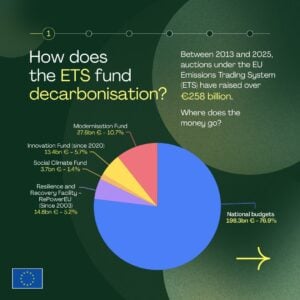
The European Union operates the worldโ€™s most advanced carbon market through its EU Emissions Trading System (EU ETS). The program covers power generation, heavy industry, and aviation within Europe.

EU ETS revenue 2025
Source: EC

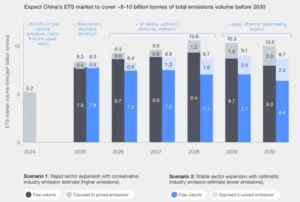
China launched its national ETS in 2021. It is now the largest carbon market in the world based on emissions covered. It primarily targets the power sector, which accounts for about 40% of Chinaโ€™s COโ‚‚ emissions.

The system covers over 5 billion tonnes of COโ‚‚ each year from the power industry alone.ย  Analysts estimate that once the additional sectors are fully included, Chinaโ€™s ETS could cover between 8.7 and 10.6 billion tonnes of COโ‚‚ by the late 2020s, representing a substantial share of the countryโ€™s total emissions.

China ETS market 2030
Source: WEF Asiaโ€™s Carbon Markets Strategic Imperatives for Corporations, 2025.

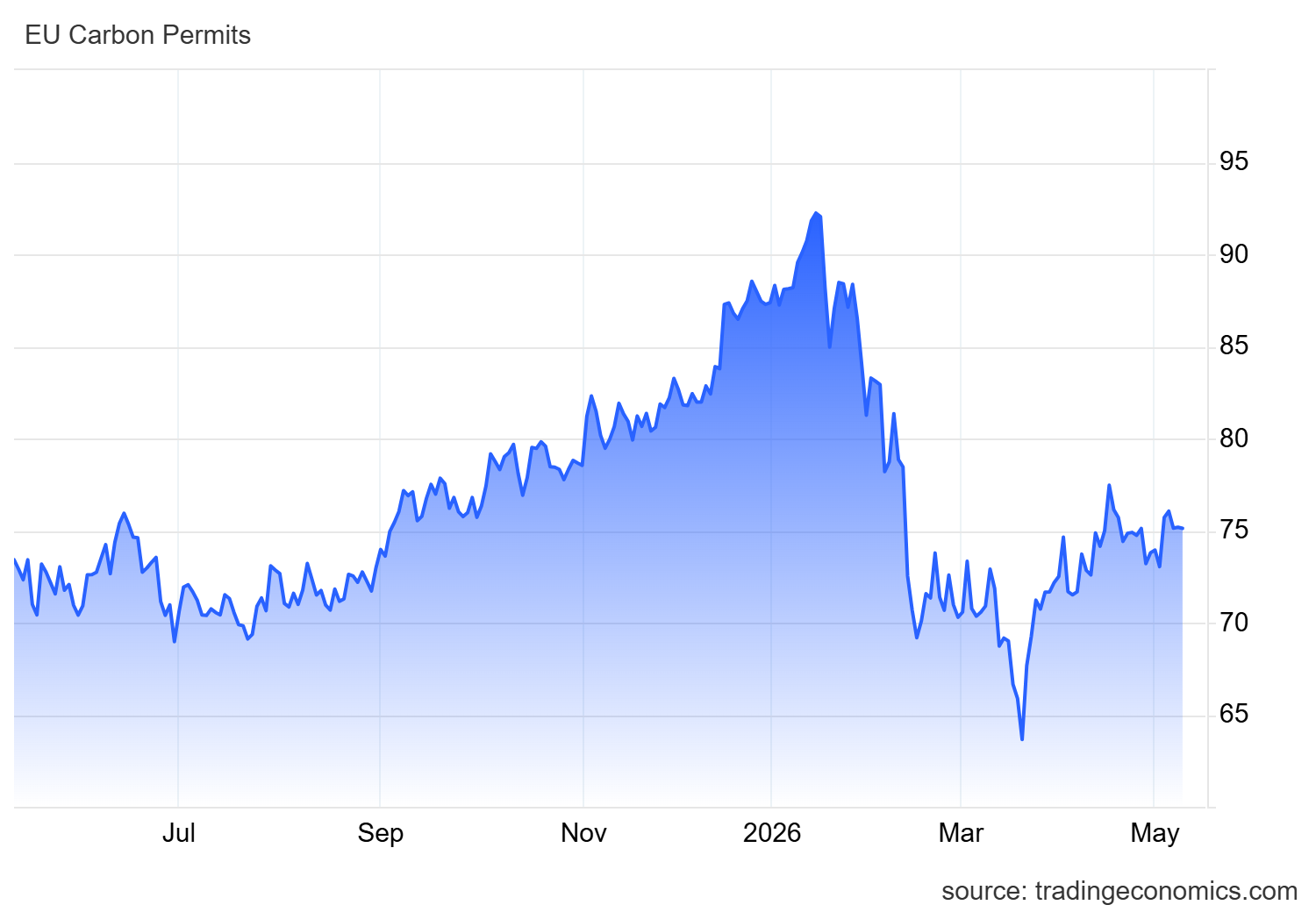
Carbon prices between the two systems remain far apart. In China, prices started at around 48 yuan per ton of COโ‚‚, equal to roughly $7 per ton at launch. European carbon prices have ranged from โ‚ฌ70 to โ‚ฌ90 per ton in recent years. This makes the EU system one of the priciest carbon markets in the world.

Eu carbon price may 11 2026

This large pricing gap is one of the main reasons China and Europe are now seeking closer coordination.

Inside the New Chinaโ€“EU Carbon Alliance

The new carbon alliance between China and the European Union is not designed to merge the two carbon markets. Instead, the partnership focuses on improving compatibility and cooperation between systems.

The initiative centers on:

  • Aligning emissions measurement standards,ย 
  • Improving monitoring, reporting, and verification (MRV) systems,ย 
  • Standardizing carbon accounting rules, and
  • Supporting cross-border carbon market cooperation.

The partnership builds on climate cooperation from the COP30 summit. The countries agreed to better coordinate their carbon pricing systems.

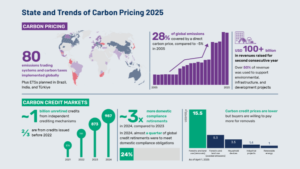
Today, more than 110 carbon pricing instruments operate globally at national and regional levels. However, many of these systems still use different accounting methods, reporting standards, and pricing mechanisms.

carbon pricing 2025 world bank
Source: World Bank Group

The Chinaโ€“EU partnership seeks to close these gaps. It aims to improve how emissions data and carbon credits are recognized across borders. This could eventually influence international carbon credit trading and future climate-linked trade rules.

US Climate Policy Direction Moves on a Different Path

While China and Europe deepen carbon pricing cooperation, the United States is moving in another direction. Recent policy trends show stronger support for fossil fuel production and slower progress toward a nationwide carbon pricing system. Many US states have regional carbon markets, but there is no national carbon pricing framework.

This has created three broad climate policy approaches globally. Europe and China are growing their carbon pricing systems. They are also linking these systems more closely to industrial policy.

The United States remains focused on energy production growth with limited carbon pricing adoption. Many emerging economies are building mixed systems. They combine carbon markets with traditional energy policies.

The divide is becoming increasingly important for global trade. The European Union has launched its Carbon Border Adjustment Mechanism (CBAM). This mechanism adds carbon costs to imported goods, depending on their emissions intensity.

This policy pushes exporting countries to adopt clear emissions reporting and better carbon accounting. They need to do this to stay competitive in global markets.

Carbon Markets Expand, But Global Rules Remain Fragmented

Despite political and regional differences, global carbon markets continue to grow. More than 55 countries now operate some form of carbon pricing system, covering over 28% of global greenhouse gas emissions.

The EU ETS covers about 40% of emissions in the European Union. In contrast, Chinaโ€™s ETS is the largest in terms of total emissions volume.

However, carbon pricing remains highly uneven across regions. Prices range from less than $10 per ton in some systems to more than $80 per ton in others. This creates uncertainty for multinational companies operating across different markets.

Chinaโ€™s ETS provides broad emissions coverage but still operates at relatively low prices compared with Europe. The EU ETS, by contrast, has become a high-price system that sends stronger decarbonization signals to industry.

These differences affect investment decisions, carbon credit trading, and long-term corporate decarbonization planning. Companies with global supply chains now face various carbon pricing systems. Each one has its own rules and compliance needs.

Impact on Carbon Credits and Global Trade Systems

The Chinaโ€“EU carbon alliance could significantly reshape global carbon credit markets over time.

If carbon pricing systems align better, the market may gain stronger trust in international carbon credits. This could lead to better liquidity in compliance markets and lower risks of double-counting emissions reductions.

Improved coordination may also strengthen demand for high-integrity carbon credits that meet stricter reporting standards. At the same time, the expansion of carbon pricing could increase trade complexity if systems are not fully recognized across borders.

Carbon pricing is becoming more closely tied to international trade policy. The EU CBAM adds carbon costs to imported goods. This change reshapes global supply chains and affects production choices.

Will Global Carbon Markets Eventually Align?

The formation of a Chinaโ€“Europe carbon pricing coalition highlights both progress and fragmentation in global climate policy.

Carbon markets are expanding rapidly and becoming a central climate policy tool in many economies. However, major differences remain in pricing levels, enforcement rules, and market structures.

The global carbon economy is changing due to three main trends:

  • More carbon pricing systems in China and Europe.
  • Ongoing fossil fuel policies in the United States.
  • Mixed or developing carbon frameworks in emerging markets.

As these systems evolve, a key question is whether global carbon markets will align or stay divided by region and politics. This fragmentation could significantly impact carbon costs, trade flows, industrial competitiveness, and decarbonization strategies for companies, investors, and policymakers in the next decade.

Boeing Buys 20,000 Tonnes of Permanent Carbon Removal as Aviation Faces Net-Zero Pressure

Boeing has secured 20,000 tonnes of permanent carbon dioxide removal (CDR) through a new agreement with Supercritical. This deal shows a broader shift toward higher-quality carbon credits in the voluntary carbon market (VCM).

The deal focuses on durable carbon removal technologies rather than traditional avoided-emissions offsets. Boeing screened more than 200 projects globally before selecting six suppliers across Brazil, Bolivia, India, and Namibia.

The agreement arrives as pressure grows on high-emission sectors like aviation. They need to cut emissions and boost their climate credibility.

Airlines and aerospace companies are under more scrutiny for using lower-quality offsets. Regulators and investors now prefer permanent carbon removal solutions.

Allison Melia, Vice President of Global Enterprise Sustainability, Boeing, remarked:

“Weโ€™re committed to supporting the responsible growth of our industry, and high-integrity carbon removal is key to cutting net emissions as global air travel demand continues to rise. Our work with Supercritical supports that goal by expanding access to high-quality, diversified, science-vetted carbon removal credits.”

Boeingโ€™s 118-Point Carbon Credit Test Signals New Market Standards

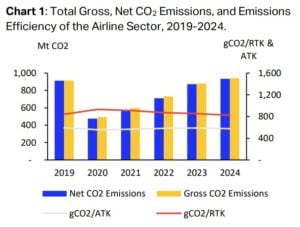
The aviation industry remains one of the hardest sectors to decarbonize. According to the International Energy Agency (IEA), aviation accounts for roughly 2% of global energy-related COโ‚‚ emissions. The chart below shows the sector’s carbon emissions in 2024.

Airline aviation sector ghg emissions 2024 IATA
Source: IATA

Passenger air traffic is still rising. The International Air Transport Association (IATA) predicts that global passenger numbers may top 5 billion each year by the decade’s end. As a result, durable carbon removal is becoming a more important part of long-term net-zero strategies.

Boeing applied a detailed 118-point evaluation framework to assess carbon removal projects. The process reviewed several factors, including:

  • permanence of carbon storage,ย 
  • additionality,ย 
  • measurement and verification,ย 
  • operational readiness, and
  • delivery risk.ย 

This reflects a major change in how large corporations buy carbon credits. Companies are now prioritizing scientific quality and long-term climate impact. They focus less on just price or availability.

Michelle You, CEO of Supercritical, said the market is moving toward โ€œcriteria-firstโ€ procurement. This means buyers define strict quality requirements before selecting projects.

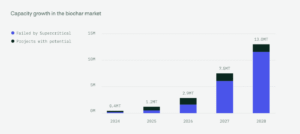
The tighter standards come as demand for durable carbon removal rises rapidly. Supercritical estimates that about 89% of the premium biochar supply for 2025 is already sold. The company’s data projects global biochar capacity rising from about 0.43 million metric tonnes in 2024 to 2.86 million metric tonnes by 2026.

However, a large share of this supply does not meet strict quality requirements. Around 58% of the projected 2026 capacity is expected to fail Supercriticalโ€™s vetting criteria, with the rejection rate rising to about 88% by 2028.

biochar capacity growth
Source: Supercritical

This growing competition for high-quality credits is reshaping the VCM. According to CDR.fyi, companies bought almost 30 million tonnes of carbon removal credits in 2025. This is more than three times the amount from 2024.

Biochar and Enhanced Weathering Gain Momentumย 

Boeingโ€™s portfolio combines two durable carbon removal technologies:

  • biochar and enhanced rock weathering (ERW).ย 

Biochar is produced by heating agricultural or forestry waste in low-oxygen conditions. The process locks carbon into a stable material that can remain stored in soil for hundreds or even thousands of years.

Enhanced weathering accelerates a natural geological process by spreading crushed basalt rock on farmland. As the rock reacts with rainwater and atmospheric COโ‚‚, carbon is permanently stored in stable mineral forms.

Scientists see both technologies as key climate tools. They can store carbon much longer than many traditional forestry offsets.

Research in ScienceDirect shows that using dunite rock for enhanced weathering can remove 1.06 to 3.48 tonnes of COโ‚‚ per hectare in sandy soils. Other studies suggest that biochar can store carbon for more than 1,000 years, depending on soil conditions.

The Intergovernmental Panel on Climate Change (IPCC) estimates that by mid-century, carbon removal technologies must take out billions of tonnes of COโ‚‚ each year. This is crucial to meet global climate goals.

Industry forecasts also show strong market growth ahead. BloombergNEF predicts that the global carbon removal market might grow into a multi-billion-dollar industry in the next decade. This growth is driven by the rise in net-zero commitments.

Boeing Spreads Carbon Removal Bets Across Global Projects

Boeing selected projects across many regions to reduce operational and delivery risks.

  • In Bolivia, Exomad Green currently removes about 260,000 tonnes of COโ‚‚ annually. The company plans to expand capacity to 1 million tonnes by 2027 through additional facilities.
  • In India, Ground Up and Varaha work with smallholder farmers to convert agricultural residues into biochar instead of burning crop waste.
  • Brazil hosts projects from NetZero and InPlanet, both focused on scaling carbon removal through agriculture.
  • Meanwhile, Planboo uses invasive bush species in Namibia to make biochar; this also helps restore degraded savannah ecosystems.

The geographic diversification is important because carbon removal markets still face major supply challenges. Industry data shows many projects fail to scale on time due to financing, permitting, or operational delays.

Earlier this year, many biochar suppliers provided fewer removal credits than expected. This shows that supply issues in the market are still a problem.

Airlines Face Growing Pressure to Clean Up Hard-to-Cut Emissions

Boeing plans to use the carbon removal credits for residual Scope 3 emissions linked to business travel. These emissions remain difficult to cut through operational improvements alone.

The broader aviation sector faces major decarbonization challenges. Aircraft mainly use jet fuel. Low-carbon options like sustainable aviation fuel (SAF) are still rare and costly.

The IEA estimates that SAF accounted for less than 1% of global aviation fuel supply in 2025. Meanwhile, global air travel demand continues to rise steadily. This creates growing pressure on airlines, plane manufacturers, and aerospace suppliers to invest in complementary climate solutions such as carbon removal.

Boeingโ€™s Net-Zero and Sustainability Commitments Intensify

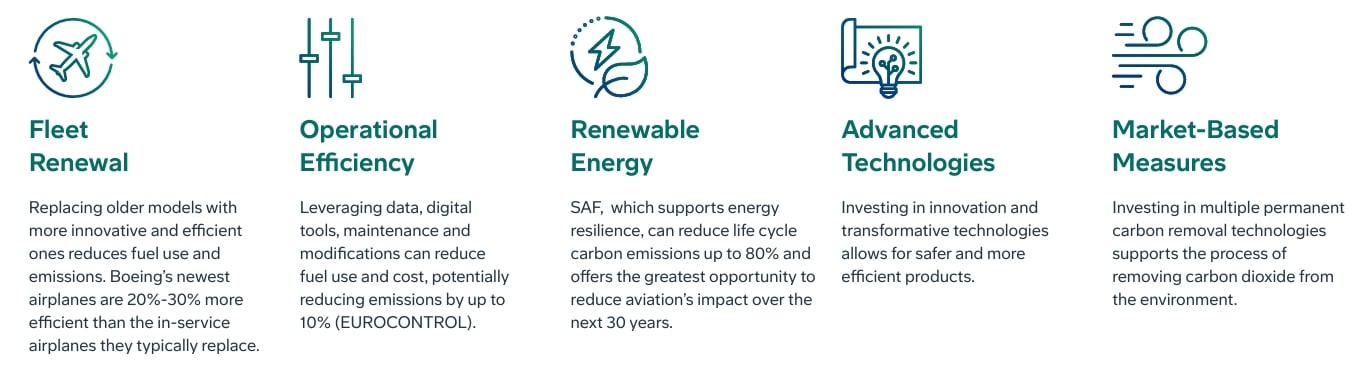
Boeing has increased its climate-related initiatives in recent years. The company backs the aviation industry’s aim for net-zero carbon emissions by 2050. It has invested in sustainable aviation fuel, improved operational efficiency, and advanced aircraft technologies.

BOEING Carbon removal SAF
Source: Boeing

The company signed a deal with Carbonfuture. They will buy at least 40,000 tonnes of durable carbon removal credits.

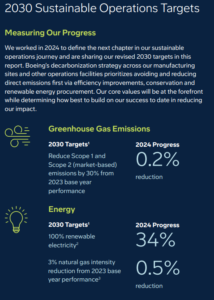
In its latest sustainability reporting, Boeing said it has reduced Scope 1 and Scope 2 emissions by around 31% compared to its 2017 baseline. It also reports that it now sources about 100% renewable electricity for its global operations through direct procurement and certificates.

A key pillar of its strategy is SAF adoption. Boeing aims to ensure all commercial aircraft are compatible with 100% SAF capability by 2030. According to the IATA, SAF can reduce lifecycle emissions by up to 80% compared to conventional jet fuel.

Boeing emissions targets 2030
Source: Boeing

The company also highlights aircraft efficiency gains, with newer models delivering around 15โ€“25% lower fuel burn and COโ‚‚ emissions compared to previous generations. It is also increasing its focus on Scope 3 emissions, which include supply chain and aircraft use. These represent the majority of its total emissions footprint.

Alongside these efforts, Boeing is expanding the use of high-quality carbon removal credits to address residual emissions that cannot yet be eliminated through technology or fuel switching.

Across the industry, major airlines and technology companies are also increasing carbon removal purchases. Microsoft is the biggest buyer worldwide. It has made most of the durable carbon removal purchases in recent years.

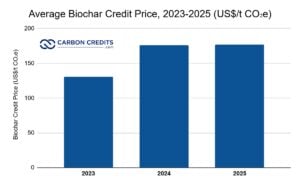
Prices for durable carbon removal credits also remain significantly higher than traditional carbon offsets. Premium biochar credits can go over $150 per tonne.

average biochar credit price

In contrast, direct air capture credits usually cost several hundred dollars per tonne. Still, many companies will pay more for trustworthy climate claims and less risk to their reputation.

A Turning Point for Carbon Market Quality

Boeingโ€™s agreement with Supercritical reflects a broader evolution in voluntary carbon markets. Large corporations are shifting from cheap offsets to carbon removal projects. These projects are scientifically verified and offer long-term durability.

As demand for high-quality carbon removal accelerates, companies with access to reliable, scalable, and scientifically verified projects may become increasingly valuable players in the global net-zero economy.

Boom-Bust-Bounce: Understanding Nickelโ€™s Latest Price Cycle

Nickelโ€™s latest price cycle is more than just a story of volatility. It shows how fast sentiment can flip in a market now shaped by policy, supply control, and long-term energy transition demand. The sharp move from a deep slump in late 2025 to a strong rebound in early 2026 has forced investors to rethink how they value nickel assets.

Letโ€™s take a ride through nickelโ€™s roller coaster journey.

Nickel Price Crash to Recovery: What Triggered the 2025โ€“2026 Market Swing?

The downturn began with oversupply. By late 2025, nickel prices had dropped to around $14,000โ€“$15,000 per tonne. A surge in production from Indonesia flooded the market and pushed prices lower. According to Reuters, prices touched near $14,235 per tonne during this phase. Producers struggled, margins shrank, and sentiment turned weak.

Then came the reversal.

Indonesiaโ€™s Supply Moves Drive Nickel Price Rebound

In early 2026, Indonesia changed the game. The country tightened mining quotas, slowed permits, and signaled more control over supply. Since Indonesia accounts for more than half of global nickel output, even small policy shifts had a big impact.

Global nickel prices advanced by 0.30% today (Aug 15, 2026), reaching $16,772.94 per ton, with Chinese markets trading at ยฅ113,103 per ton. This upward momentum is primarily driven by supply-side constraints in Indonesia, specifically tightened RKAB mining quotas and ongoing smelting production cuts. Although high exchange inventories present a macroeconomic headwind, these strict Indonesian policy controls continue to provide critical fundamental support, effectively anchoring the base metal's valuation against broader market pressures.

Here’s a complete one-year presentation of the nickel price cycle:

Nickel Spot Price

Unit: USD/Tonne
---
---
Loading Chart...

This sharp move from bust to bounce highlights a key shift. Nickel is no longer just driven by demand. It is now heavily influenced by policyโ€”especially from Indonesia.

Nickelโ€™s Two Stories: Industrial Metal vs EV Battery Metal

This boom-bust-bounce cycle also reveals something deeper. Nickel now lives a โ€œdual life.โ€

In the short term, it behaves like a traditional industrial metal. Most nickel still goes into stainless steel, so prices depend on construction activity, manufacturing, and Chinaโ€™s economy. When industrial demand slows, nickel prices fall quickly.

But in the long term, nickel is becoming a critical battery metal. It is a key input for EV batteries, especially high-purity Class 1 nickel used in NCM (nickel-cobalt-manganese) cathodes. This is where the real growth story lies.

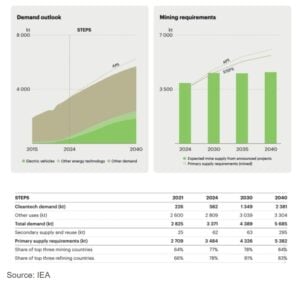
According to forecasts from the International Energy Agency, global EV sales could cross 20 million units annually in the coming years. As a result, nickel demand could double by 2030. Itย creates a strong long-term tailwind.

nickel demand

But there is a problemโ€”supply is struggling to keep up.

Nickel Supply Challenges: Indonesia Dominance and ESG Pressures

Even though Indonesia dominates more than 50% of global nickel production, not all of it is suitable for batteries. Producing battery-grade nickel requires complex processing, especially through HPAL (High Pressure Acid Leach) technology.

And this is where bottlenecks appear.

HPAL projects are expensive, difficult to scale, and often face environmental concerns. At the same time, Western mining companies are dealing with strict ESG regulations, rising costs, and long permitting timelines. These challenges are slowing new supply growth outside Indonesia.

So, while the market may look oversupplied today, the long-term picture is less certain. If demand keeps rising and supply struggles to scale, the market could tighten quickly.

Why Nickel Projects Are Slowing Despite Strong Demand Outlook

This uncertainty explains why many nickel projects are not moving forward. Companies are cautious. Prices are still volatile, and committing billions of dollars in such an environment is risky. As per analysts, this is why several producers have delayed or scaled back projects due to cost pressures and unclear price signals.

Instead of rushing into production, many companies are focusing on de-risking their assets. They are improving project economics, advancing studies, and waiting for better market conditions.

At the same time, investors are changing their approach.

Exploration Assets Become โ€œLong Optionโ€ Plays in Nickel Market

Rather than focusing on near-term production, investors are now looking at exploration-stage assets as long-term opportunities. These assets are being treated as โ€œoptionalityโ€ plays.

The idea is simple. Investors enter early, when valuations are low and sentiment is weak, and wait for a stronger price cycle. This is exactly where Alaska Energy Metals fits in.

Alaska Energy Metalsโ€™ Nikolai Project Stands Out

AEMCโ€™s Nikolai project is not designed for todayโ€™s market. It is built for the future.

The project offers two key advantages: location and scale. Located in Alaska, it benefits from strong infrastructure potential, including access to roads, ports, and possible hydro power. This is a major advantage compared to remote or politically risky regions.

At the same time, Nikolai hosts a multi-billion-pound nickel resource. This scale matters. In a future supply-constrained market, large deposits become highly valuable.

The company is also advancing toward a Preliminary Economic Assessment (PEA), which will help define the projectโ€™s economics and development pathway.

Nikolaiโ€™s Economics: Built for Higher Nickel Prices

What makes Nikolai particularly interesting is how it performs under different price scenarios. Notably, at a more conservative long-term price of $18,000-$20,000 per tonne, the economics start to look strong. The project benefits from:

  • Low strip ratios
  • Large-scale resource base
  • Additional value from byproducts like copper, cobalt, and platinum group elements (PGEs)
nickel eureka
Source: AEMC

These factors improve overall project returns and reduce risk over time. And if prices move higher, the upside becomes even more significant.

Nickel Price Outlook: Can Prices Reach $25,000?

Some market forecasts suggest that nickel could enter a deficit later this decade. If that happens, prices could rise well above current levels.

Recently, Oregon Group projected that nickel prices could climb as high as $25,000 per tonne if supply tightens in the coming years. However, for now, a more realistic and stable price range is likely to stay between $20,000 and $22,000 per tonne.

This is where the โ€œlong optionsโ€ strategy becomes clear.

AEMC is not betting everything on todayโ€™s market. Instead, it is positioning itself for a future where:

  • EV demand continues to grow
  • Supply remains constrained
  • Prices move into a stronger range

Investors entering at current valuations are essentially buying exposure to that future upside.

Final Take: Volatility Today, Opportunity Tomorrow

Nickelโ€™s boom-bust-bounce cycle has exposed how fragile and fast-moving the market can be. Prices fell sharply due to oversupply, then rebounded just as quickly when Indonesia tightened control.

But beneath this volatility lies a bigger shift.

Nickel is transitioning from a traditional industrial metal to a strategic resource for the energy transition. In the short term, it will continue to react to economic cycles. In the long term, it is driven by EV demand and supply constraints.

For Alaska Energy Metals, this shift creates a clear opportunity. The company is not chasing short-term gains. It is building a large, scalable asset that can deliver value in a tighter future market.

If nickel does move into a deficit and prices rise toward $20,000โ€“$25,000, projects like Nikolai could become highly valuable.

In that sense, todayโ€™s uncertainty may actually be the best entry point. Because in the nickel market, the biggest rewards often come to those who position earlyโ€”and wait.

DISCLAIMERย 

New Era Publishing Inc. and/or CarbonCredits.com (โ€œWeโ€ or โ€œUsโ€) are not securities dealers or brokers, investment advisers, or financial advisers, and you should not rely on the information herein as investment advice. Alaska Energy Metals. (โ€œCompanyโ€) made a one-time payment of $90,000 to provide marketing services for a term of three months. None of the owners, members, directors, or employees of New Era Publishing Inc. and/or CarbonCredits.com currently hold, or have any beneficial ownership in, any shares, stocks, or options of the companies mentioned.

This article is informational only and is solely for use by prospective investors in determining whether to seek additional information. It does not constitute an offer to sell or a solicitation of an offer to buy any securities. Examples that we provide of share price increases pertaining to a particular issuer from one referenced date to another represent arbitrarily chosen time periods and are no indication whatsoever of future stock prices for that issuer and are of no predictive value.

Our stock profiles are intended to highlight certain companies for your further investigation; they are not stock recommendations or an offer or sale of the referenced securities. The securities issued by the companies we profile should be considered high-risk; if you do invest despite these warnings, you may lose your entire investment. Please do your own research before investing, including reviewing the companiesโ€™ SEDAR+ and SEC filings, press releases, and risk disclosures.

It is our policy that information contained in this profile was provided by the company, extracted from SEDAR+ and SEC filings, company websites, and other publicly available sources. We believe the sources and information are accurate and reliable but we cannot guarantee them.

CAUTIONARY STATEMENT AND FORWARD-LOOKING INFORMATION

Certain statements contained in this news release may constitute โ€œforward-looking informationโ€ within the meaning of applicable securities laws. Forward-looking information generally can be identified by words such as โ€œanticipate,โ€ โ€œexpect,โ€ โ€œestimate,โ€ โ€œforecast,โ€ โ€œplan,โ€ and similar expressions suggesting future outcomes or events. Forward-looking information is based on current expectations of management; however, it is subject to known and unknown risks, uncertainties, and other factors that may cause actual results to differ materially from those anticipated.

These factors include, without limitation, statements relating to the Companyโ€™s exploration and development plans, the potential of its mineral projects, financing activities, regulatory approvals, market conditions, and future objectives. Forward-looking information involves numerous risks and uncertainties and actual results might differ materially from results suggested in any forward-looking information. These risks and uncertainties include, among other things, market volatility, the state of financial markets for the Companyโ€™s securities, fluctuations in commodity prices, operational challenges, and changes in business plans.

Forward-looking information is based on several key expectations and assumptions, including, without limitation, that the Company will continue with its stated business objectives and will be able to raise additional capital as required. Although management of the Company has attempted to identify important factors that could cause actual results to differ materially, there may be other factors that cause results not to be as anticipated, estimated, or intended.

There can be no assurance that such forward-looking information will prove to be accurate, as actual results and future events could differ materially. Accordingly, readers should not place undue reliance on forward-looking information. Additional information about risks and uncertainties is contained in the Companyโ€™s managementโ€™s discussion and analysis and annual information form for the year ended December 31, 2025, copies of which are available on SEDAR+ atย www.sedarplus.ca.

The forward-looking information contained herein is expressly qualified in its entirety by this cautionary statement. Forward-looking information reflects managementโ€™s current beliefs and is based on information currently available to the Company. The forward-looking information is made as of the date of this news release, and the Company assumes no obligation to update or revise such information to reflect new events or circumstances except as may be required by applicable law.


Disclosure: Owners, members, directors, and employees of carboncredits.com have/may have stock or option positions in any of the companies mentioned: None.

Carboncredits.com receives compensation for this publication and has a business relationship with any company whose stock(s) is/are mentioned in this article.

Additional disclosure: This communication serves the sole purpose of adding value to the research process and is for information only. Please do your own due diligence. Every investment in securities mentioned in publications of carboncredits.com involves risks that could lead to a total loss of the invested capital.

Please read our Full RISKS and DISCLOSURE here.

NVIDIAโ€™s Next Frontier: $2.1 Billion Deal With IREN Redefines AI Data Center Economics

NVIDIA has entered a strategic partnership with IREN Limited worth up to $2.1 billion, deepening its push into the fast-growing artificial intelligence (AI) infrastructure market.

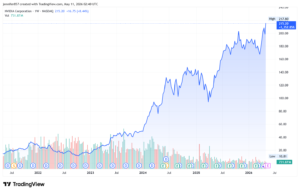
The deal gives NVIDIA the option to purchase up to 30 million IREN shares over five years at $70 per share. Investors reacted positively to the announcement, sending IREN shares up more than 20%. The same goes for NVIDIA’s stock, which almost hit its highest record price on April 27 at $216.61.

Nvidia NVDA stock price

The partnership centers on building large-scale AI infrastructure powered by high-performance GPUs and backed by massive electricity capacity. It also reflects a larger trend reshaping global energy markets: AI is driving an unprecedented surge in electricity demand from data centers.

Jensen Huang, founder and CEO of NVIDIA, remarked:

โ€œDeploying these systems [AI factories] at scale requires deep integration across the full stack โ€” compute, networking, software, power and operations. IREN brings the scale and infrastructure expertise to help accelerate the buildout of next-generation AI infrastructure globally. Together, we are building for the age of AI.โ€

NVIDIA Expands Beyond Chips Into AI Infrastructure

NVIDIA has become the dominant supplier of AI chips used in generative AI systems, cloud computing, and advanced data centers. The companyโ€™s GPUs power many of the worldโ€™s largest AI platforms, including models developed by OpenAI, Microsoft, Meta, and Google.

But NVIDIA is moving beyond just selling hardware. It’s now placing itself deeper in the AI infrastructure ecosystem. The company has pursued several similar infrastructure partnerships as AI power demand accelerates globally.

The tech giant strengthened its ties with CoreWeave by investing in 5 GW of AI โ€œfactoryโ€ capacity by 2030. It also teamed up with Oracle and the U.S. Department of Energy to create one of Americaโ€™s largest AI supercomputers, using 100,000 NVIDIA Blackwell GPUs.

NVIDIA has also partnered with AI firms like Nscale, Microsoft, and OpenAI. They focus on large data center projects in the U.K., Europe, and North America. These deals show a bigger plan to secure long-term computing and power resources. AI workloads are growing fast around the world.

The partnership with IREN aims to deploy NVIDIAโ€™s DSX AI factory setup in IRENโ€™s global data center network. This network has the potential for up to 5 gigawatts (GW) of infrastructure capacity.

A key part of the project will take place at IREN’s Sweetwater campus in Texas. This 2 GW site is set to be one of the biggest AI-focused data center hubs in the U.S.

AIโ€™s Electricity Demand Is Rising at an Extraordinary Pace

The deal comes as AI systems rapidly increase global electricity consumption. According to the International Energy Agency (IEA), global data centers consumed about 415 terawatt-hours (TWh) of electricity in 2024. That is roughly equal to the annual electricity demand of countries such as Japan.

The IEA expects global data center electricity use to more than double by 2030, reaching around 945 TWh. AI workloads are becoming a major driver of this growth. The agency estimates electricity demand from AI-focused servers could rise by about 30% annually through the end of the decade.

Research from Lawrence Berkeley National Laboratory shows that U.S. data center electricity demand might grow. It could increase from 176 TWh in 2023 to 580 TWh by 2028 in high-growth scenarios.

Generative AI systems consume significantly more electricity than traditional internet services. Analysts say one AI-generated query uses about 10 times more electricity than a typical web search. This is due to the high computing power needed for large language models.

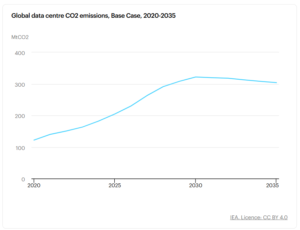
COโ‚‚ emissions from electricity used by data centers are expected to peak at around 320 million tonnes (Mt COโ‚‚) by 2030, per the IEA Report. Emissions are then projected to decline slightly to about 300 Mt COโ‚‚ by 2035.

data center emissions IEA
Source: IEA

Despite fast growth in AI and digital demand, data centers are still expected to remain a small part of the global energy system. Their electricity use is projected to rise from around 1% of global demand today to about 3% by 2030. Even at that level, they would account for less than 1% of total global COโ‚‚ emissions.

Power Capacity Is Becoming the New Competitive Advantage

As AI infrastructure expands, access to reliable electricity is becoming one of the sectorโ€™s most important strategic assets. IRENโ€™s value largely comes from its access to large amounts of grid-connected power in regions with abundant renewable energy resources. The company operates across North America, Europe, and the Asia-Pacific.

Originally a bitcoin mining company, IREN has quickly moved to AI cloud infrastructure. This shift responds to the growing demand for high-performance computing.

The company has signed a $9.7 billion deal with Microsoft. This deal is for multi-year GPU cloud services that use NVIDIA GB300 systems. The agreement requires a 20% prepayment. It could bring in about $1.94 billion in annual revenue when fully operational.

IREN has also expanded into Europe through the acquisition of Spain-based data center developer Nostrum Group. The deal added about 490 megawatts (MW) of secured grid-connected power capacity and increased IRENโ€™s total power portfolio to roughly 5 GW.

Industry analysts increasingly view power access as a major competitive moat in AI infrastructure. Building advanced AI data centers now relies on more than just chip availability. It also requires securing electricity, cooling systems, land, and transmission capacity.

AI and Clean Energy Are Becoming Closely Linked

The rapid expansion of AI infrastructure is also reshaping clean energy markets. Large technology companies are signing long-term power agreements for renewable electricity to support growing AI operations and meet climate goals.

Companies including Microsoft, Google, Amazon, and Meta are investing heavily in solar, wind, battery storage, and nuclear energy projects.

BloombergNEF reports that global investment in the energy transition topped $2 trillion in 2024. This surge was fueled by rising electricity demand from AI and electrification trends.

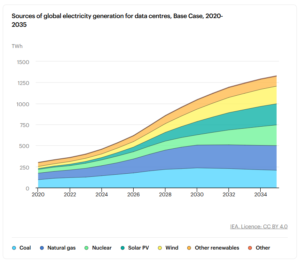
Data centers are now big buyers of renewable electricity as operators feel pressure to cut emissions and ensure stable energy supplies. Renewables supply around 27% of the electricity for data centers globally, as the IEA reports. Wind and solar are set to meet almost half of the future demand growth by 2030.

data center power sources, renewables, iea
Source: IEA

IRENโ€™s infrastructure strategy focuses heavily on renewable-rich regions with lower power costs and cleaner electricity grids. This positioning could grow more valuable as governments tighten emissions reporting and sustainability rules for digital infrastructure.

NVIDIA has also increased its focus on energy efficiency. Its latest AI systems aim to deliver higher computing performance while lowering energy use per workload. The company claims its Blackwell platform cuts electricity use more than older AI systems.

Trillions in AI Infrastructure Spending Are Coming

The NVIDIA-IREN partnership is part of a much broader wave of AI infrastructure investment. Major technology companies are expected to spend hundreds of billions of dollars this decade on AI-related infrastructure, including:

  • advanced semiconductors,
  • hyperscale data centers,
  • transmission infrastructure,
  • cooling systems,
  • battery storage, and
  • renewable power generation.

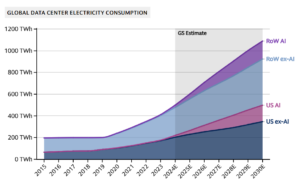
According to Goldman Sachs, global power demand from data centers could increase by as much as 165% by 2030 due to AI growth.

global data center electricity use 2030 goldman
Source: Goldman Sachs

McKinsey estimates that global demand for AI-ready data center capacity could require more than $6 trillion in infrastructure investment worldwide by 2030. This surge is creating opportunities for companies with access to electricity, land, and digital infrastructure assets.

The New Converging Supercycle

NVIDIAโ€™s potential $2.1 billion investment in IREN highlights how AI growth is transforming both the technology and energy sectors.

As AI systems become more powerful, the industryโ€™s biggest challenge may no longer be chips alone. Reliable electricity supply is quickly emerging as one of the most critical factors in scaling AI infrastructure globally.

The partnership also shows how clean energy, data centers, and AI infrastructure are becoming increasingly interconnected. Companies that can combine computing power with scalable, lower-carbon electricity may be best positioned to benefit from the next phase of the AI economy.

Microsoft May Shelve 2030 Clean Energy Target Amid AI Power Consumption Growth

Microsoft is reportedly reconsidering parts of its 2030 clean energy strategy, including its ambitious goal to match 100% of its electricity use with carbon-free energy on an hourly basis, Bloomberg reports.

The review arrives as AI infrastructure grows quickly. This surge is pushing electricity demand well past earlier forecasts.

Data Centers Become the New Power Giants

The companyโ€™s flagship commitment, known as the โ€œ100/100/0โ€ goal, was announced in 2021. It aims to cover 100% of electricity use, 100% of the time, with zero-carbon energy bought from the same regional grids where the power is consumed. This is much stricter than annual matching, which allows renewable energy credits to balance energy use over a year, not just by the hour.

Microsoft has met its annual goal of matching 100% of its electricity use with renewable energy. This was mainly achieved through long-term power purchase agreements (PPAs). However, hourly matching requires far deeper coordination between real-time electricity demand and carbon-free supply.

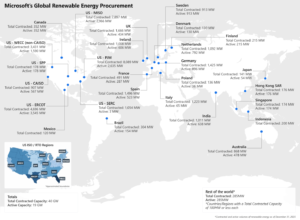
Microsoft clean energy potfolio
Source: Microsoft

As AI workloads scale, this balance is becoming more difficult to maintain.

Global electricity demand from data centers is rising sharply, and AI is now the main driver of that growth. The International Energy Agency (IEA) predicts that global data center electricity use will hit about 945 terawatt-hours (TWh) by 2030. This is almost double the current levels. This would represent close to 3% of total global electricity demand.

Within that growth, AI is the fastest-expanding segment. The IEA predicts that electricity demand from AI-optimized data centers will rise over four times by 2030. This surge is fueled by extensive model training and inference tasks.

data center electricity demand due AI 2030
Source: IEA

In the U.S., electricity use by data centers will rise by about 240 TWh by 2030. This is over a 130% increase from 2024 levels, based on industry analysis.

The IEA notes that data centers might make up over 20% of electricity demand growth in advanced economies by 2030. This means they could become a key source of power demand in todayโ€™s grids.

This structural shift is now directly impacting corporate clean energy strategies, especially for hyperscale technology firms.

The Hidden Gap Between Green Energy and AI Growth

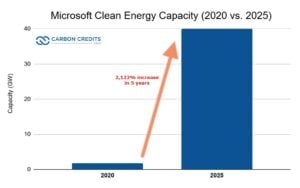
Microsoft has built one of the largest corporate clean energy procurement portfolios in the world. The company has locked in over 40 gigawatts (GW) of renewable energy capacity. This spans 26 countries and includes more than 400 power purchase agreements (PPAs).

Microsoft Clean Energy Capacity (2020 vs. 2025)

This includes partnerships with key developers. One example is a 10.5 GW agreement with Brookfield Renewable. This deal aims to speed up the renewable energy rollout while also giving multi-year demand signals for new projects.

Microsoft partners with over 20 energy firms. Each manages at least five renewable projects linked to its procurement pipeline. Several partners now have over 1 GW of contracted capacity each, linked to Microsoft demand. These investments help Microsoft reach its climate goals, including its promise to be carbon negative by 2030.

SEE MORE:

However, the companyโ€™s electricity demand is rising quickly due to AI infrastructure expansion. Large AI model training needs big computing clusters. These clusters run all the time and use much more energy than regular cloud tasks.

This creates a growing gap between clean energy procurement and real-time electricity usage.

Big Tech Faces a Structural Clean Energy Bottleneck

Microsoftโ€™s challenge is not isolated. It reflects a broader structural issue across the technology sector. Despite strong renewable energy procurement activity, overall corporate clean power contracting has slowed.

BloombergNEF reports that corporate buyers signed contracts for about 55.9 GW of clean power in 2025. This is a 10% drop from last year. It’s the first big slowdown in nearly ten years.

However, large technology companies remain dominant buyers. Amazon, Microsoft, Google, and Meta together accounted for about 49% of global corporate clean energy PPA volumes in 2025. This concentration highlights how heavily AI-driven firms now influence renewable energy markets. The chart below shows these tech giants’ planned data center growth in MW.

big tech AI data center planned growth 2030

Another shift is also emerging. These companies are looking more into nuclear energy contracts. Recently, these contracts made up about 23% of Amazon and Metaโ€™s clean energy purchases.

This shows a rising need for baseload clean power. It offers a steady electricity supply, no matter the weather, which is crucial for AI data centers.

Policy Changes and Energy Accounting Rules Add Pressure

Regulatory and accounting frameworks are also evolving, increasing pressure on corporate clean energy strategies. The Greenhouse Gas (GHG) Protocol is the main global standard for tracking corporate emissions. It is now updating its Scope 2 emissions method.

Proposed changes could require companies to move toward:

  • Hourly matching of electricity consumption and clean energy supply,ย 
  • More localized energy procurement rules, and
  • Stricter tracking of grid emissions data.

If implemented, these changes would make Microsoftโ€™s hourly matching target more aligned with future reporting standards, but also significantly more difficult to achieve at scale. At the same time, policy uncertainty in major markets is affecting clean energy investment.

In the United States, corporate power purchase agreements (PPAs) hit a record 29.5 GW. However, the number of unique buyers dropped sharply to only 33 companies. This change shows tighter market conditions and uncertainty about tax credits and energy incentives.

From Annual Matching to Hourly Reality

The clean energy market is also shifting toward more reliable power structures. Developers are increasingly offering:

  • Hybrid solar and wind systems,ย 
  • Co-located storage projects,ย 
  • Long-term nuclear PPAs, and
  • Firm power contracts designed for 24/7 supply.ย 

This trend is driven by the needs of AI data centers, which require constant electricity rather than intermittent supply. The IEA has warned that grid flexibility and firm clean power will become critical to managing rising electricity demand from digital infrastructure.

For hyperscale companies, this means a renewable energy strategy is no longer just about volume. It is now about timing, location, and reliability.

AI Is Redefining Corporate Climate Targets

Microsoftโ€™s potential reassessment of its 2030 hourly clean energy goal highlights a wider shift in the global energy system. AI-driven electricity demand is growing faster than most long-term forecasts made just a few years ago.

At the same time, clean energy procurement is becoming more complex due to grid constraints, regulatory changes, and the need for continuous power supply.

Microsoft remains committed to its carbon-negative by 2030 goal. However, its situation illustrates a broader reality for the tech sector: clean energy targets are now colliding with the physical limits of electricity systems.

As AI continues to expand, the central challenge is no longer just sourcing renewable energy. It is matching clean electricity to real-time demand on a global scale. This tension is now shaping the next phase of corporate climate strategy across the worldโ€™s largest technology companies.
Lithium Price Surges 245% as China and Zimbabwe Supply Cuts Tighten Market

Disseminated on behalf of Surge Battery Metals

The lithium market is shifting again. After a period of oversupply and price weakness, new disruptions are tightening supply in real time.

Two developments are driving this change: regulatory action in China and export restrictions in Zimbabwe. Together, they are bringing the lithium deficit narrative back into focus and reshaping how supply risk is assessed.

A New Supply Shock Emerges

In early 2026, Zimbabwe, Africaโ€™s top lithium producer, suspended exports of lithium concentrates and other unprocessed minerals. The government cited malpractices and revenue leakages as the reason for the halt.

Now, exports are set to resume under tighter controls. According to Reuters, Zimbabwe will introduce export quotas and require mining companies to commit to local processing investments.

Key measures include:

  • Export quotas assigned to individual producers
  • A continued 10% export tax on lithium concentrates
  • A requirement to build local processing capacity before January 2027, when a full ban on concentrate exports is expected

Zimbabwe is a major player in the global supply chain. In 2025, the country sent 1.128 million metric tons of lithium-bearing spodumene concentrate to China. This made up about 15% of Chinaโ€™s imports.

Any disruption at that scale has an immediate global impact.

China Tightening Adds Pressure

At the same time, China is tightening its control over domestic lithium production. Industry reports from S&P Global Commodity Insights and Fastmarkets show that permit reviews and stricter environmental rules have impacted some operations. This is especially true for smaller or higher-cost mines.

China dominates global lithium processing and refining. When domestic supply slows or becomes less predictable, it affects the entire supply chain. This includes chemical conversion capacity, which is critical for producing battery-grade lithium.

China dominance lithium supply chain

Together, these developments are creating a short-term tightening effect in the market. Supply is becoming less flexible just as demand continues to grow.

Small Disruptions, Big Price Impacts

Lithium markets are highly sensitive to supply changes. Even small disruptions can affect pricing and availability.

The current situation highlights several key dynamics:

  • Supply is still concentrated in a few regions
  • Policy decisions can quickly impact global availability
  • Processing capacity is as important as raw material supply

Zimbabweโ€™s push for local processing reflects a broader trend. Resource-rich countries are seeking more value from their minerals instead of exporting raw materials. While this may support long-term development, it can reduce short-term supply to global markets.

At the same time, Chinaโ€™s role as the dominant processor means that changes within its domestic system ripple outward. This combination of upstream and downstream pressure is what makes the current situation notable.

From Glut to Squeeze in Just One Year

Just a year ago, lithium prices were under pressure. The market saw oversupply, driven by strong production growth and slower-than-expected EV demand in some regions.

Lithium prices fell to $8,259 per tonne in June 2025, before reaching $28,528 per tonne on May 8, 2026, representing a 245% increase in under a year.

Lithium price chart as at May 08, 2026
Source: BLoomberg, CarbonCredits.com

Now, supply-side disruptions are shifting sentiment again. While the market is not yet in a severe deficit, the balance is tightening.

This shift reinforces a key point: lithium markets can move swiftly. Oversupply can quickly lead to tighter conditions, especially with policy and geopolitics at play.

Lithium Becomes a Strategic Battleground

The current supply story is not just about mining. It is about geopolitics and control over critical materials.

Zimbabweโ€™s lithium sector is heavily influenced by Chinese companies, including major operators that dominate production and processing investments.ย 

One of the biggest players is Zhejiang Huayou Cobalt, which operates the Arcadia lithium project and runs both mining and processing facilities. Sinomine Resource Group is another major operator, managing the Bikita lithium mine and expanding processing capacity.ย 

Chengxin Lithium Group is also active in mining and processing, while Yahua (Sichuan Yahua Industrial Group) is building lithium sulfate plants in the country. Even Tsingshan Holding Group has invested in Zimbabweโ€™s lithium projects. Together, these companies dominate the industry and shape how the countryโ€™s lithium resources are developed.

This creates a concentrated supply chain, where decisions in one country can affect availability in another. For governments and industry players, this raises concerns about the security of supply.

As a result, there is an increasing focus on diversification and domestic sourcing. Countries want to rely less on single regions or supply chains. This is especially true for materials needed for energy transition and tech infrastructure.

U.S. Domestic Projects Gain Strategic Edge

These global disruptions are highlighting the value of stable, domestic lithium resources. Projects located in secure jurisdictions are becoming more important as supply risks increase across regions like Africa and parts of Asia.
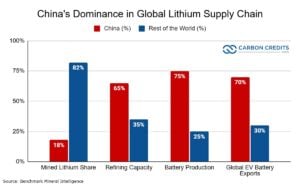
In the United States, Nevada stands out as a key lithium hub. It offers scale, infrastructure, and a well-established mining framework. Within this context, Surge Battery Metalsโ€™ (TSX-V: NILI | OTCQX: NILIF) Nevada North Lithium Project (NNLP) provides a clear example of how domestic supply can align with evolving market needs.
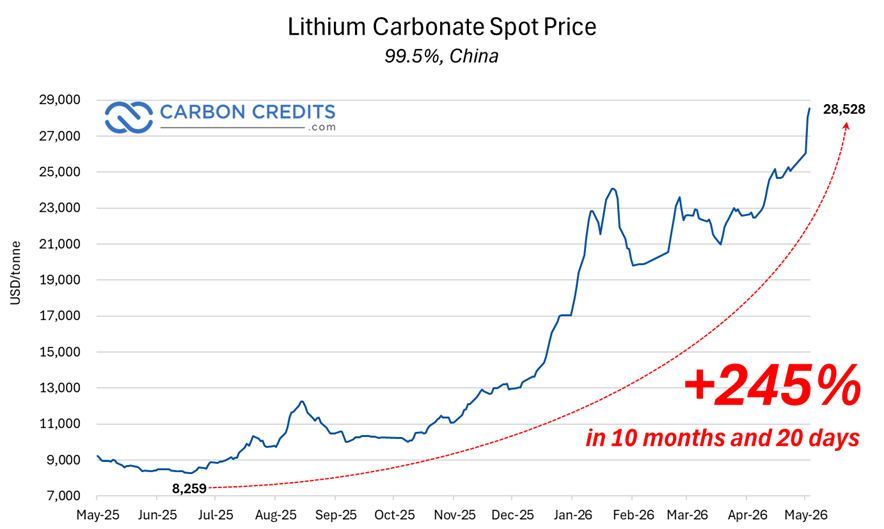
NNLP is not just defined by location, but by scale and economics. The 2025 Preliminary Economic Assessment shows a 42-year mine life, with estimated average annual production at around 86,300 tonnes of lithium carbonate equivalent (LCE). It is expected to produce around 3.6 million tonnes of battery-grade LCE over its lifetime. This positions it as one of the longer-lasting lithium supply assets in North America.
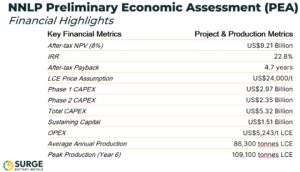
Surge-NNLP-Preliminary-Economic-Assessment-PEA

The project is also supported by a large resource base. Current estimates point to more than 11 million tonnes of lithium carbonate equivalent (inferred resource), with mineralization extending across a broad, near-surface footprint. This near-surface shape allows for a regular open-pit mining method. This can make development easier and boost efficiency in operations over time.

Grade is another key factor. NNLP reports an average lithium grade of around 3,010 ppm, with some zones exceeding 4,000 ppm. This positions the project among the higher-grade clay lithium resources in the United States. Higher grades can lead to better recovery efficiency. They also lower processing intensity per tonne, which matters in a cost-sensitive commodity market.

Surge lithium clay comparison

From an economic perspective, the project shows strong baseline metrics. Surge Battery Metalsโ€™ PEA shows an after-tax net present value of about $9.2 billion. It also indicates an internal rate of return of 22.8%, based on a lithium price assumption of $24,000 per tonne. The estimated operating cost is around $5,243 per tonne LCE, supporting its positioning as a potential low-cost producer.

Additional factors reinforcing NNLPโ€™s relevance in the market:

  • Large-scale footprint, with mineralization extending over more than 4 km of strike length
  • Open-pit design, targeting shallow, high-grade zones in early production phases
  • Two-phase development plan, allowing production to scale over time
  • Domestic processing pathway, supporting U.S. supply chain goals

Together, these characteristics position NNLP as a long-duration, scalable lithium source. It aligns with the needs of various demand drivers, including EVs, grid storage, and industrial applications.

In a market increasingly shaped by geopolitical risk, projects like NNLP represent more than just supply. They offer jurisdictional stability, long-term visibility, and alignment with domestic sourcing strategies.

These attributes are key to evaluating lithium assets as supply disruptions continue to emerge globally.

The New Reality: Volatility, Policy, and Power

The lithium market is entering a new phase. Demand is expanding, driven by EVs, grid storage, and data center infrastructure. At the same time, supply is becoming more complex and more sensitive to policy decisions.

The recent actions in China and Zimbabwe show how quickly the balance can shift. They also highlight the importance of diversification, transparency, and long-term planning in lithium supply chains.

For investors and industry participants, the takeaway is clear: The lithium deficit narrative is returning, not just because of demand growth, but because of real-world supply constraints.

In this environment, projects that offer scale, longevity, and jurisdictional stability are likely to play a larger role in meeting future demand.

DISCLAIMER

New Era Publishing Inc. and/or CarbonCredits.com (โ€œWeโ€ or โ€œUsโ€) are not securities dealers or brokers, investment advisers, or financial advisers, and you should not rely on the information herein as investment advice. Surge Battery Metals Inc. (โ€œCompanyโ€) made a one-time payment of $75,000 to provide marketing services for a term of three months. None of the owners, members, directors, or employees of New Era Publishing Inc. and/or CarbonCredits.com currently hold, or have any beneficial ownership in, any shares, stocks, or options of the companies mentioned.

This article is informational only and is solely for use by prospective investors in determining whether to seek additional information. It does not constitute an offer to sell or a solicitation of an offer to buy any securities. Examples that we provide of share price increases pertaining to a particular issuer from one referenced date to another represent arbitrarily chosen time periods and are no indication whatsoever of future stock prices for that issuer and are of no predictive value.

Our stock profiles are intended to highlight certain companies for your further investigation; they are not stock recommendations or an offer or sale of the referenced securities. The securities issued by the companies we profile should be considered high-risk; if you do invest despite these warnings, you may lose your entire investment. Please do your own research before investing, including reviewing the companiesโ€™ SEDAR+ and SEC filings, press releases, and risk disclosures.

It is our policy that information contained in this profile was provided by the company, extracted from SEDAR+ and SEC filings, company websites, and other publicly available sources. We believe the sources and information are accurate and reliable but we cannot guarantee them.

CAUTIONARY STATEMENT AND FORWARD-LOOKING INFORMATION

Certain statements contained in this news release may constitute โ€œforward-looking informationโ€ within the meaning of applicable securities laws. Forward-looking information generally can be identified by words such as โ€œanticipate,โ€ โ€œexpect,โ€ โ€œestimate,โ€ โ€œforecast,โ€ โ€œplan,โ€ and similar expressions suggesting future outcomes or events. Forward-looking information is based on current expectations of management; however, it is subject to known and unknown risks, uncertainties, and other factors that may cause actual results to differ materially from those anticipated.

These factors include, without limitation, statements relating to the Companyโ€™s exploration and development plans, the potential of its mineral projects, financing activities, regulatory approvals, market conditions, and future objectives. Forward-looking information involves numerous risks and uncertainties and actual results might differ materially from results suggested in any forward-looking information. These risks and uncertainties include, among other things, market volatility, the state of financial markets for the Companyโ€™s securities, fluctuations in commodity prices, operational challenges, and changes in business plans.

Forward-looking information is based on several key expectations and assumptions, including, without limitation, that the Company will continue with its stated business objectives and will be able to raise additional capital as required. Although management of the Company has attempted to identify important factors that could cause actual results to differ materially, there may be other factors that cause results not to be as anticipated, estimated, or intended.

There can be no assurance that such forward-looking information will prove to be accurate, as actual results and future events could differ materially. Accordingly, readers should not place undue reliance on forward-looking information. Additional information about risks and uncertainties is contained in the Companyโ€™s managementโ€™s discussion and analysis and annual information form for the year ended December 31, 2025, copies of which are available on SEDAR+ atย www.sedarplus.ca.

The forward-looking information contained herein is expressly qualified in its entirety by this cautionary statement. Forward-looking information reflects managementโ€™s current beliefs and is based on information currently available to the Company. The forward-looking information is made as of the date of this news release, and the Company assumes no obligation to update or revise such information to reflect new events or circumstances except as may be required by applicable law.


Disclosure: Owners, members, directors, and employees of carboncredits.com have/may have stock or option positions in any of the companies mentioned: None.

Carboncredits.com receives compensation for this publication and has a business relationship with any company whose stock(s) is/are mentioned in this article.

Additional disclosure: This communication serves the sole purpose of adding value to the research process and is for information only. Please do your own due diligence. Every investment in securities mentioned in publications of carboncredits.com involves risks that could lead to a total loss of the invested capital.

Please read our Full RISKS and DISCLOSURE here.

Hydrogen Jet Breakthrough at NASA: Rolls-Royce and easyJet Push Aviation Toward Zero-Carbon Flight

Rolls-Royce and easyJet have finished a hydrogen engine flight cycle test at a NASA facility. This is a big step for zero-carbon aviation research. The test looked at how a hydrogen-powered aircraft engine works in various flight conditions. This included changes in thrust and engine load. The results were shared through Aerospace Global News.

The work forms part of a wider collaboration between the aerospace industry, airlines, and research institutions to explore hydrogen as a future aviation fuel.

Rolls-Royce has been developing hydrogen combustion technology for several years. easyJet, a low-cost European airline, has also been investing in long-term decarbonization options as it targets net-zero emissions.

NASAโ€™s involvement highlights the global nature of the project. The agency provides advanced testing facilities that simulate real-world flight conditions without leaving the ground.

The test does not mean hydrogen aircraft are ready for commercial use. However, it shows that hydrogen engines can operate through a full simulated flight cycle, which is an important technical milestone.

How Hydrogen Aviation Technology Works

Hydrogen aviation is being explored in two main forms: hydrogen combustion engines and hydrogen fuel cells. In this case, Rolls-Royce is focusing on hydrogen combustion, where hydrogen is burned in a modified jet engine instead of kerosene. The goal is to produce thrust while emitting only water vapor at the point of combustion.

Hydrogen has a major advantage. When used as fuel, it produces no direct carbon dioxide emissions. However, it also comes with major technical challenges.

Hydrogen has a very low energy density by volume. It must be stored at extremely low temperatures (liquid hydrogen at around -253ยฐC) or under high pressure. This requires redesigned fuel systems and larger storage tanks.

Aircraft design must also change. Hydrogen takes up more space than jet fuel, which affects range and aircraft structure. Engine control systems also need adjustment. Hydrogen burns differently from kerosene, which affects combustion speed and temperature.

Despite these challenges, aerospace companies are continuing to develop because aviation is one of the hardest sectors to decarbonize.

Aviationโ€™s Emissions Problem Is Getting Harder to Ignore

Air travel is a growing source of global emissions. According to the International Civil Aviation Organization (ICAO), aviation accounts for about 2โ€“3% of global COโ‚‚ emissions. However, its overall climate impact is higher when including non-COโ‚‚ effects such as contrails.

Airline aviation sector ghg emissions 2024 IATA
Source: IATA

At the same time, demand for air travel continues to rise. The International Air Transport Association (IATA) predicts that global passenger traffic will nearly double by 2040. This growth will mainly come from Asia and emerging markets.

This creates a major challenge. Even with efficiency improvements, total emissions could rise without new fuel technologies.

Sustainable aviation fuel (SAF) is currently the main short-term solution. SAF can cut lifecycle emissions by up to 80% compared to regular jet fuel. This change depends on the feedstock and how itโ€™s made.

However, SAF supply remains limited. IATA estimates that SAF production is still less than 1% of total jet fuel demand. The supply gap is driving the industry to look into new technologies. This includes hydrogen and electric propulsion for shorter routes.

NASA Testing Strengthens Hydrogen Development Path

NASA plays a key role in aviation research and decarbonization technology. Its testing facilities let engineers simulate extreme flight conditions. They can measure engine performance, fuel efficiency, and emissions.

The Rolls-Royce and easyJet hydrogen engine test is part of a broader push by NASA to support zero-emission aviation concepts. The agency has also worked with other aerospace companies on electric aircraft, hybrid propulsion systems, and advanced fuel technologies.

Hydrogen testing at this level is crucial. It checks if engines can run safely and reliably in various conditions. It also helps identify engineering gaps before full-scale aircraft development begins.

The aerospace industry typically moves slowly due to strict safety and certification requirements. Each stage of testing is required before commercial deployment is possible.

Rolls-Royce and easyJet Net Zero Goals

Both Rolls-Royce and easyJet have set long-term climate targets.

Rolls-Royce has committed to reaching net-zero carbon emissions by 2050 across its operations and products. The company is also investing in cleaner propulsion systems, including hydrogen, electric, and hybrid-electric technologies.

Rolls Royce net zero targets
Source: Rolls-Royce

Its aerospace division focuses on improving engine efficiency and developing new power systems that can reduce fuel consumption and emissions. Here are the company’s net zero targets:

easyJet has also committed to net-zero emissions by 2050. The airline has cut carbon emissions per passenger-kilometer by over 30% since 2000. This change comes mainly from updating its fleet and improving operations.

easyjet net zero roadmap
Source: easyJet

However, aviation remains difficult to decarbonize. Aircraft have long lifespans, often operating for 20โ€“30 years. This slows the transition to new technology. To bridge this gap, airlines are investing in multiple solutions at the same time:

  • Fleet renewal with more fuel-efficient aircraft,
  • Use of sustainable aviation fuel (SAF), and
  • Research into hydrogen and electric propulsion.

easyJet has also entered partnerships with aircraft manufacturers and technology companies to explore future zero-emission aircraft designs. Rolls-Royce, meanwhile, is positioning itself as a long-term supplier of advanced propulsion systems for next-generation aviation.

The Roadblocks Standing Between Hydrogen and Commercial Flight

Hydrogen aviation is still in the early development stage, but global interest is rising.

The European Union, the United States, and several Asian countries are funding hydrogen research programs. Governments see hydrogen as a potential solution for hard-to-decarbonize sectors, including aviation, shipping, and heavy industry.

Airbus has also launched its ZEROe program, aiming to develop a hydrogen-powered commercial aircraft by the mid-2030s. However, the company has recently adjusted timelines, reflecting technical challenges in hydrogen storage, infrastructure, and certification.

Industry forecasts suggest that hydrogen aircraft will likely enter the market first in regional or short-haul routes before expanding further. But key challenges remain, including:

  • Lack of hydrogen production infrastructure at airports,
  • High cost of green hydrogen compared to jet fuel,
  • Need for redesigned aircraft and engine systems, and
  • Certification and safety approval timelines.

Despite these barriers, investment is increasing. According to the Hydrogen Council, global hydrogen investment commitments have reached $680 billion in announced projects through 2030, covering production, transport, and end-use applications.

As of the latest updates, this committed capital has passed $110 billion across more than 500 mature projects worldwide. Meanwhile, the current project pipeline could support up
to 14 mtpa of clean hydrogen capacity by the decade’s end.

clean hydrogen committed capital
Source: Hydrogen Council

Aviation is expected to be a smaller but strategic part of this broader hydrogen economy.

A Multi-Fuel Future for Aviation Is Taking Shape

The Rolls-Royce and easyJet hydrogen engine test reflects a broader shift in aviation. The sector is under pressure from governments, investors, and consumers to reduce emissions. At the same time, demand for air travel continues to grow.

This creates a structural challenge. Efficiency improvements alone are not enough to meet long-term climate goals. As a result, the industry is moving toward a multi-path approach:

  • SAF for near-term emission cuts,
  • Hydrogen for long-term zero-carbon flight, and
  • Electric propulsion for short regional routes.

Each technology is still developing, and none is ready to fully replace jet fuel today. However, tests like the NASA hydrogen engine trial show that progress is moving from theory to real-world engineering.

For Rolls-Royce and easyJet, the results support long-term plans to transform aviation into a lower-carbon industry.

For the wider market, it signals that hydrogen is now entering practical testing inside real aerospace systems, even if commercial use is still years away.