Verra Looks Beyond Voluntary Markets with New Compliance Strategy and Article 6 Push

The carbon market is entering a new phase. Governments are building compliance carbon markets. Companies are demanding better carbon credits. At the same time, international carbon trading under Article 6 of the Paris Agreement is starting to expand.

Verra, the world’s largest carbon credit standard, is responding with a new strategy focused on stronger credit quality, government partnerships, and compliance markets. The organization recently announced three major initiatives that could shape its future role in global carbon markets.

Beyond Voluntary Carbon: Verra Broadens Its Role

First, Verra said it wants to play a bigger role in compliance carbon markets, where governments require companies to cut or offset emissions. Second, it introduced stricter rules for issuing soil carbon credits from sustainable grasslands. Then it signed a cooperation agreement with Misiones Province in Argentina. This will help develop projects that could create carbon credits for international trading under Article 6.

Together, these moves show that Verra is preparing for a carbon market that goes far beyond voluntary corporate purchases.

The shift reflects changes across the industry. The World Bank’s State and Trends of Carbon Pricing 2026 reports 87 carbon pricing tools in use globally. This includes 47 carbon taxes and 40 emissions trading systems.

Together, they cover about 29% of global greenhouse gas emissions and generated a record $107 billion in government revenue in 2024.
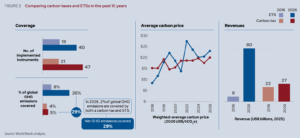
carbon tax and ets 2026
Source: World Bank report

As more countries introduce carbon pricing, demand for high-quality credits that meet government rules could grow.

Carbon Credit Quality Is Now the Top Priority

Verra’s strategy also follows a slower year for carbon credit issuances. The organization said credit issuance declined by around 30% year-on-year. The slowdown reflects a broader market shift rather than weaker climate ambition.

After years of rapid growth, buyers are paying much closer attention to project quality. They want stronger scientific evidence, better monitoring, and clear environmental benefits before purchasing credits.

This change follows increased scrutiny of carbon markets over the past two years. Organizations like the Integrity Council for the Voluntary Carbon Market (ICVCM), the Voluntary Carbon Markets Integrity Initiative (VCMI), and the Science Based Targets initiative (SBTi) have stepped up. Theyโ€™ve introduced stricter guidelines to boost market integrity.

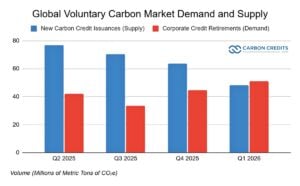
Even with slower issuance, short-term and even long-term demand remains strong, as shown in the chart below.ย 

voluntary carbon credit market demand and supply
Source: Sylvera Carbon Market Analytics Platforms, 2025โ€“2026 data consolidation

While data reflects the total global market, the steep drop in Q4 2025 and Q1 2026 issuances is primarily driven by structural freezes, project audits, and methodology overhauls at Verra, which commands over 60% of total market activity.

Rather than issuing more credits, Verra says its priority is to improve quality and prepare for the next stage of market growth.

Verra Tightens Standards for Soil Carbon Credits

Verra is also tightening the rules for soil carbon projects. Its updated method includes sustainably managed grasslands. These grasslands take in carbon dioxide from the air and store it in the soil.

Healthy grasslands boost biodiversity, cut soil erosion, and help hold water in droughts.

However, measuring soil carbon is difficult. Carbon levels vary due to weather, soil conditions, and how land is managed. Verra’s new rules need better monitoring, improved data collection, and stricter verification. This will help boost confidence in the credits.

The move comes as nature-based carbon credits receive growing attention from buyers. MSCI reports that nature-based projects made up around 36% of voluntary carbon credit retirements in 2025. This makes them the biggest project category in the market.

Argentina Partnership Supports Article 6 Carbon Trading

Lastly, Verra’s latest agreement with Misiones Province in Argentina shows where the carbon market is heading.

Instead of working only with private project developers, Verra is now helping governments prepare for Article 6 carbon trading. The agreement will help Misiones build technical skills. It will also aid in developing carbon projects, measuring emissions reductions, and meeting international reporting standards.

These projects could eventually generate Internationally Transferred Mitigation Outcomes (ITMOs) under Article 6. ITMOs are verified emissions reductions that one country can transfer to another to help meet climate targets.

Pamela Kruszelnicki, director of financial management at the Ministry of Treasury, Finance, Public Works, and Public Services of Misiones, remarked:

“The recent certification of our Jurisdictional REDD+ Program under Verraโ€™s JNR Frameworkโ€”a first-of-its-kind milestone globallyโ€”demonstrates that it is possible to combine development, conservation, and climate finance under high standards of integrity and transparency.”

Interest in Article 6 is growing quickly. According to the UNFCCC, more than 100 countries have expressed interest in using Article 6 to help achieve their climate goals. Several bilateral agreements have already been signed, including deals involving Singapore, Japan, Switzerland, South Korea, and Sweden.

As countries implement these agreements, they are likely to increase the demand for trusted carbon accounting and independent verification. That creates new opportunities for standards organizations like Verra.

Trust Is Replacing Volume as the Market’s Currency

The carbon market is no longer focused on issuing as many credits as possible.

Instead, buyers are asking tougher questions. They want to know whether a project delivers real emissions reductions, protects biodiversity, and benefits local communities. They also expect stronger monitoring and independent verification.

These changes are reshaping the market. Higher-quality credits may take longer to develop, but they are expected to attract stronger long-term credit demand and higher buyer confidence.
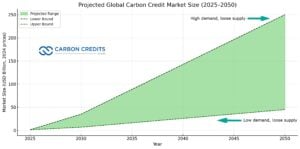
projected global carbon credit market 2050
This chart shows the projected global carbon credit market size from 2025 to 2050. The green range shows lower and upper bounds, reaching $50โ€“250 billion by 2050 (2024 prices). Growth depends on demand: high demand with loose supply drives the market to the upper bound, while low demand with loose supply results in the lower bound.

Verra Is Positioning for a New Era of Carbon Trading

Verra’s recent announcements are part of a broader strategy, not a series of separate updates.

The organization is strengthening project methodologies, expanding its work with governments, and preparing for the growth of compliance carbon markets under Article 6. These efforts reflect how the carbon market is evolving from a voluntary system into a more connected global framework.

Analysts expect this trend to continue. McKinsey & Company estimates that demand for carbon credits could reach 1.5 billion to 2 billion metric tons per year by 2030. At the same time, the World Bank expects more countries to introduce carbon pricing as they work toward their net-zero goals.

For Verra, success will depend less on the number of credits it issues and more on the trust those credits earn. As governments tighten climate policies and buyers demand greater integrity, organizations that can deliver transparent, science-based carbon credits are likely to play a larger role in the next generation of global carbon markets.

US Uranium Production Triples as Nuclear Energy Revival Fuels Mining Boom

America’s uranium industry is reviving after more than a decade of decline. Rising nuclear power demand, government support, and energy security concerns are boosting investment in the domestic fuel supply. Once thought to be fading due to low prices and heavy imports, U.S. uranium mining is now gaining strength.

The recovery aims to lessen reliance on foreign uranium and nuclear fuel services. This comes as the country faces increased electricity demand from artificial intelligence (AI), data centers, electrification, and advanced manufacturing. The growth of nuclear power and small modular reactors (SMRs) also enhances uraniumโ€™s long-term prospects.

However, domestic uranium production has recently risen, supported by billions in federal funding to rebuild mining, conversion, enrichment, and fuel manufacturing.

US Uranium Output Climbs to Its Highest Level in Years

After years of modest production, U.S. mines are ramping up.

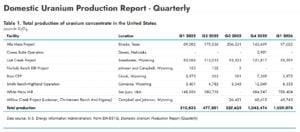
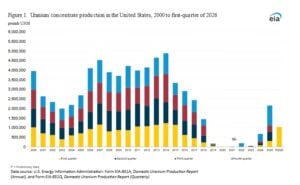
According to the EIA, domestic uranium concentrate production surged in 2025. In-situ recovery (ISR) operations restarted, and previously idle mines resumed production. This output roughly tripled from the previous year.

The momentum continued into 2026. In the first quarter, U.S. producers generated over 1 million pounds of uranium concentrate (U3O8) from six facilities.

uranium production
Source; EIA

They are mainly in Wyoming, Texas, and Utah. Wyoming led production, followed by Texas, where the Alta Mesa project resumed. Utah’s White Mesa Mill remained the only operational conventional uranium mill, processing ore from various states.

Despite this recovery, domestic production still covers only a small fraction of the uranium needed for Americaโ€™s 94 operating nuclear reactors. The U.S. consumes over 50 million pounds of uranium annually, so imports are still vital.

Utilities have long relied on supplies from Canada, Kazakhstan, Australia, and Russia. Geopolitical tensions and supply chain security concerns have prompted Washington to rebuild domestic production.

DOE Federal Funding Sparks a Nuclear Fuel Renaissance

Government support drives the uranium industry’s recovery.

Over the past two years, the U.S. Department of Energy (DOE) has started initiatives to rebuild every stage of the nuclear fuel cycleโ€”from mining to enrichment and advanced reactor fuel production.

A major investment occurred in early 2026 when the DOE awarded up to $2.7 billion in contracts to expand domestic uranium enrichment capacity. This funding aims to reduce reliance on Russian enrichment services while ensuring adequate fuel supplies for existing reactors and next-generation technologies.

The government is also investing heavily in High-Assay Low-Enriched Uranium (HALEU) production, which is needed by many advanced reactor designs.

In another significant step, the DOE awarded General Matter a contract worth up to $900 million to establish HALEU production at the Paducah facility in Kentucky. This project aims to boost Americaโ€™s nuclear fuel independence while supporting advanced reactor deployment over the next decade.

Federal support also extends to mining and mineral processing. Energy Fuels, a major uranium producer, secured a conditional $725 million federal loan to expand domestic rare earth processing. This financing supports the companyโ€™s broader uranium operations and strengthens Americaโ€™s strategic mineral supply chain.

These investments mark a policy shift. The U.S. is moving away from reliance on imported uranium and enrichment services to build a fully integrated domestic nuclear fuel industry.

Higher Uranium Prices Encourage Mine Restarts

The improving policy environment aligns with rising uranium prices.

After years of low investment post-Fukushima, uranium markets tightened as global demand grew and mine supply lagged.

Utilities are choosing long-term supply contracts more often than the spot market. This change leads to higher contract prices. It also gives mining companies the confidence to restart halted operations and invest in new projects.

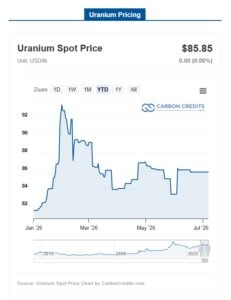
Although uranium prices saw volatility in 2025, analysts expect the market to remain strong long-term due to limited new mine development and growing nuclear capacity worldwide.

uranium prices
Source: CarbonCredits

Several investment firms forecast supply deficits later this decade as reactor demand outpaces global mine production.

Leading Companies Drive Domestic Production

A few established producers are leading the U.S. uranium revival.

  • Energy Fuels operates the White Mesa Mill in Utah, the only licensed conventional uranium mill. The facility processes uranium ore, produces vanadium, and is expanding into rare earth element processing.
  • Uranium Energy Corp. (UEC) has quickly increased production through its Wyoming ISR operations and South Texas facilities, restarting several idle projects.
  • Meanwhile, enCore Energy has resumed commercial production at its Alta Mesa ISR project in Texas, boosting domestic output.
  • Global producer Cameco also maintains U.S. assets while supplying utilities worldwide through its Canadian operations.

Together, these companies are rebuilding an industry that nearly vanished after years of weak uranium prices.

us uranium production
Source: EIA

AI and Nuclear Power Create New Demand

More than just government policy fuels the uranium recovery.

Electricity demand is rising as AI applications, cloud computing, and hyperscale data centers require reliable power. Unlike solar and wind, nuclear plants provide continuous carbon-free electricity, making them attractive to utilities and tech companies.

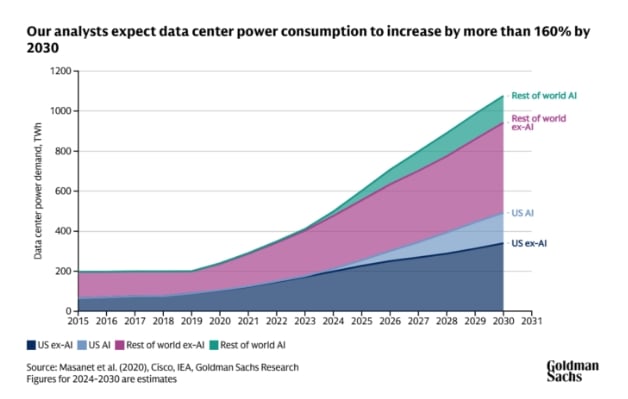
AI currently accounts for about 20% of total data center energy use, but this could rise to 40% by 2030 as AI applications expand. Goldman Sachs predicts that data center power use will climb by over 160% by the same period.

ai data center demand

Several major tech firms have made deals to support nuclear energy, ensuring reliable electricity for future data centers. Countries worldwide are extending the lives of current reactors and planning new nuclear projects. Small modular reactors are attracting significant investment for their flexibility and lower costs.

These trends are expected to boost uranium demand in the coming decades.

A Long Road Still Lies Ahead

Despite the rapid recovery, significant challenges remain.

Domestic uranium production still meets only a small share of U.S. reactor needs, meaning imports will stay essential for years. Developing new mines requires substantial capital, environmental permits, and long timelines.

However, analysts believe the fundamentals are shifting. Stronger government support, rising uranium prices, expanding nuclear generation, and growing electricity demand are creating conditions not seen since the mid-2000s uranium boom.

As the U.S. aims to boost energy security and clean energy goals, uranium is gaining importance. Production is rising, federal funding is increasing, and new reactors are on the way. Americaโ€™s uranium industry seems poised for steady growth in the next decade.

US Natural Gas in 2026: Rising Demand, Record Supply, and the Emissions Challenge

The U.S. natural gas industry is entering another year of strong growth. Domestic production is reaching record highs, liquefied natural gas (LNG) exports continue to expand, and electricity demand is climbing as artificial intelligence (AI), data centers, and electrification reshape the country’s energy needs.

Natural gas remains the largest source of U.S. electricity generation, helping balance renewable energy while replacing coal in many regions. At the same time, the fuel remains under increasing scrutiny because of its carbon dioxide (COโ‚‚) emissions and methane leaks, which are major contributors to climate change.

With prices stabilizing after years of volatility, the market is entering a new phase where demand growth and export opportunities are likely to keep natural gas at the center of the U.S. energy mix.

US Natural Gas Production Hits New Highs

The United States remains the world’s largest producer of natural gas.

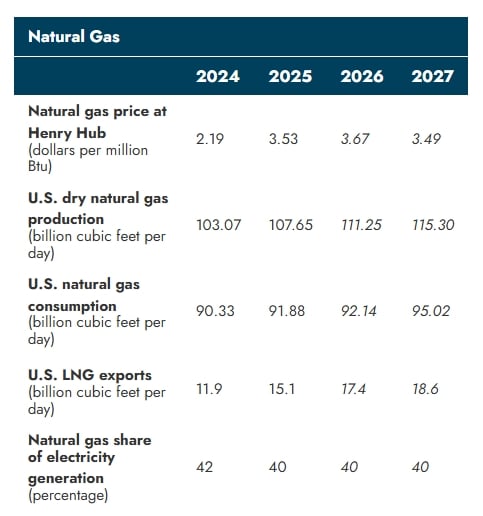
According to the latest U.S. Energy Information Administration (EIA) Short-Term Energy Outlook, U.S. dry natural gas production is expected to average 111 billion cubic feet per day (Bcf/d) in 2026, up from 107.65 Bcf/d in 2025. Production is forecast to increase further to 113.6 Bcf/d in 2027.

The growth is largely driven by:

  • Higher associated gas production from the Permian Basin
  • Increased drilling in the Haynesville shale
  • Expanding LNG export capacity along the Gulf Coast
  • Rising electricity demand

The EIA also reported that U.S. marketed natural gas production averaged 120.2 Bcf/d during the first quarter of 2026, about 4% higher than the same period last year.

Strong production has kept storage levels healthy and prevented significant price spikes despite increasing consumption.

US natural gas prices
Source: EIA

Demand Continues to Grow

Natural gas consumption remains robust across several sectors.

The EIA forecasts U.S. natural gas consumption to average 92.14 Bcf/d in 2026, increasing to nearly 95 Bcf/d in 2027.

Power generation remains the biggest source of demand.

Growing electricity use from AI data centers, cryptocurrency facilities, manufacturing, and electrification is increasing the need for reliable baseload and flexible generation.

For the Electric Power Sector

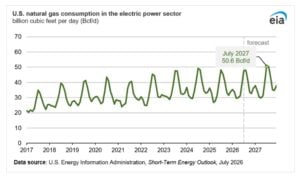
Natural gas consumption by the electric power sector is expected to reach a record 38.1 Bcf/d in 2026, with monthly demand potentially exceeding 50 Bcf/d during peak summer periods.

Electricity demand itself is also setting new records.

natural gas prices
Source: EIA

The EIA projects total U.S. electricity consumption will rise to 4,269 billion kilowatt-hours (kWh) in 2026 and 4,399 billion kWh in 2027, driven largely by commercial customers and energy-intensive AI infrastructure.

LNG Exports Are Supporting the Market

The United States has become one of the world’s largest LNG exporters, and overseas demand continues to strengthen domestic natural gas markets.

  • LNG exports to increase from 15.1 Bcf/d in 2025 to 17.2 Bcf/d in 2026, reaching 18.6 Bcf/d in 2027.

New export terminals along the Gulf Coast are creating additional demand for U.S. shale gas while helping supply Europe and Asia as many countries diversify away from Russian gas.

Higher exports also provide producers with more stable long-term markets, even when domestic demand fluctuates.

Natural Gas Prices Have Stabilized

After several years of sharp swings caused by weather, geopolitical tensions, and storage changes, natural gas prices have become relatively stable.

  • Henry Hub natural gas prices are expected to average around $3.60 per million British thermal units (MMBtu) in 2026, slightly above 2025 levels, according to the EIA.
  • In recent trading, NYMEX natural gas futures have remained close to $3.25 per MMBtu, supported by strong summer electricity demand while abundant production continues to limit major price increases.

Analysts say prices are likely to remain moderate unless extreme weather significantly reduces storage or major supply disruptions occur.

Natural Gas Still Dominates US Power Generation

Despite rapid renewable energy growth, natural gas continues to be the backbone of the U.S. electricity system. This sector can potentially generate approximately 40% of U.S. electricity through 2027, while coal’s share continues to decline.

natural gas electricity US

Renewables are projected to supply 27% of electricity generation, with nuclear contributing about 18%.

Natural gas plants remain valuable because they can quickly adjust output when wind and solar generation changes, supporting grid reliability during periods of high demand.

What About US Emissions?

Natural gas emits less carbon dioxide than coal when burned, which has helped reduce emissions from the U.S. power sector over the past two decades.

However, it remains a fossil fuel.

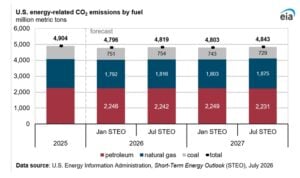
The EIA said U.S. energy-related COโ‚‚ emissions are projected to decline by 1.7% in 2026 compared with 2025 before edging up by 0.5% in 2027.

  • In the near term, they are expected to remain around 4.8 billion metric tons annually. However, emissions intensity continues to decline as renewable energy expands and coal generation falls.

us emissions

Methane emissions present another challenge.

Methane is the primary component of natural gas and has a much stronger warming effect than carbon dioxide over the short term. Leaks during production, processing, and transportation significantly increase the climate impact of natural gas.

Reducing methane emissions through improved monitoring, leak detection, and tighter regulations remains one of the fastest ways to lower greenhouse gas emissions from the industry.

AI Is Creating a New Source of Gas Demand

One of the biggest changes in the U.S. energy market is the rapid growth of AI infrastructure.

Large data centers require enormous amounts of electricity, and utilities are increasingly relying on natural gas plants to provide reliable power while renewable generation and transmission projects are built.

The EIA expects commercial electricity demand to exceed residential demand for the first time in U.S. history, reflecting rapid expansion of AI and digital infrastructure.

However, environmental groups warn that relying heavily on gas-fired generation for AI could increase greenhouse gas emissions if renewable deployment does not keep pace. Recent research suggests dozens of proposed gas plants dedicated to data centers could substantially increase emissions over the coming decades.

Can Natural Gas Support the Energy Transition?

Supporters argue that it provides reliable, affordable electricity while enabling higher levels of wind and solar generation. It also strengthens energy security and supports economic growth through exports and manufacturing.

Critics point to continued carbon emissions, methane leakage, and the risk of locking in long-term fossil fuel infrastructure that could delay deeper decarbonization.

The future role of natural gas will likely depend on several factors:

  • Growth of renewable energy and battery storage
  • Carbon capture and storage deployment
  • Methane emission reductions
  • LNG export demand
  • AI-driven electricity consumption
  • Federal and state climate policies

Outlook

The U.S. natural gas market remains fundamentally strong.

Production continues to reach new records, LNG exports are expanding, and electricity demand from AI, industry, and electrification is creating new growth opportunities. At the same time, abundant supply is keeping prices relatively stable for consumers and businesses.

Yet natural gas also sits at the center of America’s climate challenge. While it has helped replace coal and lower emissions in the power sector, meeting long-term climate goals will require substantial reductions in methane leaks and carbon emissions.

For now, natural gas is expected to remain the dominant fuel in the U.S. energy systemโ€”supporting grid reliability, economic growth, and global energy exports while the country continues its transition toward a lower-carbon future.

Tesla Expands Clean Energy Push With New 6-Seater Model Y L Despite TSLA Stock Sell-Off

Tesla is adding a new version of its best-selling vehicle as it works toward its broader mission of accelerating the shift to clean energy. The company has begun U.S. production of the six-seat Model Y L. This gives families a larger electric SUV and expands one of the world’s top EV models.

Although many customers welcomed the launch, Tesla’s stock shares fell after the announcement as investors locked in profits. Even so, the new model could strengthen Tesla’s earnings while supporting the wider move toward lower transport emissions.

Tesla Expands Its Best-Selling EV Lineup

Tesla has officially begun producing the Model Y L, a new six-seat version of its best-selling electric SUV. The company launched the model earlier than many investors expected, with customer deliveries scheduled to begin in September.

The new EV model is for larger families and buyers who need more passenger space. It features three rows with six seats, a longer wheelbase than the standard Model Y, and a roomier cabin for improved comfort.

The SUV is powered by Tesla’s dual-motor all-wheel-drive system and could deliver up to 456 horsepower (340 kW). This design offers strong performance while maintaining the efficiency that the Model Y is known for. The larger model also provides more cargo space and is expected to support Tesla’s premium pricing strategy.

This larger SUV gives Tesla a stronger position in the growing family vehicle market. It also adds to the Model Y lineup without needing a new vehicle platform. This helps the company boost production efficiency and cut manufacturing costs.

The Model Y has already become one of the world’s most successful electric vehicles. It became the first electric vehicle to lead global sales across all powertrains. Despite rising global competition, the Model Y remains one of Tesla’s top products. It still ranks among the best-selling EVs worldwide.

The new six-seat version is expected to sell at a higher price than the standard Model Y. That could improve Tesla’s profit margins once deliveries begin later this year.

Electric Vehicles Continue to Reduce Transport Emissions

The launch comes as electric vehicles play a bigger role in cutting global emissions.

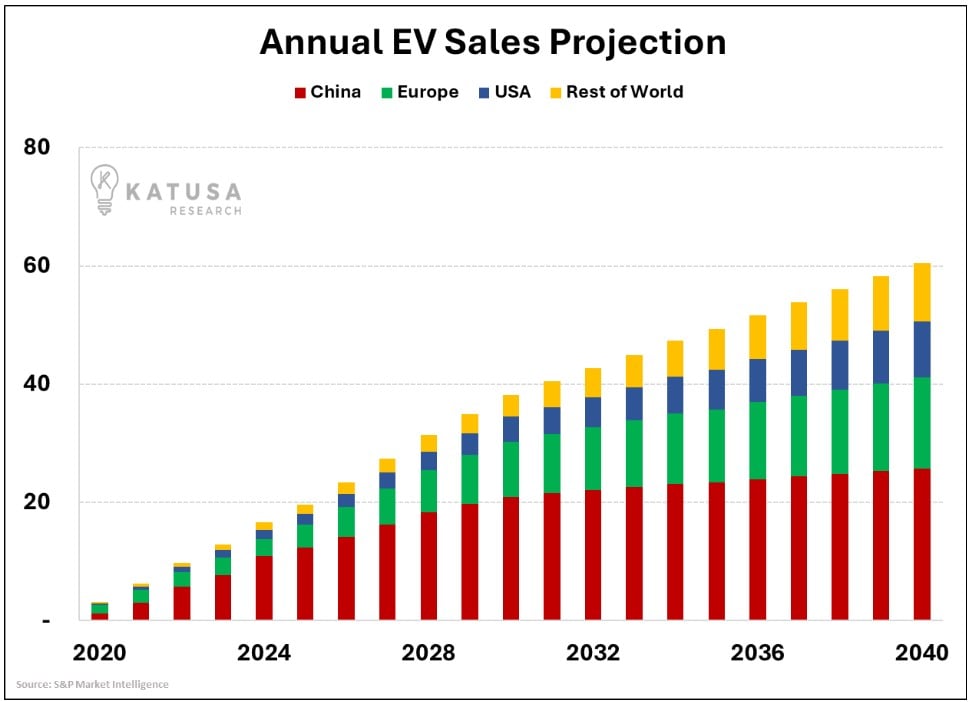
The International Energy Agency (IEA) reports that global EV sales topped 20 million in 2025. This is a 25% jump from last year. EVs accounted for more than 20% of all new cars sold worldwide, setting another record.

The IEA expects global EV sales to keep rising this decade. This growth will happen as battery prices drop, charging networks expand, and governments boost clean transport policies.

annual EV sales projection KR
Chart: Katusa Research

This growth matters because transport remains one of the world’s largest sources of greenhouse gas emissions. The IEA estimates that transport generates about 25% of global energy-related COโ‚‚ emissions. Most of these come from road vehicles.

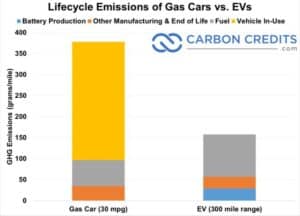
Switching from gasoline and diesel vehicles to electric ones can cut lifetime emissions. This is especially true as electricity grids get cleaner with more renewable energy.

lifecycle emissions of gas cars vs EV

Tesla Is Building More Than an EV Company

The EV giant says its mission is “to accelerate the world’s transition to sustainable energy.” The company views electric vehicles as only one part of that strategy.

Tesla’s latest Impact Report shows that Tesla drivers have avoided about 35 million metric tons of COโ‚‚ emissions. This is compared to similar gasoline-powered cars.

The report notes that Tesla’s productsโ€”like EVs, solar panels, and battery storageโ€”helped customers avoid over 20 million metric tons of COโ‚‚ equivalent in 2024.

Tesla EV emissions reductions
Source: Tesla Impact Report

Tesla is also expanding its energy business. In 2025, the company deployed a record 46.7 gigawatt-hours (GWh) of battery energy storage, a 49% increase from the 31.4 GWh deployed in 2024. Its Megapack systems are now helping utilities store electricity from wind and solar farms, making renewable energy more reliable.

The company is also improving battery recycling. Tesla claims its recycling facilities recycle all retired lithium-ion battery packs. This process helps recover and reuse important materials like lithium, nickel, cobalt, and copper.

Together, these efforts show that Tesla’s climate strategy reaches well beyond vehicle sales. It is building a broader clean energy ecosystem that includes transportation, renewable electricity, battery storage, and resource recovery.

Why Investors Took Profits After the Launch

Despite the early launch of the Model Y L and another strong quarter for vehicle deliveries, Tesla shares fell about 7.5% after the announcement.

The decline appears to reflect profit-taking rather than concerns about the new vehicle itself. Many investors had already expected positive news, meaning much of the optimism was already built into Tesla’s share price.

Tesla TSLA stock price

Market analysts often call this selling the news.” Investors buy shares ahead of an expected event, then sell once the announcement is made to lock in gains.

However, the launch could still benefit Tesla’s financial results. The six-seat Model Y L is expected to carry a higher selling price than the standard Model Y.

If demand remains strong, the larger SUV could improve vehicle margins and boost revenue when deliveries begin in September. Investors are likely to pay less attention to the product launch. Instead, they’ll focus on whether Tesla can boost earnings in the upcoming quarters.

Battery Storage Becomes Tesla’s Second Growth Engine

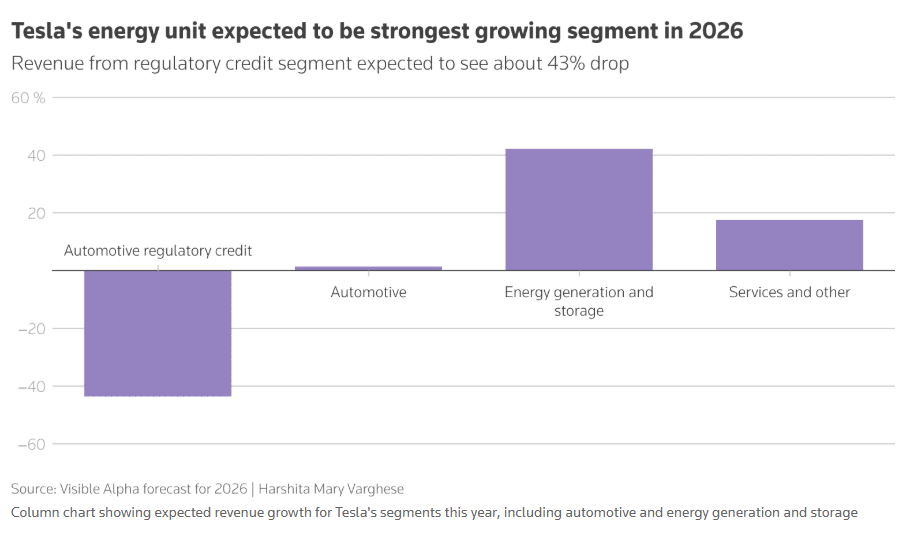
While Tesla remains best known for electric vehicles, its energy business is growing even faster. In fact, it will be the strongest-growing segment this year.ย 

Tesla energy storage business growth 2026

The business features Megapack utility-scale batteries and Powerwall home battery systems. These products store electricity from renewable sources.

Demand continues to rise as countries build more wind and solar projects. The International Energy Agency (IEA) says the world must add over 1,500 gigawatts (GW) of energy storage by 2030. This is crucial to meet global climate goals. That is more than six times today’s installed capacity.

Tesla is well-positioned to benefit from that trend and is boosting its Megapack production, which will help supply battery storage projects. These projects improve grid reliability and support renewable energy growth.

This gives Tesla another source of revenue beyond vehicle sales and helps strengthen its role in the clean energy transition.

Tesla’s Long-Term Bet Is on the Entire Clean Energy Ecosystem

The new Model Y L is more than another vehicle launch. It reflects Tesla’s broader strategy to expand clean transportation while building an integrated clean energy business.

Electric vehicles remain at the center of that strategy, but they are only one part of the company’s long-term vision. Battery storage, solar power, charging infrastructure, and battery recycling help cut emissions in the energy system.ย ย 

Global electricity demand is rising. This growth comes from artificial intelligence, data centers, and electrification. Because of this, the need for clean transport and reliable energy storage will also increase.

Tesla’s latest product launch fits into that broader transition. The market had a quick sell-off, but the companyโ€™s long-term plan is clear. It aims to expand clean energy solutions and cut emissions in various sectors.

Whether the Model Y L becomes another sales success will become clearer once deliveries begin in September. But the launch shows Tesla is continuing to invest in products that support both its business growth and its mission to accelerate the world’s transition to sustainable energy.

Lithium Prices Enter a New Era as China Expands Futures Market, Sodium Batteries Rise, and EnergyX Bets $225M on Supply

Lithium prices are entering a new phase. China is strengthening its role in price discovery, sodium-ion batteries are gaining ground, and EnergyX is investing heavily in future supply. Together, these trends are reshaping the global lithium market.

China Tightens Its Grip on the Global Lithium Market

China has opened its lithium carbonate futures market on the Guangzhou Futures Exchange (GFEX) to qualified foreign investors. The move gives overseas traders direct access to one of the world’s most important lithium pricing markets.

Until now, most global lithium contracts have relied on price assessments from private agencies. By opening its futures market, China is taking another step toward making domestic prices an international benchmark.

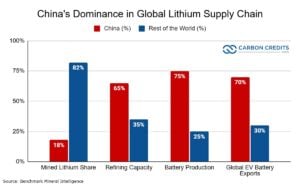
The timing is significant. China already dominates much of the global lithium supply chain. According to the International Energy Agency (IEA), the country refines about 70% of the world’s lithium and produces around 80% of lithium-ion battery cells.

China dominance lithium supply chain

China also leads electric vehicle (EV) production and battery manufacturing. Expanding access to its futures market boosts its control over global lithium price discovery.

For producers, battery makers, and investors, the new market offers another tool to manage price risk. For China, it reinforces its growing role as the center of the global battery economy.

Lithium Prices Remain Far Below Their Peak

The futures market opens during a very different price environment than it did just a few years ago.

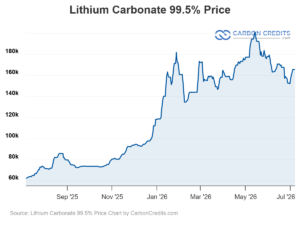
Lithium prices surged to record highs in late 2022 as EV demand outpaced supply. Since then, a wave of new production from Australia, China, South America, and Africa has pushed prices sharply lower.

According to CarbonCredits.com, battery-grade lithium carbonate in China traded around 165,250 yuan per metric ton, down from a peak above 590,000 yuan in November 2022.

Lithium Carbonate 99.5% Price - CarbonCredits

The sharp decline has squeezed profit margins across the industry. Several producers have delayed expansions or reduced output while waiting for market conditions to improve.

Still, demand continues to grow. The IEA estimates that global demand for lithium reached roughly 240,000 metric tons in 2024โ€”more than triple the level recorded in 2020. Long-term forecasts still point to strong growth as EV adoption and battery storage expand worldwide.

Can Sodium Batteries Slow Lithium Demand?

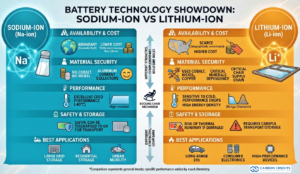
Another factor shaping the market is the rapid development of sodium-ion batteries. China recently approved wider commercial use of sodium-ion batteries, which replace lithium with sodium, an element that is far more abundant and lower in cost.

Several Chinese companies are already scaling production. Sodium batteries are attracting interest because they perform well in cold weather and reduce dependence on critical minerals.

However, most experts do not expect sodium to replace lithium in the near future.

Lithium-ion batteries still provide higher energy density, making them the preferred choice for long-range electric vehicles. Sodium batteries are likely to be used in lower-cost EVs, stationary energy storage, and other applications. In these cases, energy density is not as crucial.

The IEA expects lithium to remain the dominant battery material through at least the next decade, even as alternative chemistries gain market share.

For investors, sodium batteries might slow future demand growth. However, they probably won’t remove the need for a lot of lithium.

sodium battery versus lithium battery

Investment Keeps Flowing Into New Lithium Supply

Despite lower lithium prices, companies are still investing in new supply.

U.S.-based EnergyX recently secured a $225 million investment from Italian energy major Eni to advance its Black Giant Lithium Project in Chile’s Atacama region. The funding will support project development and expand EnergyX’s direct lithium extraction (DLE) technology.

The investment shows that major energy companies still expect strong long-term demand for lithium.

The Black Giant project is one of the largest undeveloped lithium brine resources in the world. EnergyX says the project could become an important new source of lithium as global EV production continues to grow.

The project could produce 52,500 metric tons of lithium carbonate equivalent (LCE) per year when fully operational. It will be built in two phases.

The first phase includes Train 1, which will produce 7,500 metric tons of LCE per year and could begin operating in 2028. The second phase will add more processing trains, increasing total annual capacity by another 45,000 metric tons, with operations expected to start in 2030.

The company also believes DLE technology can recover more lithium while using less land and water than traditional evaporation ponds. Although the technology is still being scaled, many producers see it as a way to improve both efficiency and sustainability.

The investment comes at a time when many developers are slowing projects because of weak prices. That makes Eni’s decision a strong vote of confidence in the long-term outlook for lithium.

Demand Still Points Higher

While prices have fallen, the long-term demand outlook remains strong.

The International Energy Agency (IEA) reports that global electric vehicle sales topped 20 million in 2025. This means one in four new cars sold worldwide was electric. Battery storage is also growing rapidly as countries add more solar and wind power.

Both trends require large amounts of lithium.

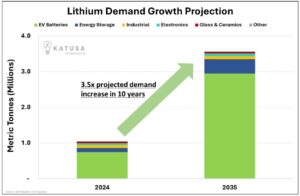
The IEA projects that demand for critical minerals used in clean energy technologies will continue rising through 2035. Lithium will likely remain one of the fastest-growing minerals because of its central role in rechargeable batteries.

lithium demand forecast 2035 KR
Source: Katusa Research

Meanwhile, the U.S. Geological Survey (USGS) estimates global lithium reserves at about 30 million metric tons, with major resources located in Chile, Australia, Argentina, and China. As demand rises, countries are also trying to diversify supply chains by developing new projects in North America and other regions.

These investments aim to reduce reliance on a single region while improving long-term supply security.

What Comes Next for Lithium Prices?

The lithium market is entering a new stage.

China is expanding its influence over global pricing through its futures market. At the same time, sodium-ion batteries are adding more competition in some battery segments, while companies like EnergyX continue investing in future supply.

In the short term, lithium prices may remain under pressure as new production continues to enter the market. However, many analysts expect supply and demand to become more balanced later this decade as EV sales, battery storage, and electricity demand continue to grow.

The market is also becoming more mature. Prices will not just be driven by shortages. They will also respond to new technologies, financial markets, government policies, and shifts in global supply chains.

The latest developments show that the lithium industry is changing, not slowing down. These trends are reshaping how the market operates.

Although lithium prices remain far below their 2022 record highs, demand fundamentals remain strong.ย The next chapter for the lithium industry will likely be defined not only by higher production but also by better pricing tools, new technologies, and more diversified sources of supply.

Singapore and Indonesia Seal Landmark Carbon Credit Deal to Boost Southeast Asia’s Green Economy

Singapore and Indonesia have signed a new agreement to expand carbon credit trading. The deal is another step toward building a stronger carbon market in Southeast Asia.

The agreement was signed during the annual leaders’ retreat between the two countries. It creates a legal framework for carbon credit projects under Article 6 of the Paris Agreement. These rules allow countries to trade verified emissions reductions while making sure each credit is counted only once.

Why the Singapore-Indonesia Carbon Credit Deal Matters

The partnership is expected to support more climate projects in Indonesia. It will also help Singapore use high-quality international carbon credits to meet part of its climate goals.

Officials from both countries said the agreement will encourage private investment, support new climate technologies, and create more opportunities for low-carbon growth.

Gan Kim Yong, Singapore Deputy Prime Minister, stated:

“This MOU signals Singaporeโ€™s and Indonesiaโ€™s intent to work towards creating a framework for channelling climate finance into high-integrity projects, from protecting forests and restoring coastal ecosystems, to deploying clean technology solutions that reduce emissions and create new economic opportunities.”

The deal also shows that countries are working more closely to reach their net-zero goals. Itย brings together two countries with different strengths.

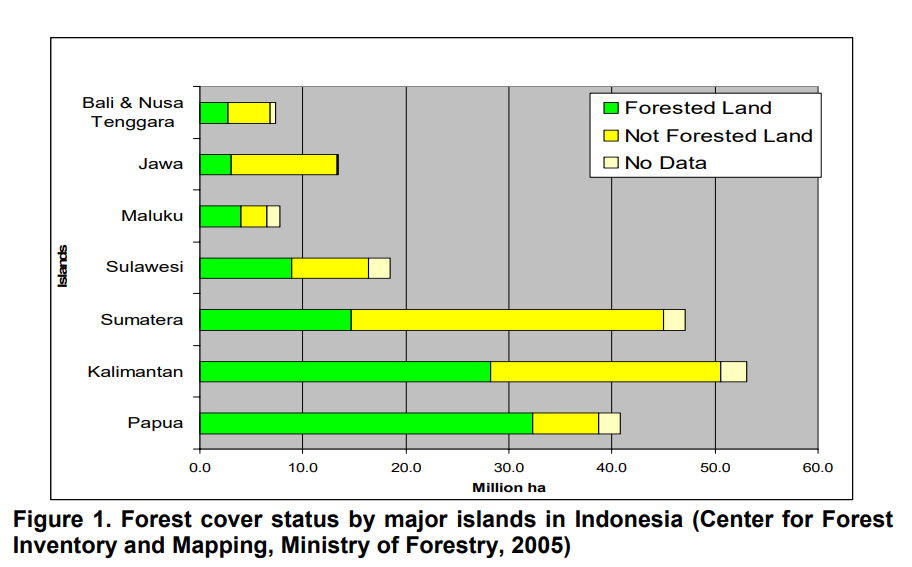
Indonesia has some of the world’s richest natural carbon resources. It has the third-largest tropical rainforest after Brazil and the Democratic Republic of the Congo. According to the Food and Agriculture Organization (FAO), forests cover about 60% of the country’s land. Indonesia also has the world’s largest mangrove forests and vast peatlands, which store huge amounts of carbon.

forest cover in indonesia islands
Source: FAO

Singapore has a different role. Because of its small land area, it cannot develop many large carbon removal projects. Instead, it is becoming a regional center for carbon trading, green finance, and climate services.

The agreement allows each country to use its strengths. Indonesia can develop carbon projects that protect forests, restore peatlands, expand renewable energy, and cut emissions. Singapore can provide funding, project expertise, and access to global buyers.

Together, they hope to build a trusted carbon market that supports climate action and creates new business opportunities.

Article 6 is Opening New Carbon Markets

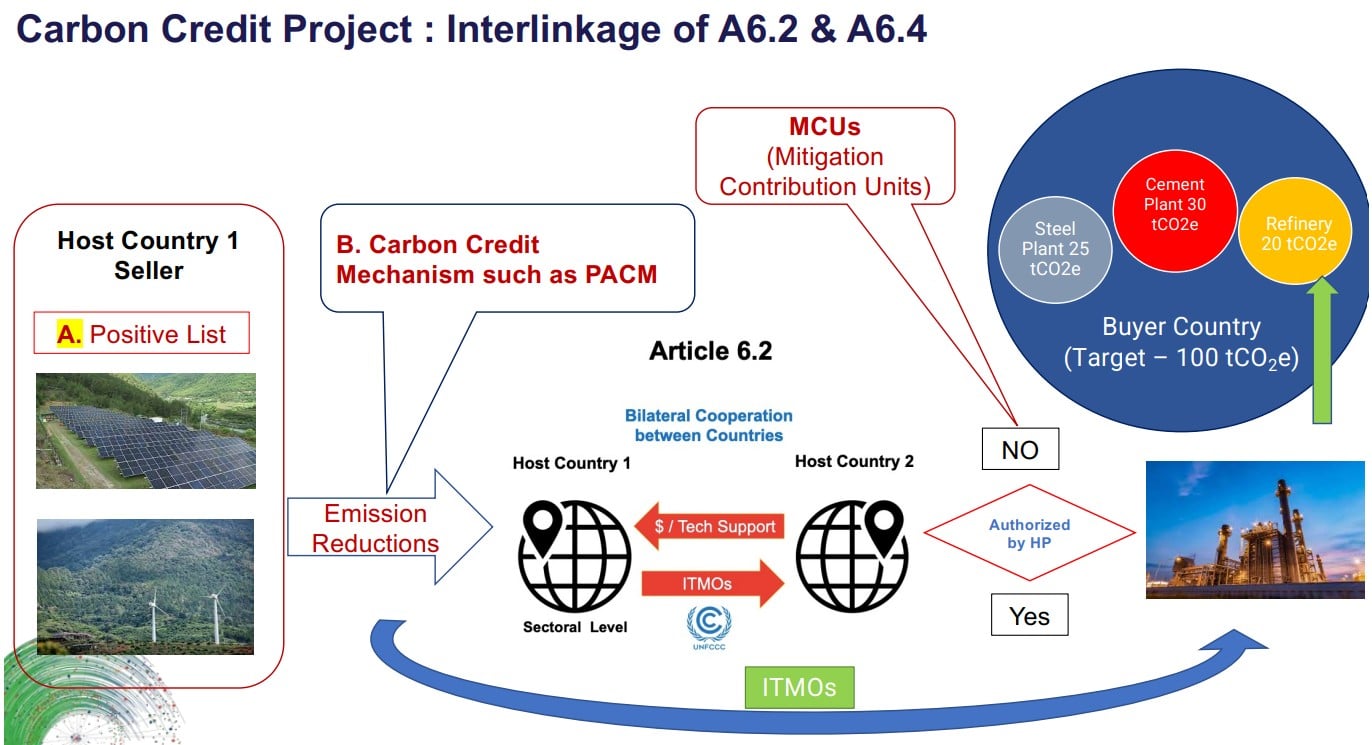
The new agreement follows the rules under Article 6 of the Paris Agreement. These rules allow countries to trade verified emissions reductions to help meet their climate targets.

Each transaction must include a corresponding adjustment. This makes sure the same carbon credit is not claimed by both countries.

Carbon Credit generation article 6
Source: UNFCCC

Singapore has been one of the first countries to sign Article 6 agreements. Before Indonesia, it signed similar deals with Ghana, Papua New Guinea, Bhutan, and Peru.

Singapore has also introduced one of Asia’s first economy-wide carbon taxes. Large industrial facilities currently pay S$25 (about US$19) per metric ton of carbon dioxide equivalent. The tax will rise to S$45 per ton in 2026 and 2027, and then increase to S$50 to S$80 per ton by 2030.

Companies can use eligible international carbon credits to offset up to 5% of their taxable emissions. This is expected to increase demand for high-quality carbon credits from countries such as Indonesia.

Net-Zero Targets Are Fueling Climate Investment

Both countries have set ambitious climate targets, making carbon markets more important.

Singapore plans to reach net-zero emissions by 2050. It also aims to reduce emissions to 45 million to 50 million metric tons of COโ‚‚ equivalent by 2035. Along with expanding solar power and improving energy efficiency, Singapore sees international carbon credits as one way to help reach its climate goals.

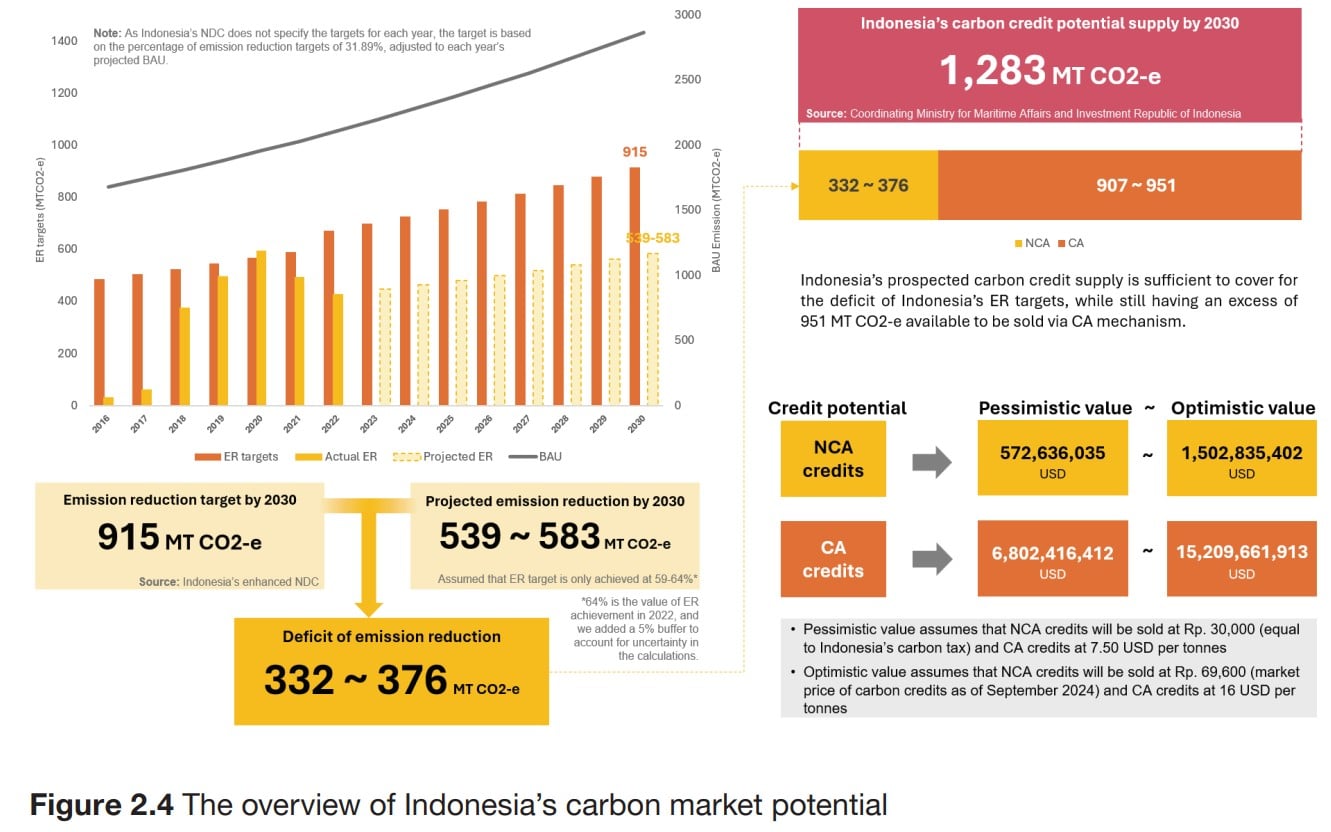
Indonesia has pledged to achieve net-zero emissions by 2050. Under its new climate plan, the country aims to reduce greenhouse gas emissions by 31.89% using its own resources. With international support, the goal is 43.2% by 2030 compared to its business-as-usual scenario.

The new agreement can help both countries move closer to these goals. It can also attract more investment into projects that reduce emissions, protect forests, and support local communities.

More countries are adopting carbon pricing, and companies are looking for high-quality carbon credits. So partnerships like this could play a bigger role in Southeast Asia’s low-carbon transition.

Indonesia Could Become a Leading Carbon Credit Supplier

Indonesia has some of the world’s biggest opportunities to produce high-quality carbon credits.

Indonesiaโ€™s carbon market potential
Source: PwC

The country has about 95 million hectares of tropical forests, the world’s largest mangrove forests, and vast peatlands. These ecosystems store huge amounts of carbon and help protect biodiversity.

According to the World Bank, Indonesia’s forests and peatlands are among the world’s most important natural carbon sinks. Protecting and restoring them can cut emissions while creating new income for local communities.

Indonesia has already taken steps to build its carbon market. In 2023, it launched the Indonesia Carbon Exchange (IDXCarbon), allowing companies to trade carbon credits under the country’s climate rules. The government also plans to expand carbon trading as more sectors join its emissions reduction program.

The new agreement with Singapore could bring more international buyers into this market. It can also fund projects that restore forests, protect mangroves, create renewable energy, and cut industrial emissions.

Carbon Markets in Southeast Asia Are Growing

Southeast Asia is expected to become one of the world’s fastest-growing carbon markets over the next decade.

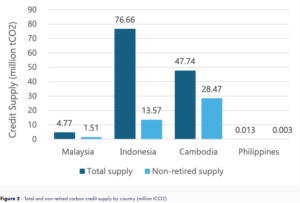
According to a recent HAMERKOP market analysis, Indonesia, Cambodia, Malaysia, Thailand, and the Philippines had issued a combined 129 million verified carbon credits as of April 2025. This represents about 22% of global nature-based credit issuance.

Southeast Asia Nbs carbon credit supply or issuance
Source: Hamerkop

Around 43 million credits remain available for buyers, with Indonesia and Cambodia supplying most of the region’s credits.

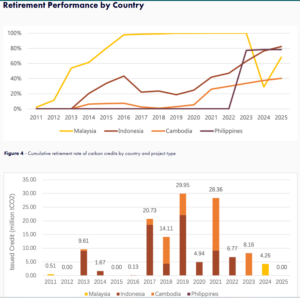
The study also identified 28 projects under development and found that credit retirement rates have climbed from less than 20% in the late 2010s to more than 65% by 2025. This shows stronger buyer demand and growing confidence in Southeast Asia’s carbon market.

Southeast Asia Nbs carbon credit retirement
Source: Hamerkop

The region also has some of the world’s largest supplies of nature-based carbon credits. Forests, peatlands, mangroves, and other ecosystems in Indonesia, Malaysia, Vietnam, and the Philippines provide great chances to create high-quality carbon credits. They also help protect biodiversity and support local communities.

The Singapore-Indonesia agreement is more than a bilateral climate deal. It signals that the region is becoming a larger player in global carbon markets.

Together, the two countries are creating a framework that could attract more private investment into climate projects while supporting regional economic growth.

As more countries and companies are taking climate goals seriously, international carbon partnerships may become more common. The Singapore-Indonesia partnership shows how neighboring countries can work together to cut emissions, protect nature, and build a stronger low-carbon economy.

Vietnam Earns $56.5M From Forest Carbon Credits Paid by The World Bank

Vietnam has earned $56.5 million from the World Bank after cutting 10.3 million metric tons of carbon dioxide (COโ‚‚) through forest protection and better land management.

The payment covers verified emissions reductions from 2018 to 2019 in Vietnam’s North Central Region. It was made under the Emission Reductions Payment Agreement (ERPA) of the Forest Carbon Partnership Facility (FCPF), a World Bank program that rewards countries for reducing emissions from forests.

The program covers six provinces: Thanh Hoa, Nghe An, Ha Tinh, Quang Binh, Quang Tri, and Thua Thien Hue.

More than 70% of the payment will go directly to forest owners, local communities, households, and organizations that helped protect and restore forests. The remaining funds will support forest management, monitoring, and future conservation work.

The payment is one of Southeast Asia’s largest jurisdictional forest carbon transactions. It also marks another step in Vietnam’s plan to build a stronger carbon market.

Forests Are Key to Vietnam’s Net-Zero Goal

Vietnam sees its forests as one of its biggest climate assets. At the COP26 climate summit, the country pledged to reach net-zero emissions by 2050.
It also improved its climate target in the updated Nationally Determined Contribution (NDC). The goal is to cut emissions by 15.8% by 2030 using domestic resources. If it gets international support, the target could rise to 43.5%, compared to its usual scenario.

Vietnam’s emissions have surged in the last twenty years due to economic growth. The energy sector is now the biggest source of greenhouse gases in the country. To reverse this trend, the government is investing in renewable energy, improving energy efficiency, expanding electric transport, and developing green hydrogen.

It has launched a pilot phase for a national emissions trading system, which includes the power, steel, and cement industries. Together, these industries make up about 50% of the country’s COโ‚‚ emissions.

Forests remain a key part of this strategy. They help clear carbon dioxide from the air. They also protect biodiversity, water sources, and rural livelihoods.

According to the Food and Agriculture Organization (FAO), forests cover about 43% of Vietnam’s land area. Years of reforestation and stronger forest protection have helped increase forest cover across the country.

vietnam forest
Source: Tran Quoc, C. et al (2023). Journal of Forest Research, 28(3), 159โ€“167. https://doi.org/10.1080/13416979.2023.2182259

By combining forest conservation with clean energy and industrial decarbonization, Vietnam aims to build a more balanced pathway toward its 2050 net-zero goal.

Vietnam also plans to launch a pilot carbon exchange, which will start before the full market opens. This will create new chances for forest carbon credits and other emissions reduction projects.

Why High-Quality Forest Credits Are in Demand

Vietnam’s latest payment comes as global demand for high-quality forest carbon credits continues to grow.

Companies are facing greater pressure to reduce emissions and invest in credible climate projects. Buyers are now more selective. They want carbon credits that have strong science, independent verification, and clear benefits for local communities.

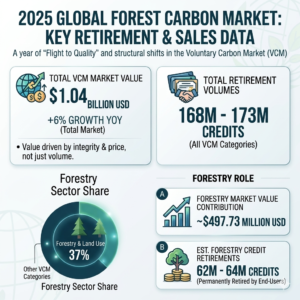
Forest carbon credits remain the largest segment of the voluntary carbon market (VCM) in 2026, making up 37% of all retired credits. However, buyers are placing greater focus on credit quality, transparency, and project integrity than ever before.

Across the entire VCM, total retirements reached between 168 million and 173 million credits, per Sylvera data. That means roughly 62 million to 64 million forest carbon credits were permanently retired by end-users in 2025.

forest carbon credit market
Sources: Sylvera Carbon Markets Report; AlliedOffsets VCM Review; Ecosystem Marketplace SOVCM Data; Market Growth Reports (Voluntary Carbon Offsets for Forestry).

Jurisdictional forest programs, like Vietnam’s, are set to gain from this trend. They measure emissions over large areas, not just single projects. This boosts transparency and cuts the risk of double-counting.

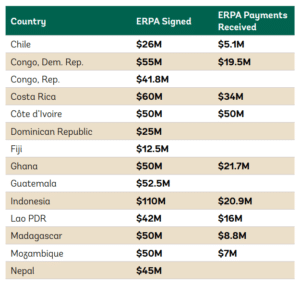
Vietnam joins a growing list of countries receiving results-based payments through the FCPF’s ERPA program. Since its start, the FCPF has helped 47 developing countries. It has raised around $1.3 billion to cut emissions from deforestation and forest degradation. Other successful participants include Mozambique and the Dominican Republic.

Costa Rica, Chile, Ghana, Guatemala, Lao PDR, Nepal, and Indonesia have also signed ERPAs worth millions. This shows that results-based forest finance is key to protecting forests. It also helps rural livelihoods and supports national climate goals.

FCPF ERPA payments received
Source: World Bank

Nature-Based Carbon Markets Continue to Expand

Forests are expected to play a growing role in global climate action.

The Intergovernmental Panel on Climate Change (IPCC) states that we must protect and restore forests. This is crucial for limiting global warming. alongside significant reductions in fossil fuel emissions.

At the same time, the United Nations considers forests one of the most cost-effective natural climate solutions available today.

For Vietnam, carbon finance offers more than environmental benefits. It creates a new source of income for rural communities while encouraging long-term forest conservation.

As governments strengthen climate policies and more companies seek high-quality carbon credits, jurisdictional forest programs could attract more investment. Vietnam’s latest agreement with the World Bank shows how healthy forests can deliver both climate benefits and long-term economic value.

Forest Carbon Is Becoming More Valuable

Forest carbon credits are changing. Buyers are no longer looking only for large volumes. They also want projects with strong environmental benefits and reliable verification.

According to MSCI, companies are paying $40 to $50 per credit to secure future supplies of high-quality nature-based carbon credits. That is three to five times higher than the average market price for this carbon credit.

nature-based carbon credits price

The report also found that just 3% of companies in the MSCI ACWI Investable Market Index retired nature-based carbon credits in 2024, but they accounted for 65% of all disclosed retirements. This shows that demand is becoming concentrated among a small group of large corporate buyers.

Market forecasts also point to strong long-term growth. McKinsey & Company estimates that global demand for carbon credits could hit 1.5 billion to 2 billion metric tons annually by 2030. Nature-based solutions could be one of the biggest market segments.

For countries like Vietnam, this creates new opportunities to earn climate finance while protecting forests.

Vietnam Is Building a Larger Carbon Economy

The World Bank payment is only one part of Vietnam’s broader climate strategy.

The government plans to launch a pilot carbon trading exchange before expanding into a full carbon market later this decade. This follows new regulations that establish the legal framework for carbon credit trading and emissions reporting.

Vietnam is also working with international partners to develop more forest carbon projects and improve carbon accounting. These efforts could help the country attract more investment from companies seeking high-integrity carbon credits.

Beyond carbon markets, healthy forests support biodiversity, protect watersheds, reduce soil erosion, and strengthen rural livelihoods. They also make communities more resilient to floods, droughts, and other climate risks.

A Model for Other Forest-Rich Countries

Vietnam’s $56.5 million carbon credit payment rewards actual emissions reductions. It also gives financial support to the people and communities that protect the forests. This creates a stronger incentive to preserve forests instead of clearing them for other land uses.

Challenges remain. Forest carbon projects need strong monitoring, transparency, and long-term protection. This keeps buyer confidence high. At the same time, countries will need clear policies and strong governance to expand these programs successfully.

Even so, Vietnam has shown that jurisdictional forest carbon programs can deliver measurable climate benefits at scale. Governments want net-zero goals, and companies need high-quality carbon credits. With this, similar programs may play a bigger role in the global carbon market.

For Vietnam, the latest payment is more than a financial milestone. It shows that protecting forests can generate lasting economic value while helping the world move closer to its climate goals.

Philippines Launches First Nature-Based Solutions Framework to Unlock Climate Finance and Restore Ecosystems

The Philippines has launched its first national policy framework for Nature-based Solutions (NbS). The plan uses forests, mangroves, wetlands, and other natural ecosystems to help fight climate change and protect biodiversity.

The Department of Environment and Natural Resources (DENR) led the effort. The framework gives government agencies, local governments, businesses, and investors a common guide for planning and funding nature-based projects.

It follows global standards from the International Union for Conservation of Nature (IUCN). The goal is to make sure projects deliver clear environmental, social, and economic benefits.

Officials say the framework can attract more investment for ecosystem restoration. It also improves climate resilience and supports sustainable development.

Environment Secretary Juan Miguel Cuna remarked:

“This policy turns nature into a frontline partner for Filipino families. By restoring forests, mangroves, and urban green spaces, we reduce flood risk, secure water supplies, and protect livelihoods.”

Why Nature Is One of the Philippines’ Strongest Climate Defenses

The Philippines is one of the countries most vulnerable to climate change. Stronger typhoons, floods, droughts, sea-level rise, and coastal erosion continue to threaten communities, farms, and infrastructure.

According to the World Risk Index 2024, the Philippines remains among the countries most exposed to natural hazards. The World Bank estimates that climate change could cut the country’s economy by up to 13.6% by 2040. This will happen if stronger adaptation measures are not taken.

Nature-based solutions can help reduce these risks.

Forests absorb carbon dioxide, protect watersheds, and reduce flooding. Mangroves shield coastlines from storm surges and store large amounts of carbon. Wetlands improve water quality and help manage floods during heavy rains.

The new framework encourages combining natural ecosystems with traditional infrastructure to build stronger climate resilience. It is under DENR Administrative Order No. 2026-30, shifting environmental funding toward private carbon finance to support initiatives like mangrove and forest restoration.

The policy, enacted June 30, introduces a 21-playbook catalogue for technical guidelines and mandates projects to register with a centralized system to ensure alignment with IUCN standards.

Here are the key points to note about the new NbS framework and its relation to carbon finance:

  • Carbon Credit Generation: Projects monetize carbon sequestration from forest and mangrove restoration. Meeting verified ecological standards generates tradeable carbon credits.ย 
  • Private and Institutional Funding: Tradeable carbon credits attract corporate investments. International institutions fund these high-integrity carbon offsets.
  • Blended Financing Stream: The national framework legalizes combined funding structures. It mixes carbon finance with government appropriations.
  • International Partner Support: Financial streams include international development partner funds. The Canadian Embassy provides notable financial support.
  • Ecosystem Service Payments: The framework integrates localized Payments for Ecosystem Services. This creates varied revenue streams for projects.
  • Mandated Local Budgets: Nature-based solutions are integrated into municipal development plans. Dedicated public budget lines complement private investments.

Nature Supports the Country’s Climate Targets

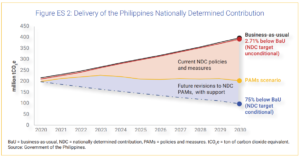
The framework also supports the Philippines’ climate targets. The country has pledged to cut greenhouse gas emissions by 75% by 2030 under its updated Nationally Determined Contribution (NDC). However, about 72% of that target depends on international funding and technical support.

Philippines Nationally Determined Contribution
Source: Climate Change Commission

The government does not have a formal net-zero emissions goal yet. But it plans to expand renewable energy and protect natural ecosystems, too.

The energy sector is the biggest source of emissions in the country. Still, forests are key in taking carbon out of the air.

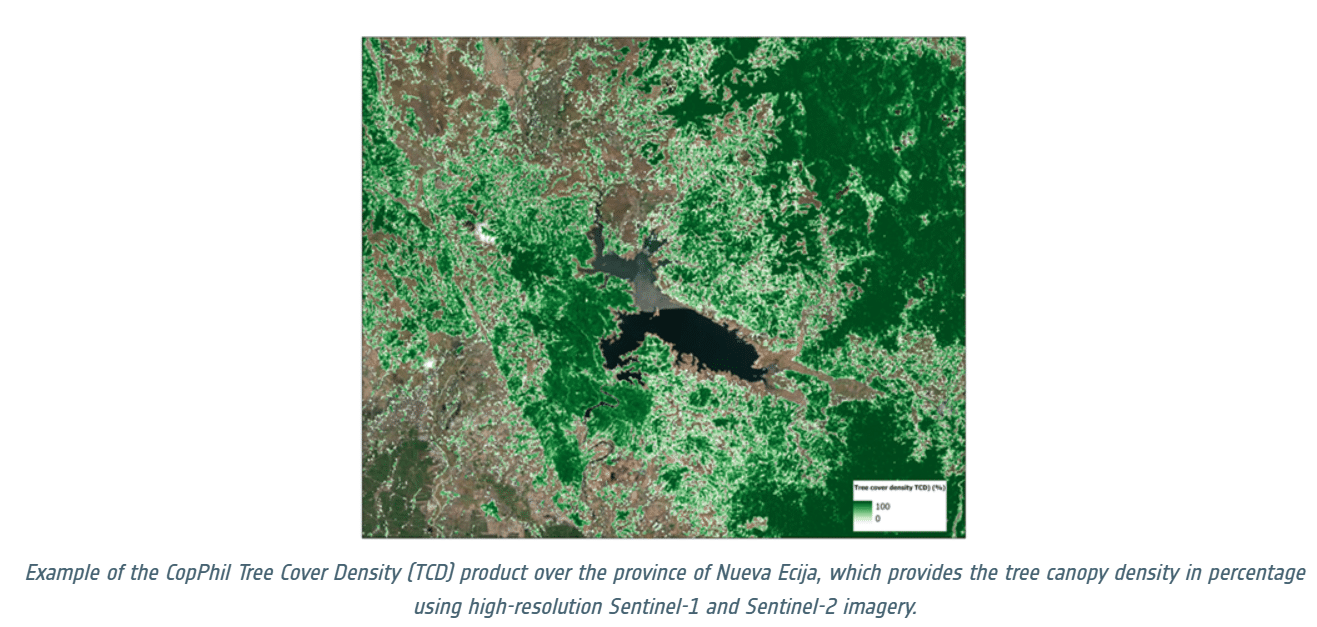
Forests in the Philippines cover about 7.2 million hectares. Thatโ€™s around 24% of the country’s land area, according to the Food and Agriculture Organization (FAO). The country also has about 311,400 hectares of mangrove forests, one of the largest mangrove areas in the world. These mangroves help protect coastal communities and store significant amounts of blue carbon.

forest map philippines
Source: image from CopPhil

The government views these ecosystems as key natural resources. They can help reduce emissions, protect biodiversity, and support rural livelihoods.

Global Investors Are Putting More Money Into Nature

The Philippines’ new framework comes as global investment in nature-based climate solutions continues to grow.

The United Nations Environment Programme (UNEP) states that we need to nearly triple our annual investment in nature-based solutions by 2030. This means investing over $542 billion each year. This funding is essential to meet global goals for climate, biodiversity, and land restoration.

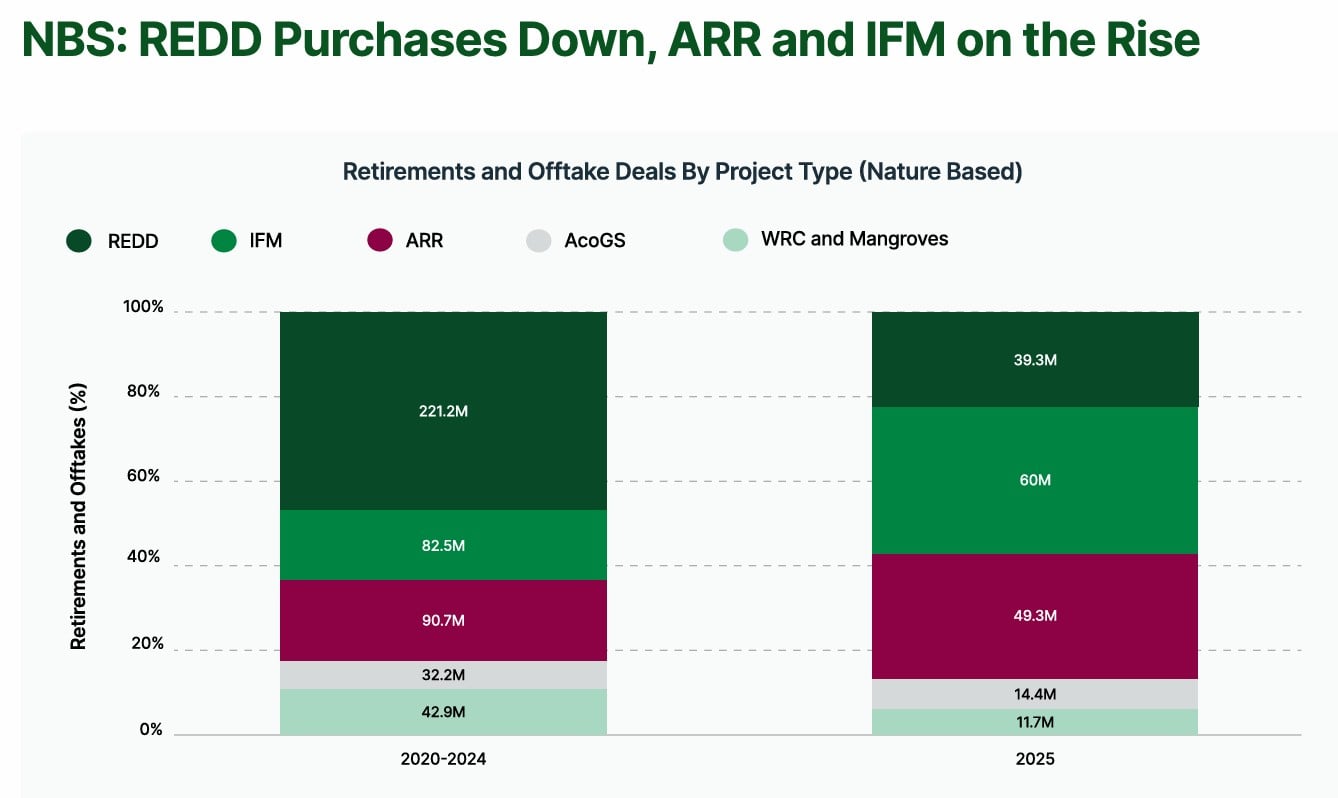
Demand for high-quality nature-based carbon projects is also increasing. Forest protection (REDD), reforestation (ARR), and mangrove restoration remain among the largest sources of nature-based carbon credits. More buyers want projects that have solid science, clear monitoring, and obvious benefits for local communities.

nature based credits Allied Offsets
Source: AlliefOffsets

For the Philippines, the new framework could help attract more public and private investment. It could also create new opportunities in emerging carbon markets while supporting long-term economic growth.

From Policy to Investment: Unlocking More Climate Finance

The new framework is more than a conservation policy. It also aims to attract more funding for nature-based projects.

Governments alone cannot provide all the money needed to restore forests, mangroves, rivers, and other ecosystems. The framework promotes partnerships with businesses, investors, development banks, and local communities. This helps close the gap.

This could also support the growth of carbon markets in the Philippines. Forests and mangroves that are well-managed create valuable carbon credits. This is because they absorb carbon dioxide from the air or stop emissions from deforestation.

Global demand for these credits continues to grow. According to McKinsey & Company, demand for carbon credits could reach 1.5 billion to 2 billion metric tons a year by 2030. Nature-based projects are expected to remain one of the largest parts of that market.

The Philippines could benefit from this trend because it has rich natural resources and large areas that could be restored. A clear national framework helps the country attract climate finance and protect its ecosystems.

A Growing Opportunity for the Philippines

The Philippines already has many natural assets that could support large-scale nature-based projects.

Beyond forests, the country has extensive mangroves, seagrass beds, coral reefs, and peatlands. These ecosystems store carbon, protect biodiversity, and reduce the impact of storms and flooding. They also support fisheries, tourism, and millions of livelihoods.

The government believes the new framework can help bring these benefits together under one national strategy. By using consistent planning and international standards, future projects can deliver stronger climate, environmental, and social outcomes.

The framework also sends a positive signal to investors. Clear policies reduce uncertainty and make it easier to finance long-term restoration projects.

A Foundation for Future Climate Action

The Philippines’ first Nature-based Solutions framework marks an important step in the country’s climate strategy.

It provides a common roadmap for restoring ecosystems, strengthening climate resilience, and attracting green investment. At the same time, it supports the country’s long-term emissions goals and efforts to protect biodiversity.

If done right, the policy could restore forests and coastal ecosystems. It may also create jobs, strengthen rural communities, and unlock more climate finance. As global investment in nature-based solutions continues to grow, the Philippines now has a stronger foundation to become a regional leader in using nature to address climate change.

Amazon’s Biggest Forest Carbon Bet in South Africa Shows Why Nature-Based Climate Finance is Winning

Amazon is making one of its biggest investments in nature-based carbon removal. The company has agreed to buy about half of the carbon credits expected from South Africa’s Bacon Tree Restoration Project. The large project will restore degraded land in the Eastern Cape while removing carbon dioxide from the atmosphere.

The project is expected to generate up to 18 million carbon credits over 30 years. It will restore native vegetation across thousands of hectares of damaged land.

For Amazon, the deal is more than a carbon credit purchase. It shows how large companies are changing the way they buy carbon credits. Many are choosing long-term agreements instead of short-term purchases. This helps them secure high-quality credits years in advance.

Kara Hurst, Amazonโ€™s chief sustainability officer, stated:

“Spekboom is a natural wonder, but it canโ€™t heal the land without help from the people who call the Eastern Cape home. This project will restore the ecosystem and create jobsโ€”a model for how nature-based solutions can enable both climate action and economic development.”

Restoring Nature While Removing Carbon

The timing of the project is also important. The voluntary carbon market (VCM) is showing signs of recovery after several difficult years. Buyers are now focusing more on credit quality than on low prices. They want projects that remove carbon, protect nature, and deliver clear benefits for local communities.

carbon credit retirements H1 2026
Source: AlliedOffsets

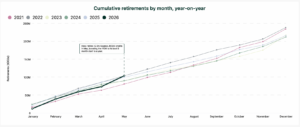
AlliedOffsets reports that in 2026, over 200 million carbon credits were retired worldwide. This set a new record and shows that companies want high-quality credits more than ever.

The Bacon Tree Restoration Project is one of Africa’s largest forest restoration efforts. The project will restore degraded subtropical thicket using native plants, especially Spekboom (Portulacaria afra). This hardy plant, locally known as elephant bush, can store large amounts of carbon while surviving in dry conditions.

Spekboom thrives in dry conditions where many other plants cannot grow. It can be planted from simple cuttings placed directly into the soil, making large-scale restoration practical. As it grows, it helps restore soil, reduce erosion, and create conditions for native plants and wildlife to return.

Spekboom (Portulacaria afra)
Source: Shutterstock

Today, the project area supports 165 recorded plant and animal species, including several considered vulnerable.

South Africa has lost an estimated more than one million hectares of subtropical thicket because of decades of overgrazing and land degradation. Researchers estimate that restoring these ecosystems could remove well over 100 million metric tons of COโ‚‚ over time while improving biodiversity and soil health.

Unlike commercial tree plantations, the project aims to rebuild a natural ecosystem spanning 50,000 hectares. Restoring native plants helps pull carbon dioxide from the air. It also improves soil health, cuts down erosion, and supports wildlife.

By the end of 2028, the project will plant 180 million spekboom cuttings to help restore the Albany thicket, a unique ecosystem that has been declining for decades.

The project is also expected to create 11,000 jobs for local communities through planting, land management, and environmental monitoring. These benefits make the project attractive to companies looking for carbon credits that deliver both climate and social value.

A New Way to Finance Carbon Projects

Large restoration projects need significant funding before they can generate carbon credits. That has slowed many projects because developers often wait years before earning any revenue.

The Bacon Tree project uses a different approach. It secured about $91 million in blended finance by combining private investment with support from development finance partners and climate investors.

Amazon’s long-term purchase agreement also helps reduce financial risk. It gives developers confidence that there will be buyers for future carbon credits. This makes it easier to raise money and move the project forward.

The tech giant has committed to buying 1.95 million tons of carbon removal credits from the project. This long-term purchase agreement also helped the World Bank launch the Spekboom Outcome Bond.

The bond gave investors confidence because the project already had a major buyer for its future carbon credits. Companies that qualify can buy these credits through Amazon’s carbon credit service.

Moreover, the credits will meet some of the world’s highest standards for nature-based carbon removal, including the ABACUS label and Climate, Community & Biodiversity (CCB) certification.

This financing model is becoming more common across the carbon market. More companies are signing long-term offtake agreements instead of waiting for credits to become available. The same trend is now spreading across direct air capture, biochar, and other carbon removal technologies.

Many experts think these agreements will matter more as demand for high-quality carbon removals increases.

Amazon Builds on a Bigger Net-Zero Strategy

The Bacon Tree deal is part of Amazon’s wider climate plan. In 2019, Amazon co-founded The Climate Pledge, committing to reach net-zero carbon by 2040, ten years ahead of the goals set in the Paris Agreement.

The company says its priority is cutting emissions across its business. It continues to invest in renewable energy, electric delivery vehicles, cleaner buildings, and more efficient operations.

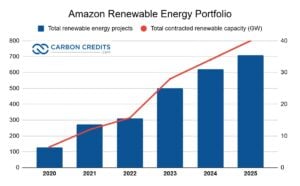
Amazon has already become the world’s largest corporate buyer of renewable energy. By the end of 2025, it had supported more than 700 wind and solar projects worldwide. The company says these projects can generate enough clean electricity to power millions of homes each year.

Amazon renewable energy portfolio 2025

Still, Amazon recognizes that some emissions are difficult to eliminate. These include emissions from aviation, heavy transport, and some industrial processes.

The company reports that its renewable energy portfolio now tops 40 gigawatts (GW). This makes it the largest corporate buyer of renewable energy in the world for five years running.

For those remaining emissions, the company is investing in high-quality carbon removals.

Besides the Bacon Tree project, Amazon has backed direct air capture (DAC), reforestation, biochar, and other carbon removal technologies. The company says these investments will help address emissions that cannot yet be avoided.

Demand for High-Quality Nature-Based Carbon Credits Is Growing

Amazon’s latest purchase reflects a broader shift in the VCM. Companies look for carbon credits that do more than just cut emissions; they must also restore nature, support local communities, and pass strict verification standards.

Demand is expected to keep rising. The International Energy Agency (IEA) states that industries like aviation, shipping, cement, and steel will keep depending on carbon removals. This helps tackle emissions that are hard to get rid of.

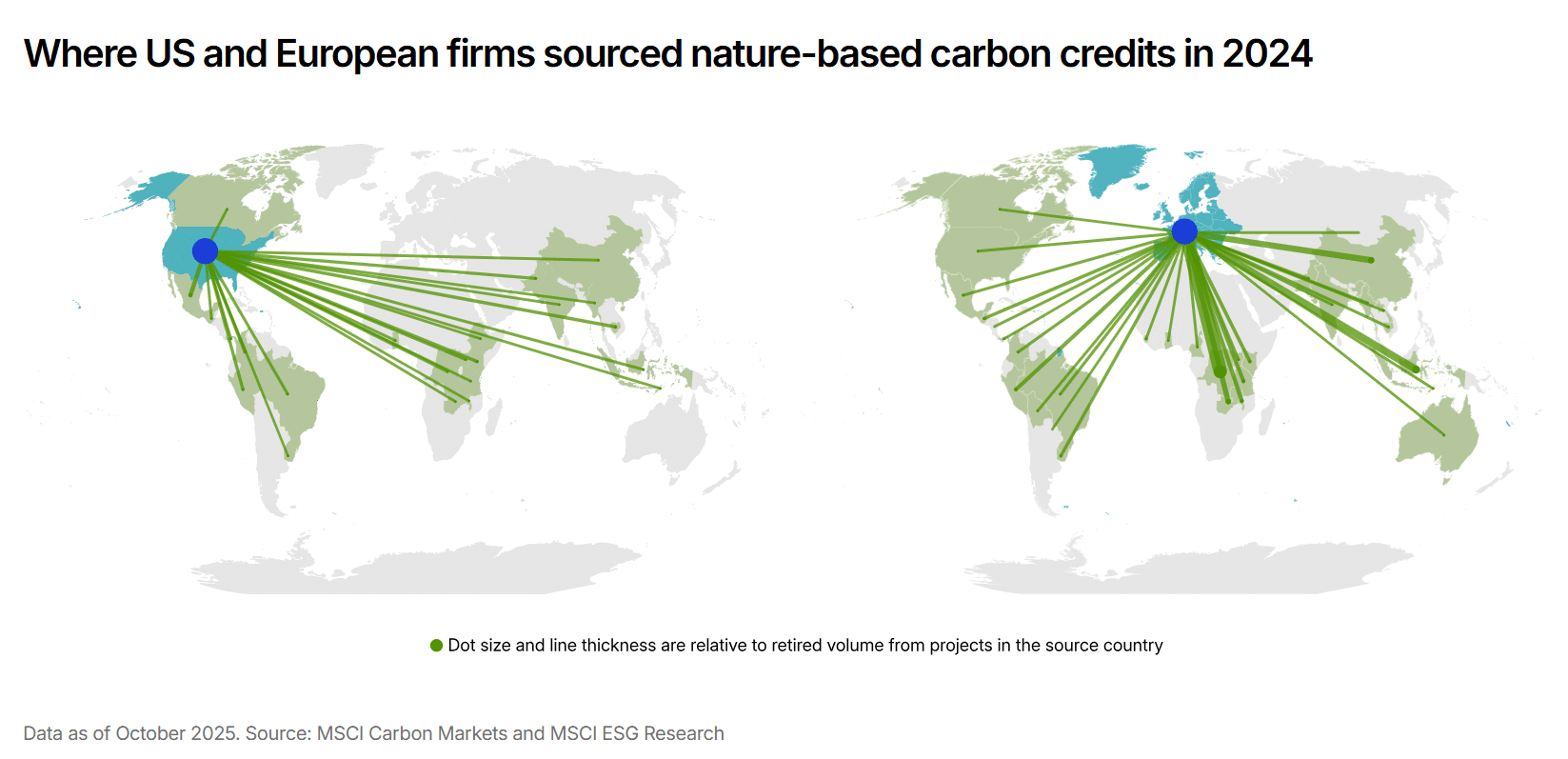
Nature-based carbon markets are becoming more concentrated around high-quality projects. According to MSCI, only 3% of companies in the MSCI ACWI Investable Market Index retired nature-based carbon credits in 2024, yet those firms accounted for 65% of all disclosed retirements.

nature-based carbon credits sources 2024
Source: MSCI

Buyers are also willing to pay $40โ€“$50 per creditโ€”three to five times the current market averageโ€”to secure future supplies of high-integrity projects. This shows strong long-term demand for premium nature-based credits.

Also, the UN Decade on Ecosystem Restoration estimates that every $1 spent on restoration can bring $7 to $30 in economic benefits.

Projects like Bacon Tree show how carbon removal can also restore ecosystems and support local communities. However, experts stress that carbon credits should complement, not replace, direct emissions cuts.

A Blueprint for Future Climate Finance

Amazon’s investment in the Bacon Tree projectย shows that major companies are becoming long-term partners in building the next generation of carbon removal projects. Funding before credits are issued helps developers. It allows them to restore larger areas, lower financial risk, and attract more investment.

For Amazon, the agreement supports its goal of reaching net zero by 2040 while helping restore one of South Africa’s most important ecosystems.

For the wider carbon market, the deal sends a clear message. Companies are no longer looking only for carbon credits. They are investing in projects that can remove carbon, restore nature, and create lasting benefits for local communities.

World Bank Ends 45% Climate Finance Target: What Changes Now?

The World Bank has made a major change to its climate strategy. It has dropped its target of directing 45% of its annual financing to climate-related projects after pressure from the United States. Although the bank says climate action remains a priority, the decision changes how it will measure its support for clean energy and climate resilience.

The move comes at a critical time. Climate disasters are becoming more frequent, and developing countries need billions of dollars to build clean energy, protect communities, and adapt to rising temperatures. Many experts worry that removing the target could weaken accountability, even if climate funding continues.

Why Did the World Bank Drop the Target?

The World Bank has decided to remove both its 35% and 45% climate finance targets under its Climate Change Action Plan (CCAP). Instead of tracking the percentage of lending that supports climate goals, the bank says it will focus on broader development results and the needs of borrowing countries.

As per reports, the change followed months of pressure from the United States, the bank’s largest shareholder. U.S. Treasury Secretary Scott Bessent argued that fixed climate targets could pull the World Bank away from its main mission of reducing poverty and boosting economic growth.

According to the bank, future lending will be client-driven. This means countries will decide which projects they want to finance. If a country wants more renewable energy or climate resilience projects, the World Bank says it will continue to support them.

World Bank President Ajay Banga also stressed that the institution is not abandoning climate finance. Instead, it wants to give countries more flexibility while keeping climate action part of their development plans.

Unlocking World Bank’s Climate Finance Program

Climate finance is money that helps countries fight climate change while supporting economic development. The World Bank uses these funds to finance projects that lower greenhouse gas emissions or help communities prepare for climate impacts.

Instead of offering separate climate loans, the bank includes climate goals in many development projects. For example, it may finance roads that can withstand floods, renewable power plants, water conservation systems, or climate-smart farming.

The World Bank measures these investments through “climate co-benefits.” This refers to the share of a project’s funding that directly supports climate action.

The projects generally fall into two main categories:

  • Climate mitigation, such as renewable energy, clean transportation, energy-efficient buildings, and lower-carbon industries.
  • Climate adaptation, including flood protection, drought management, climate-smart agriculture, stronger water systems, and disaster preparedness.

This approach became the foundation of the bank’s Climate Change Action Plan, launched in 2021. The goal was to make climate action part of everyday development projects instead of treating it as a separate program.

Climate Finance Has More Than Doubled

Ironically, the World Bank removed its target after reaching record levels of climate finance.

According to its latest figures, climate financing increased from about $17 billion in 2020 to more than $39 billion in fiscal year 2025. That is an increase of well over 100% in just five years.

the world bank
Source: The World Bank

In fiscal year 2025, the bank reported:

  • More than $39 billion in climate finance.
  • 48% of total lending delivered climate co-benefits.
  • Around $22.6 billion supported emissions reduction and clean energy projects.
  • About $16.6 billion went toward climate adaptation and resilience.

Across the wider World Bank Group, including the International Finance Corporation (IFC), total climate-related financing reached about $50.8 billion.

These numbers show that climate finance has become one of the bank’s fastest-growing areas of investment.

Why Did the Target Matter?

The 45% target was more than just a percentage. It helped governments, investors, and environmental groups measure the bank’s progress.

The target also encouraged teams inside the World Bank to include climate solutions in projects involving transport, agriculture, water, and infrastructure.

Most importantly, it showed that the bank was committed to supporting the goals of the Paris Agreement.

Without a clear target, some experts worry that it will become harder to track whether climate finance is growing or shrinking in the future. The World Bank says it will continue reporting climate data, but many believe a numerical target provides stronger accountability.

climate finance
Source: The World Bank

How Could This Affect Developing Countries?

The decision is unlikely to stop climate funding immediately. However, it could change how future projects are selected.

Developing countries face huge climate challenges. They need money to:

  • Build renewable energy.
  • Upgrade electricity grids.
  • Protect communities from floods and droughts.
  • Improve water security.
  • Make agriculture more resilient.

Many low-income countries cannot afford these investments on their own. They depend on low-cost loans and grants from institutions like the World Bank.

Under the new approach, countries that request climate-related projects can still receive funding. However, governments that focus on other development priorities may receive less climate financing than before.

This could create differences in climate investment across regions and make long-term planning more difficult.

Here’s a breakdown of climate finance by region in the last year:

climate finance
Source: The World Bank

Global Climate Finance Faces a New Test

The World Bank plays a major role in international climate finance. Its decisions often influence other multilateral development banks.

At the COP29 climate summit in Baku, multilateral development banks pledged to provide $120 billion every year for low- and middle-income countries by 2030. They also committed another $42 billion annually for high-income countries.

The World Bank is expected to remain the largest contributor to these efforts.

However, removing its own climate finance target has raised new questions. Some analysts believe other investors may wonder whether the bank will continue increasing climate lending at the same pace.

Others argue that the bank is simply changing how it measures success rather than reducing funding.

Investors Are Watching Closely

So far, the World Bank has continued to finance clean energy projects.

Just days after announcing the policy change, it approved $265 million for a pumped-storage hydropower project in Morocco. The project will improve renewable energy integration and strengthen the country’s electricity grid.

This suggests that the bank still plans to support clean energy, climate adaptation, and resilient infrastructure.

Still, investors, governments, and environmental groups will closely watch future lending data. Without a formal target, the annual climate finance figures will become the best way to judge the bank’s commitment.

The Bottom Line

The World Bank’s decision to remove its 45% climate finance target marks an important shift in global development finance. The bank says climate action remains part of its mission, but it will now focus on development outcomes instead of meeting a fixed lending target.

For developing countries, climate funding is expected to continue. However, the lack of a measurable goal makes it harder to know whether support will keep growing in the years ahead.

The world needs trillions of dollars to expand clean energy, cut emissions and protect communities from climate change. Whether the World Bank can maintain its leadership without a formal climate finance target will become clear only through its future lending decisions.

In the end, the numbers will matter more than the policy. If climate finance continues to rise, the change may prove to be mostly administrative. But if funding slows, this decision could become a defining moment for global climate finance and the world’s transition to a low-carbon economy.